

You are using an out of date browser. It may not display this or other websites correctly.
You should upgrade or use an alternative browser.
You should upgrade or use an alternative browser.
Audire Forte 250 Build
- Thread starter hamrules
- Start date
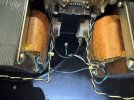

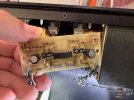

Oh yes, open end wrench would work. Mind isn’t working good today.To remove the front handles? Photo?
I just use an open end wrench.
I only wanted to take the front off to see what the grommets/rubber washers looked like but there good enough so I’m just going to pass on that.

I've been giving more thought to the diff pair substitution. I can't find Noise Figures (NF) for MPS8099/8599 to compare with that shown for 2N5401/5551 in the datasheet, but if you find the noise level is higher for the latter parts, you should be able to substitute the 1N4148 strings with some Zeners to drop the rail voltage a few more volts to provide added SOA for the MPS parts. I'm also unsure if you will have to adjust the emitter resistor values for the diff pairs when using the 2N5401/5551 parts; you won't with the MPS parts.
Lots of dead bugs and dust came out from behind those transformers when I used some canned air spray. Nice and clean now.
Chased the threaded holes in the heatsink for the new 8-32 screw coming next week.
Cleaned up the new 4-40 holes for the T0220 screws so nothing cuts into the silpad's.
Also have some new screws to replace those horrible, slotted screws they used.
Chased the threaded holes in the heatsink for the new 8-32 screw coming next week.
Cleaned up the new 4-40 holes for the T0220 screws so nothing cuts into the silpad's.
Also have some new screws to replace those horrible, slotted screws they used.
I'm sorry but I do not understand this. It looked to me that from the data sheets the MPS vs the 2N's should be OK. The HFE and the FT seemed to cross over enough.I've been giving more thought to the diff pair substitution. I can't find Noise Figures (NF) for MPS8099/8599 to compare with that shown for 2N5401/5551 in the datasheet, but if you find the noise level is higher for the latter parts, you should be able to substitute the 1N4148 strings with some Zeners to drop the rail voltage a few more volts to provide added SOA for the MPS parts. I'm also unsure if you will have to adjust the emitter resistor values for the diff pairs when using the 2N5401/5551 parts; you won't with the MPS parts.
In bed last night I actually thought why couldn't I put a Zener in to cut the voltage down.
Interestingly there is one set of MPS8099/8599's installed up front on the board of which there is a handwritten note on the XLR version schematic that subbing the 2N5401/5551 in place of that set of MPS8099/8599 is OK.
I am not good with this part of things I will admit.
Last edited:
Sweet! This amp is getting the careful attention it deserves.
By the way... have you ever heard any model of Audire amp? If not, I think you will be surprised at the detail, note/instrument separation, low distortion. Even the early 50 wpc and later 75wpc Crescendo amps sound fantastic. The 125wpc Forte sounds like a much bigger amp; the 250 should be expected to retain the characteristics but handle difficult speakers even better.
By the way... have you ever heard any model of Audire amp? If not, I think you will be surprised at the detail, note/instrument separation, low distortion. Even the early 50 wpc and later 75wpc Crescendo amps sound fantastic. The 125wpc Forte sounds like a much bigger amp; the 250 should be expected to retain the characteristics but handle difficult speakers even better.
Yes, the MPS parts are what Julius used to replace the MPQ6600, and they are rated at 80V which is sufficient for his amps running somewhat lower rail voltages than you observed in the Forte 250. I'm sure that's why he used the MPQ7051 even though the datasheets point to the former as perhaps a better part in other respects.MPS vs the 2N's should be OK
The 2N parts have 150V ratings, and are ubiquitous, but I'm unsure of how their noise figure compares to the MPS parts, although they both are close in other characteristics according to the datasheets. I haven't seen any other Audire amps with 2N5401/5551 for the input diff pairs. The handwritten notes I see in the XLR schematic were not from Julius, and point to the current sources, not the diff pairs, and they may be even better in those positions due to the higher voltage ratings.
I haven't found any higher-voltage sub for the MPS parts that has other similar characteristics of the original quad packages or the discrete parts, so it seems reasonable to just go with the 2N parts and see you you like the amp. If your FFTs show the noise to be higher than expected, maybe, perhaps, if you want, experiment with running Zeners to drop the supply voltages to a matched set of MPS8099/8599? We're in rather uncharted territory here, as even the monster Otez amp used the 40V MPQ6600 (not even the 45V "A" version, and even though the available schematic shows 1N4148 strings, I read that someone found Zeners in their Otez.
Last edited:
I have to be honest, when I got this Bedini amp that I have I was disappointed but after setting the bias and re-capping it it was fantastic. That put me on the search for another amp or two.Sweet! This amp is getting the careful attention it deserves.
By the way... have you ever heard any model of Audire amp? If not, I think you will be surprised at the detail, note/instrument separation, low distortion. Even the early 50 wpc and later 75wpc Crescendo amps sound fantastic. The 125wpc Forte sounds like a much bigger amp; the 250 should be expected to retain the characteristics but handle difficult speakers even better.
Last edited:
Well, we will see how it fairs as we move along. I'm only doing the one channel first so I can check it out and see how it works out.Yes, the MPS parts are what Julius used to replace the MPQ6600, and they are rated at 80V which is sufficient for his amps running somewhat lower rail voltages than you observed in the Forte 250. I'm sure that's why he used the MPQ7051 even though the datasheets point to the former as perhaps a better part in other respects.
The 2N parts have 150V ratings, and are ubiquitous, but I'm unsure of how their noise figure compares to the MPS parts, although they both are close in other characteristics according to the datasheets. I haven't seen any other Audire amps with 2N5401/5551 for the input diff pairs. The handwritten notes I see in the XLR schematic were not from Julius, and point to the current sources, not the diff pairs, and they may be even better in those positions due to the higher voltage ratings.
I haven't found any higher-voltage sub for the MPS parts that has other similar characteristics of the original quad packages or the discrete parts, so it seems reasonable to just go with the 2N parts and see you you like the amp. If your FFTs show the noise to be higher than expected, maybe, perhaps, if you with, experiment with running Zeners to drop the supply voltages to a matched set of MPS8099/8599? We're in rather uncharted territory here, as even the monster Otez amp used the 40V MPQ6600 (not even the 45V "A" version, and even though the available schematic shows 1N4148 strings, I read that someone found Zeners in their Otez.
I did find the MPQ7051, maybe I would just be better off getting them?
Haha! Well, you are a brave man, then!I have not even heard the name Audire before.
These amps are high-current, high bandwidth, with very stiff power supplies. Julius wanted them to power the most difficult speaker loads of the time. They do that but are prone to oscillation, so be careful when probing the circuit, and do not use long interconnects, do not plug/unplug the interconnects or speaker cables when the unit is turned on or even until after the big caps have drained down. Deviate at your peril.
They have no speaker protection, no soft-start, no SOA protection, no relays, just very pure, simple circuit design using high-quality components. Julius tended to make many production-run changes as needed, which I am guessing were in response to parts changes, failures, etc. He made them to be modular, so he could repair a customer's unit in an hour or less by pulling and replacing a module and repairing it for later use. His designs evolved quickly and in some cases profoundly. By the time he stopped, the most evolved amps were pretty incredible and very expensive. I've not been inside any of his latest amps, so don't know if he added protection or soft start circuits later, but these days, these amps wouldn't get made commercially, in my view.
The sound is quite amazing, however. The Forte sounds like a 200wpc amp - yours might be staggering.
If they aren't counterfeit, I'd get them, but test them for hFE at least. I've not found one single MPQ6600 with good matching among all 4 transistors. I have gotten much better sound/performance/distortion using discrete, matched MPQ parts. If yours test very close, use them. Otherwise, try the 2N5401/5551, and/or the MPQ parts with a bit lower supply voltage.I did find the MPQ7051, maybe I would just be better off getting them?
They are not easy to find. There was a guy who was a customer of Audire who obtained a lot of Audire's residual stuff at the end, and who has been selling it for years. I haven't seen anything on the market worth buying for awhile.
I did a bunch of complete restorations for an owner of many amps and preamps, and my brother was one of Julius' earliest clients. He had Julius make him an enormous pair of his famous biplanar ribbon speakers - about 4' wide x 6' high, and they were efficient enough for one Otez to power them. The most incredible speakers I've ever heard in my life. I inherited his Andante preamp which I had to completely rebuild. It has been my daily preamp for the past few weeks (I have many, many that rotate through).
BTW - when your amp is back in service, I suggest you switch one amp section on at a time. I have other suggestions for later.
I did a bunch of complete restorations for an owner of many amps and preamps, and my brother was one of Julius' earliest clients. He had Julius make him an enormous pair of his famous biplanar ribbon speakers - about 4' wide x 6' high, and they were efficient enough for one Otez to power them. The most incredible speakers I've ever heard in my life. I inherited his Andante preamp which I had to completely rebuild. It has been my daily preamp for the past few weeks (I have many, many that rotate through).
BTW - when your amp is back in service, I suggest you switch one amp section on at a time. I have other suggestions for later.
