• The move to the new server is done. There are some software and database maintenance updates in process. This has us passing the hat around to help out. We appreciate any donations. Seriously, even a dollar helps. The payment page may be found here - https://www.audiokarma.org/support.html

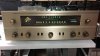
Avery's "First" Maker: The TA-800

Are those warm white or cool white LEDs? I changed the dash lighting in my car to 2800K white and its extremely close to the stock light color. The 4000-5000K bulbs have a distinct blue tint to them.
The description on the bulb was simply "WHITE" but it appears to be more of a cool white. It looks like from the picture most of the blue tint is coming from the edges where the bulbs are. I need to replace the foam strips around the glass anyway and hopefully that will help the appearance considerably. I need to find the thread that covers the foam replacement. If that really doesn't help I may look around for the warm white although I had difficulty finding other options. The TA-800 takes 32mm length 6mm OD bulbs. The LEDs installed are 6.3 VAC and draw 18 milliamps versus the factory original incandescent bulbs drawing between 150-300. This is all based on research and information provided by the seller.
 
The description on the bulb was simply "WHITE" but it appears to be more of a cool white. It looks like from the picture most of the blue tint is coming from the edges where the bulbs are. I need to replace the foam strips around the glass anyway and hopefully that will help the appearance considerably. I need to find the thread that covers the foam replacement. If that really doesn't help I may look around for the warm white although I had difficulty finding other options. The TA-800 takes 32mm length 6mm OD bulbs. The LEDs installed are 6.3 VAC and draw 18 milliamps versus the factory original incandescent bulbs drawing between 150-300. This is all based on research and information provided by the seller.
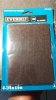
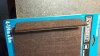
This is what I use for replacing the foam gaskets behind the face plate, I like the fact that it should hold up better and that I can cut to what ever width I need. I use a small straight edge and sharp razor knife to cut the strips I need, it has a good adhesive on the back side that makes attaching a breeze. Thickness is just shy of 1/4", this is what I will use on all units I restore now.

20170614_092431.jpg 20170614_092451.jpg
 
This is what I use for replacing the foam gaskets behind the face plate, I like the fact that it should hold up better and that I can cut to what ever width I need. I use a small straight edge and sharp razor knife to cut the strips I need, it has a good adhesive on the back side that makes attaching a breeze. Thickness is just shy of 1/4", this is what I will use on all units I restore now.

View attachment 949685 View attachment 949686
Thanks Steve! I hope mine turns out as good as your 500b you did this on. Do you recall if you had the cool or warm white bulbs?
 
Last edited:
That was my 500-B that I finished up, they were warm white LED's, I'm extremely pleased with lamps and how the felt gaskets worked out.

20170516_134436.jpg
 
Last edited:
There is just no rhyme or reason as to which tubes can and cannot be substituted into a given unit. I had seen it reported that the 6GH8A worked well in the stock ST-70. When Steve's 70 was here, I checked to confirm their proper operation (distortion, FB level, stability, etc.), and in fact they do work just fine with adapters in place of the 7199 on the original board -- every bit as good as the specified tube. Yet in the SCA-35, designed by the same man who developed the ST-70, a 6GH8A with adapters will not work properly to replace the 7199 on the stock boards in that unit without modifications. In Steve's TA-600, a previous tech had installed 6BL8s (as I recall), and that unit showed heavy ringing on 10 kHz square waves, which were completely absent when 7199s were installed. So as much as the suitability of a given replacement tube for a given unit is a function of the tube itself, just as much of it is also due to the particulars of the circuit the replacement tube is being considered for. Unfortunately, there's just no one size fits all answer to the 7199 issue. To effectively replace it requires any potential substitution for it be handled on a case by case basis.

Dave
 
Dave; Take a look at the 40001-49999 TA-600 manual (7199's) and then look at the 50001 series. Fisher changed to 7247's from the 7199's in the 50001-59999 series. Would they have enough balls to drive the 7591's, and could the TA-800 circuits be changed to accomodate the 7247(12DW7)? May be something to look at if all the 7199's fall on their faces, and the subs just aren't good enough.

Larry
 
That's exactly my thought, Larry. The 7247 could in fact drive 7591s easily enough, and a circuit doing that could be designed. I guess my original question I posed to you (via PM) should be modified to: We know that the TA-600 did in fact get modified to ultimately use a 7247 driver tube. But do we know for a fact if this ever happened with the TA-800 units? Or were their production numbers so small that the modification was never done?

Dave
 
I've only ever seen one TA-800 schematic, and it was a 7199 setup. Very possible the TA-800 never got changed. Would be interesting to give it a go. new production 7247's exist and with a little care, old production can be turned up for reasonable. For all that you could use one 12AX7 and one 12AU7, though the wiring may be slightly messier.
 
I was thinking this afternoon - is the 7199 a half-this, half-that like a 7247? Now that I think about it, I think one of my TA800's is 7247 based - will report when I get home tomorrow night. Ideally as you say, you would wire it for whatever is easier to get - a 12ax7 and a 12au7 is an easy way to go - they make both these days, though as you say, the rewire would be messy.
 
7199 is half pentode and half triode, roughly speaking a 6AU6 and half a 12AU7.
7247 is two different triodes, half a 12au7 and half a 12ax7 basically. If you've got two 7247's, you can rewire things to use one 12ax7 and one 12au7, but physically speaking the wiring can get messy. EH makes a 7247, but old ones can be had too.
 
IIRC the TA-600 was made longer than the TA-800 with the TA-600 having 5 different versions (via manuals) and the last version (50001-59999) being changed to work the 7247's. The TA-800 came out in 60 or 61 IIRC and was superceded by the 800B, a year later. The TA-800 was strictly a standalone unit, and was not used in a console. I don't believe it was in production long enough to have 2 manuals. It can be checked against the serial numbers of the one's owned by members. If all are below 19999 then the probablility might exist the TA-800 was a 10000-19999 series only.
 
Last edited:
That was my 500-B that I finished up, they were warm white LED's, I'm extremely pleased with lamps and how the felt gaskets worked out.

View attachment 949689
Thanks Steve! I guess the vendor I used was out of the "Warm" white but now has them back in stock. I've never bought so many bulbs but I want this unit to look right and have two more on the way. I will also go pick up some of that felt you posted. Wondering how hard it'll be getting the old gasket off. I'd love to do it without taking the glass out. Thanks for sharing your process.
 
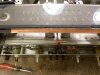
Also as an update on the cabinet for this unit, Matt with McIntosh Cabinets emailed me last night to let me know that my cabinet was stained and is curing for several days before the finish is applied and it will be in the mail next week. They were very accommodating and gave great feedback despite initially being weary of taking it on. They said they've seen several versions of the faceplate design on the TA-800's and that mine was the later design. With this cabinet though, I need to install a fan as Dave suggests. Anyone have any simple solutions or suggestions? Larry, I think you recommended a computer fan. I'd be great to simply plug something into the powered outlets in the back of the receiver.
 
Matt -- If you (or anyone else) has such an animal (TA-800 specifying a 7247 driver tube), some good close up pics of the driver tube and tone amp tube wiring in it would be beneficial to all TA owners.

Besides the four specific problems I've already noted that invariably all the tri-pent tubes can present, when you add in the cost and availability of the 7199 along with the other generic problems that can potentially afflict all tubes in general (microphony, envelope defects, intermittents, etc.), it just makes the long term outlook for the upkeep of any set that's used as a daily driver and employing this tube problematic. If that's the case, and the 800s were ultimately modified to use the 7247, a very strong case could be made to convert the set to the latter design. This is hardly a subliminal pitch to Rob (since by all accounts it appears that the model never was updated) but rather, an honest discussion of the long term problems any set will have that uses this tube. There's also one other variable to consider as well: If a given set using this tube is paired with relatively INsensitive speakers, then problems with a specific tube example (like excessive heater cathode leakage) could be covered up to make for a workable scenario. However, if the set with the same tube is used with high sensitivity speakers, then the hum produced by such a fault would not be workable. I have three units that were originally designed with this tube (Dynaco SCA-35, ST-70, and Heath AA-30), and of those, only the AA-30 continues to use the 7199 with the thought that hopefully, the two decent spares I have of the tube will keep that unit going for the short term -- although long term, I plan to modify even it away from this tube down the road.

The design of the two TAs is remarkably similar, with in fact most of the tuner and audio circuits nearly identical between the relevant (i.e. 7199 based) 600 and 800 versions, based on available schematics. An analysis of later 600 versions to the early one shows that Fisher increased the gain in the first tone amplifier stage by ~ 180% to make up for the loss of sensitivity in the power amp section when the swap was made to the 7247 driver tube. Since the 7189 and 7591 output tubes are of a similar Gm, then it shows that a 7247 based TA-800 is at least theoretically, if not quite practically possible.

Hopefully, the new tube will arrive today so it can be checked out. Fingers crossed!

Rob -- The tint of the current LEDs not withstanding, the biggest detractor I see from the frontal appearance on your unit is in fact the dial glass itself. Specifically, the film that has accumulated on the back side of it over time. When illuminating lamps (of any color) hit it, its presence is made clear. Removing it for a proper cleaning and new gaskets is the only way to really address it. Resolving that and the LED color will knock the appearance factor of your unit waaay out of the park!

Dave

 
Last edited:
Matt -- The tint of the current LEDs not withstanding, the biggest detractor I see from the frontal appearance on your unit is in fact the dial glass itself. Specifically, the film that has accumulated on the back side of it over time. When illuminating lamps (of any color) hit it, its presence is made clear. Removing it for a proper cleaning and new gaskets is the only way to really address it. Resolving that and the LED color will knock the appearance factor of your unit waaay out of the park!

Dave

Hey Dave, are you referring to my unit here?
 
Yep. Sorry about that -- a senior moment no doubt! I went back and corrected the miscue.........

Dave
 
Thanks Steve! I guess the vendor I used was out of the "Warm" white but now has them back in stock. I've never bought so many bulbs but I want this unit to look right and have two more on the way. I will also go pick up some of that felt you posted. Wondering how hard it'll be getting the old gasket off. I'd love to do it without taking the glass out. Thanks for sharing your process.
I used a brand new razor blade to get the old material off, just be sure to only scrape the edge where the material was to avoid any scratches or damage to the main glass area. It came off with very little effort. I took the glass out, just need to be careful, cleaning both sides really makes it pop!
 
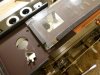
Removing the glass from Rob's unit is more complex than the later receivers where removing the two securing screws on each side, and then off the glass comes. In this unit, the glass is secured by four corner pieces that each have two tabs that press through slots in the backing plate, and are twisted to secure them in place. Getting to the bottom ones requires the backing plate to be removed. The film on the glass is quite obvious:
SAM_2040.JPG
One of the four corner pieces (this one from the bottom left corner) can be seen in this pic. Once all four were removed, the glass was still well stuck to the rubber backing strips that the dial glass seats against:
SAM_2041.JPG
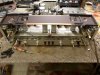
The dial lamp snap-in connectors and their wiring also needs to be removed, as well as both eye tubes, and the FM dial pointer de-strung. The rear rubber seating strips were found to be in perfect condition since they are not a foam based product:
SAM_2042.JPG
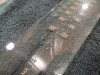
This pic shows the rear side of the glass, with the front and all side edges of the glass having already been cleaned. The rear has had the first pass of cleaning up to the highest mHz and kHz numbers, with the film easily seen down the rest of the glass. Felt swabs rule the day from here on down the dial.......
SAM_2043.JPG

Dave
 
Last edited:
hm, interesting. I was able to remove the glass on my TA-600 without all that. I think I just pulled the two upper corner clamps out, and the glass tipped out enough to sneak it past. can't exactly recall but I know I didn't unwire or un-string it.
 
Back
Top Bottom