
I do the same thing with units and this type of retainers. Undo the uppers and the glass with the rubber seals flips out enough that you can just lift out the glass, clean it and reinstall.



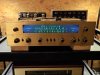
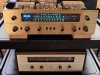


I don't know, that first picture kind of grows on ya (like fungus).Wow!!! What a difference!!! Unbelievable how good that looks. The cosmetic condition of this unit just shot up several grades! Just wait till it goes into its mahogany cabinet! Dave what kind of felt did you use and what kind of shape was the original in?


Gadget, I've been looking for a spare forever. Long before a restoration was put into motion! I thought I'd have to buy a beater TA800 if I ever broke the glass.If you had broken it, I've got a spare
Definitely looks better with the haze gone.
Steve, I'm hoping this thread tempts you to send Dave your TA800 as well. Then there can be 2 Fisher/Gillespie Hybrids!I don't know, that first picture kind of grows on ya (like fungus).
Dave has restored quite a few of my units, but the TA-800 was restored by sony6060 a few years back, and probably not correctly. Dave pushes me to do my own work when possible since he knows how much enjoyment I get from it. My TA-600 got his full treatment and rates right up there with my X-202 for best sound.Steve, I'm hoping this thread tempts you to send Dave your TA800 as well. Then there can be 2 Fisher/Gillespie Hybrids!
Dave,Rob -- The TA used two different products associated with the dial glass: Fairly dense rubber strips that act as a seat for the glass to rest against when in place (which is what the glass was stuck to). The same rubber was used on the front of the glass at the ends, to prevent any light from seeping out the sides of the front plate cutout when mounted in place. These rubber pieces were found to be in perfect shape -- not dried or brittle or cracked. They looked like the day they were installed. Then, along the bottom front side of the glass, there was a strip of rubberized cork to prevent any light shining loosely behind the front plate from emerging out between the bottom of the dial glass, and the back of the front plate. This product was all dried and cracked, and came off in broken pieces as it was removed. Look at the third pic down in my post #80. You'll see a pile of the stuff on the bench just to the left of the receiver. That's what was used along the bottom of the glass.
I did not use a felt product along the bottom of the glass, but a silicone rubber stick on product that I modify. It is designed to compress when pushed against thanks to the seal having an open air core. For this application however, the pressure required to compress the seal is more than I like, so I carefully cut out a small strip of the seal along one side of its sealing surface where it attaches to its backing strip. This allows the seal to compress much more easily so that it perfectly fills the space between the front of the glass and the back of the front plate, without causing any undo pressure against the dial glass. And, because it's silicone, it will stay compliant forever, and be highly resistant to the heat of the unit as well. I generally stay away from foam rubber as a sealer as I've found that it dries out loosing it's compression over time, and is not as effective in blocking the light. I think that's why the original product was a cork based seal.
Dave

Dave,Well the new 7199 tube arrived today, and it's a no-go. This sucker hums nearly as loud as the music, and of course since it appears after the volume control in the circuit, the setting of the volume control does not affect the hum level. It's just there all the time which you can hear even outside the listening room. The vendor has offered a refund or replacement, but this shows just how tough it's getting to be to find just a decent working example of this tube.
Dave
I have (3) 7199's here if you think you'd like to try them.Well the new 7199 tube arrived today, and it's a no-go. This sucker hums nearly as loud as the music, and of course since it appears after the volume control in the circuit, the setting of the volume control does not affect the hum level. It's just there all the time which you can hear even outside the listening room. The vendor has offered a refund or replacement, but this shows just how tough it's getting to be to find just a decent working example of this tube.
Dave
The design of the two TAs is remarkably similar, with in fact most of the tuner and audio circuits nearly identical between the relevant (i.e. 7199 based) 600 and 800 versions, based on available schematics. An analysis of later 600 versions to the early one shows that Fisher increased the gain in the first tone amplifier stage by ~ 180% to make up for the loss of sensitivity in the power amp section when the swap was made to the 7247 driver tube. Since the 7189 and 7591 output tubes are of a similar Gm, then it shows that a 7247 based TA-800 is at least theoretically, if not quite practically possible.

