• The move to the new server is done. There are some software and database maintenance updates in process. This has us passing the hat around to help out. We appreciate any donations. Seriously, even a dollar helps. The payment page may be found here - https://www.audiokarma.org/support.html

Avery's "First" Maker: The TA-800

Well that just sucks Hind teat. Wish I had a couple of 7199's to send down. I could see for the sake of experimentation possibly changing it over to 7247's "ala" the late version TA-600's, but then a long term study would be needed to access stability and operational parameters before putting the modification out for general use. But being a customers unit, you tend to not want to experiment on them. Even if you DO get the ok for a change over, like you said earlier a few posts up you'd have to back track a couple stages to start with and go from there. And from what i understood from the post it would be a quite involved changeover.

From post #76:


ROB: I'm not totally advocating a change to the 7247, but with the current bunch of 7199's causing the problems they are, and the fact that a case is already being completed for it, Dave would be the guy to do it if it was found to be advantageous from an operational standpoint. But, on the other side of the coin, it would seem to me to be a very involved and complicated modification just to get a fairly comparable result to a TA-600. And would be quite expensive from a standpoint of labor costs. Ultimately it's up to you and Dave to determine whether it's worth the cost of R&D and then the actual changeover. Personally if it were mine, I would think hard and long over this one, unless Dave can come up with some 7199's that don't hum at reasonable costs. And as the 7199's diminish in numbers the costs will only go up.

But what ever you do, I know that you will do the right thing for this FISHER. Even if it's only a non-working "hanger queen" that sits on the shelf and looks pretty. And that would be fine with a lot of us who collect these whether for aesthetic or operational reasons or both.

Hang in there. Dave will take care of you and give you all options with the Risk/Benefits of each option.

Larry
Thanks Larry. I appreciate the support.

I know I am in good hands with Dave. Everything has been 100% explained, well thought-out and meticulous with his work on my 800. I am also planning on using this unit daily as my primary system. This project from the very beginning has been to bring this unit to its full potential. I'm not a wealthy man by any means, but this unit is very dear to me and I have prepared to go "upside down" in it knowing I will pass it to my children rather than ever sell it. It's value is meaningless to me in dollar signs. My first reaction, is if some good 7199 tubes don't turn up, is do any stable modification Dave can implement converting it to 7247 tubes. That may mean holding off on EFB for now to bring it operational and stock depending on cost. We'll see what Dave comes up with. Either way I will do this unit and wonderful Fisher community proud.

Rob
 
Hiya,

My TA-800 serial number (And its kinda rubbed off) is 1127XB (X is rubbed off)

Frannie
 
Hi Frannie -- Thanks for supplying the serial number of your unit -- it's even earlier than Rob's. It will be interesting to see what the numbers are for other member's units. As for the tube I received today, it is a NOS Sylvania from the 70's that was rebranded as a Philips/ECG, in a properly labeled ECG box. The tube prior to that was a new JAN tube! Both tubes had issues that would not be disclosed through standard Gm testing -- which is more and more what I'm finding with 7199 tubes.

Dave
 
Well, hold the phone. Rob has decided to really up the ante in terms of firsts with this unit, and change the driver tube out for a more trouble free design for his TA. Based on his long term plans for this unit, and that he apparently wants to keep it operational into the 23ed century, I think it's a good move. :) 7199s aren't able to easily service this decade -- let alone a century!

So, a side trip will now begin, starting with a base of measurements on the existing power amplifier design as a basis to build from specification wise, and then onto developing a new AF Amplifier stage and phase splitter stage for the power amplifier section, based on the 7247 tube. I'll certainly post progress as that unfolds, and be happy to make the final results available to anyone wishing to update their own TA as well.

Dave
 
Hi Frannie -- Thanks for supplying the serial number of your unit -- it's even earlier than Rob's. It will be interesting to see what the numbers are for other member's units. As for the tube I received today, it is a NOS Sylvania from the 70's that was rebranded as a Philips/ECG, in a properly labeled ECG box. The tube prior to that was a new JAN tube! Both tubes had issues that would not be disclosed through standard Gm testing -- which is more and more what I'm finding with 7199 tubes.

Dave
Dave,

Very interesting to be sure and thanks for that info. Makes me wonder what Fishers original testing criteria could have been ?? Or perhaps later 7199's are just 6GH8's/6U8's in a 7199 pinned bottle.

Because I know you need to go through a mountain of 6GH8's/6U8's to find quiet ones.

Frannie
 
This project from the very beginning has been to bring this unit to its full potential.

Hey Rob

The unit is coming along nicely in Dave's capable hands. It's a great looking unit you will be proud of. Since you are going "full monte," do you already have an outboard MPX unit so you can enjoy stereo FM with the TA-800? (The TA-800 doesn't have a built in MPX so FM is mono otherwise.) For example, Fisher offered MPX-100 and MPX-200 outboard units that would be "period correct" for your receiver to deliver FM stereo. They come up time from time on the auction site.
 
Hey Rob

The unit is coming along nicely in Dave's capable hands. It's a great looking unit you will be proud of. Since you are going "full monte," do you already have an outboard MPX unit so you can enjoy stereo FM with the TA-800? (The TA-800 doesn't have a built in MPX so FM is mono otherwise.) For example, Fisher offered MPX-100 and MPX-200 outboard units that would be "period correct" for your receiver to deliver FM stereo. They come up time from time on the auction site.
I've been looking every single day on eBay and here on Bartertown. No luck yet but I'm desperate for one. When I find one, I will mail it to Dave for a rebuild.
 
I would have been all over that. My wife and I were backpacking last week. Must have sold fast!
 
Last edited:
Rob - by the way, the faceplate on your unit is remarkably clean for a TA-800! A very nice example. For some reason, most of the TA units seen today have heavily corroded faceplates. I guessing the finishing process Fisher used for the TA faceplates didn't seal out moisture and most end up corroding when stored in a basement or damp environment. Perhaps the issue with TA faceplates could also be a flawed pot metal formulation.

It seems Fisher solved the faceplate corrosion issue with either superior material and / or anodized finishing that was introduced with the "B" series in 1961 (and continued with the launch of the "C" series receivers) which are much more stable and usually free of corrosion even when stored in less hospitable conditions.
 
Rob - by the way, the faceplate on your unit is remarkably clean for a TA-800! A very nice example. For some reason, most of the TA units seen today have heavily corroded faceplates. I guessing the finishing process Fisher used for the TA faceplates didn't seal out moisture and most end up corroding when stored in a basement or damp environment. Perhaps the issue with TA faceplates could also be a flawed pot metal formulation.

It seems Fisher solved the faceplate corrosion issue with either superior material and / or anodized finishing that was introduced with the "B" series in 1961 (and continued with the launch of the "C" series receivers) which are much more stable and usually free of corrosion even when stored in less hospitable conditions.
Thanks Monk!

It really is beautiful in person. Dave is now making it sound as good as it looks. He said he ranks it with the TA-600 and the X-202 as the best sounding Fishers. I've only ever heard it on its last leg so I am dying to hear it!

Thanks for the support. Let me know if you see another MPX-100. That will complete this project.
 
One of the cool features the TA-800 has that I wish Fisher had maintained for the later B and C series receivers was a broad complement of trim level sets. This allows you to make AM, FM MPX and phono audio a more consistent volume level when changing the input selector. The "B" series receivers only maintained the phono level set trim, and the "C" series receivers dropped the level sets completely.

ta800b.jpg
 
Thanks Monk!

It really is beautiful in person. Dave is now making it sound as good as it looks. He said he ranks it with the TA-600 and the X-202 as the best sounding Fishers. I've only ever heard it on its last leg so I am dying to hear it!

Thanks for the support. Let me know if you see another MPX-100. That will complete this project.


Scott also made an MPX adaptor (model MPX 335) that would be period correct (assuming you are open to using another manufacturer).
 
Last edited:
Lots of data has now been collected on the design of the original power amps in the TA-800. When looked at collectively with the tone control amplifier stages, there are a number of design elements that stand out between this receiver, and that of the 500C/800C series units:

1. As I had surmised earlier, the tone controls in the TA series (both models) have much more loss built into them, which ultimately allows for more boost to be had when the tone controls are advanced from the flat setting. Whereas the TA can provide about 20 DB of boost or cut, the later receivers had toned this down (pun intended) to about 14 db. The effect of this is that the TA's have twice the boost/cut capability in their tone controls than the later receivers have -- and it's definitely noticeable in use when switching between the TA and later receivers. This is in keeping in general with a trend in Fisher design, where less tone control range is available in their products throughout the 60s, versus those of the 50s. I have often commented that the amount of bass boost produced in a 400C preamp by the two-step loudness circuit of that unit is just gross, even on the first step -- to the point of being unlistenable/unusable. This was not an engineering defect, but a result of the sources available in that day. 78 RPM records and early microgroove recordings had little LF information to offer, so Fisher's tone controls of the day had more boost built into them. As source material improved, less range was needed in the tone altering circuits, so they were adjusted accordingly in later years. The TAs were part of the pivoting process, and so did not yet represent the end goal of the pivot.

All of this plays into this project because Fisher had the option to account for the greater signal loss of the tone control networks via the greater gain of the pentode section of the 7199 driver tube in the power amplifier section -- and they did take some advantage of that fact as will be seen later. All else being equal then, if the unit is modified to use a lower gain driver tube, that loss of gain will need to be made up somewhere else in the circuit if the ultimate high level (Aux input) sensitivity specification (250 mV measured) is to remain unchanged. The tone control amplifiers is the only available place to go and find it.

As designed, with the tone and balance controls centered, the overall gain of the complete 12AX7 tone amplifier stages at 1 kHz in the TA-800 (from Aux input to the top of the volume control) clocks in at a measly X1.60, and is derived as follows: With each 12AX7 section in the tone amplifier stages having a raw gain of about 40, this becomes a total raw gain of 1600 when they are cascaded from one section into the other. This total raw gain gets reduced by a factor of 10 due to the 20 db loss in the tone controls, and then by a factor of 10 at each 12AX7 section due the 20 db of NFB that each stage employs. That results in the overall gain of the tone control section reaching a factor of just 1.60. When Fisher converted the early version 600 to the later version of that unit, they had to deal with the loss of gain in the power amplifier section as well. They did that by slightly reducing the NFB applied around the first tone amplifier stage, which is ultimately what will be done with this project as well. But first, the sensitivity of the new power amplifier design will have to be accurately established to know how much the NFB will need to be reduced in the first tone stage to maintain the original high level input specification. So moving on........

2. The power amplifier section in the TA-800 is rather conventional, with two three notable points regarding its design:

A. The output tube screen grid dropping resistor is nearly 185% larger in the TA-800, versus that of later receivers. This causes the screen grid voltage to drop 75 volts (which is significant) when both channels are driven to full power output, which in turn causes 1 kHz THD to come in at 1.75% under those conditions, which is not a very attractive result at this frequency. Even when a single channel is driven, 1 kHz THD at full power output is still 0.8%. Fisher lowered the value of the screen dropping resistor considerably in later units, and while the screen grid voltage still drops in those units, it doesn't do so as much, allowing (in part) those units to develop more power, at less distortion. The addition of EFB will make a notable impact on the performance of the TA-800.

B. With the greater gain of the 7199 available in the power amplifier section, that could allow for more NFB to be used to reduce distortion -- especially to counter that produced by the large drop in screen grid voltage in the output stage as power output increases. Except, Fisher did not opt to do this, with the power amplifier sections operating with 15 db of NFB -- the same amount that the later receivers use as well. OK, then at least the extra gain could be used to make the power amplifier section more sensitive than with a lower gain drive tube -- and it does, but only increasing it by an estimated factor of about 2.5. The stock 7199 based power amplifier in the TA-800 has an input sensitivity of .40 vac to develop full power output. In the later receivers with a 12AX7 driver tube, that figure is more typically around 1.0 volt for the 2.5X reduction in sensitivity as noted. Yet, the pentode section of a 7199 tube has a gain of nearly 8X that of a single 12AX7 section, so where did all the extra gain go? In this design, Fisher chose to introduce NFB into the screen grid circuit of the 7199, to help stabilize the gain of the pentode section of that tube from one example to the next. High gain is a virtue of pentode stages, but it isn't always consistent from one example to the next. By introducing the screen grid feedback as they have, the gain is stabilized, which helps to stabilize the performance of the design.

C. Since Fisher didn't really need to use all the gain advantages the 7199 offered over that of a more conventional dual triode driver tube, then why was it used? One advantage it does have is its being immune to the effects of Miller, where HF response can be reduced in an otherwise triode stage due to the internal plate to grid feedback that takes place in those tubes. For those with really super sharp ears and a capable source and speakers, the early TA receivers have the capacity then to sound incrementally brighter than later receivers that use a dual triode tube in the driver position. But the effect is almost entirely pushed to very highest extremities of the audio spectrum where so very little audio exists, so the difference will be miniscule at best. Fisher clearly didn't have an issue converting to the use of a dual triode driver stage, so wanting to develop this modification in the spirit of "How would Fisher have done this?", that's the path this modification will take as well.

The best answer as to why Fisher used the 7199 in these units likely falls into the realm of traditions in the industry. When a new tube came out, it was traditionally offered to manufacturers at rock bottom prices to entice them into designing them into their sets. That gives the manufacturers a break, gets the tube "out there", and consumers get the latest technology, so everybody wins -- and often, that process did work great. Just look at the 7591!! But the 7199 wasn't filling a gap like the 7591 was, and with performance that was really little improved from the previous tri-pent tubes already out there, it just represented another inventory line, and as history has shown, didn't really solve any of the well known tri-pent tube construction problems. Fisher did their part to help out RCA and gave it a go, but in my opinion, made the smart move back to using dual triodes for their driver tubes.

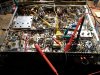
One last specification of the 7199 design: HF response of the power amplifier section was down .70 db at 20 kHz, and down 3.0 db at 50 kHz. A 10 kHz square wave from Channel A is shown for future reference. As I customarily do, the development work for the new driver stage will all be done on one channel (Channel A in this case), leaving the other completely stock. This allows for real time side by side comparisons at any time throughout the project. Once the development is finalized and complete, then the other channel will be modified to match.

With that, work on a new 7247 based driver stage can now get under way.

Dave

SAM_2052.JPG
Havin' fun now!
SAM_2053.JPG
 
If I may, the MPX-10 and MPX-20 units were designed for the Crosby based multiplexing system, which was ultimately not approved by the FCC. As a result, these particular units will make nice display pieces, but are incapable of decoding the approved GE-Zenith format FM Stereo MPX broadcasts.

Dave
 
Lots of data has now been collected on the design of the original power amps in the TA-800. When looked at collectively with the tone control amplifier stages, there are a number of design elements that stand out between this receiver, and that of the 500C/800C series units:

1. As I had surmised earlier, the tone controls in the TA series (both models) have much more loss built into them, which ultimately allows for more boost to be had when the tone controls are advanced from the flat setting. Whereas the TA can provide about 20 DB of boost or cut, the later receivers had toned this down (pun intended) to about 14 db. The effect of this is that the TA's have twice the boost/cut capability in their tone controls than the later receivers have -- and it's definitely noticeable in use when switching between the TA and later receivers. This is in keeping in general with a trend in Fisher design, where less tone control range is available in their products throughout the 60s, versus those of the 50s. I have often commented that the amount of bass boost produced in a 400C preamp by the two-step loudness circuit of that unit is just gross, even on the first step -- to the point of being unlistenable/unusable. This was not an engineering defect, but a result of the sources available in that day. 78 RPM records and early microgroove recordings had little LF information to offer, so Fisher's tone controls of the day had more boost built into them. As source material improved, less range was needed in the tone altering circuits, so they were adjusted accordingly in later years. The TAs were part of the pivoting process, and so did not yet represent the end goal of the pivot.

All of this plays into this project because Fisher had the option to account for the greater signal loss of the tone control networks via the greater gain of the pentode section of the 7199 driver tube in the power amplifier section -- and they did take some advantage of that fact as will be seen later. All else being equal then, if the unit is modified to use a lower gain driver tube, that loss of gain will need to be made up somewhere else in the circuit if the ultimate high level (Aux input) sensitivity specification (250 mV measured) is to remain unchanged. The tone control amplifiers is the only available place to go and find it.

As designed, with the tone and balance controls centered, the overall gain of the complete 12AX7 tone amplifier stages at 1 kHz in the TA-800 (from Aux input to the top of the volume control) clocks in at a measly X1.60, and is derived as follows: With each 12AX7 section in the tone amplifier stages having a raw gain of about 40, this becomes a total raw gain of 1600 when they are cascaded from one section into the other. This total raw gain gets reduced by a factor of 10 due to the 20 db loss in the tone controls, and then by a factor of 10 at each 12AX7 section due the 20 db of NFB that each stage employs. That results in the overall gain of the tone control section reaching a factor of just 1.60. When Fisher converted the early version 600 to the later version of that unit, they had to deal with the loss of gain in the power amplifier section as well. They did that by slightly reducing the NFB applied around the first tone amplifier stage, which is ultimately what will be done with this project as well. But first, the sensitivity of the new power amplifier design will have to be accurately established to know how much the NFB will need to be reduced in the first tone stage to maintain the original high level input specification. So moving on........

2. The power amplifier section in the TA-800 is rather conventional, with two three notable points regarding its design:

A. The output tube screen grid dropping resistor is nearly 185% larger in the TA-800, versus that of later receivers. This causes the screen grid voltage to drop 75 volts (which is significant) when both channels are driven to full power output, which in turn causes 1 kHz THD to come in at 1.75% under those conditions, which is not a very attractive result at this frequency. Even when a single channel is driven, 1 kHz THD at full power output is still 0.8%. Fisher lowered the value of the screen dropping resistor considerably in later units, and while the screen grid voltage still drops in those units, it doesn't do so as much, allowing (in part) those units to develop more power, at less distortion. The addition of EFB will make a notable impact on the performance of the TA-800.

B. With the greater gain of the 7199 available in the power amplifier section, that could allow for more NFB to be used to reduce distortion -- especially to counter that produced by the large drop in screen grid voltage in the output stage as power output increases. Except, Fisher did not opt to do this, with the power amplifier sections operating with 15 db of NFB -- the same amount that the later receivers use as well. OK, then at least the extra gain could be used to make the power amplifier section more sensitive than with a lower gain drive tube -- and it does, but only increasing it by an estimated factor of about 2.5. The stock 7199 based power amplifier in the TA-800 has an input sensitivity of .40 vac to develop full power output. In the later receivers with a 12AX7 driver tube, that figure is more typically around 1.0 volt for the 2.5X reduction in sensitivity as noted. Yet, the pentode section of a 7199 tube has a gain of nearly 8X that of a single 12AX7 section, so where did all the extra gain go? In this design, Fisher chose to introduce NFB into the screen grid circuit of the 7199, to help stabilize the gain of the pentode section of that tube from one example to the next. High gain is a virtue of pentode stages, but it isn't always consistent from one example to the next. By introducing the screen grid feedback as they have, the gain is stabilized, which helps to stabilize the performance of the design.

C. Since Fisher didn't really need to use all the gain advantages the 7199 offered over that of a more conventional dual triode driver tube, then why was it used? One advantage it does have is its being immune to the effects of Miller, where HF response can be reduced in an otherwise triode stage due to the internal plate to grid feedback that takes place in those tubes. For those with really super sharp ears and a capable source and speakers, the early TA receivers have the capacity then to sound incrementally brighter than later receivers that use a dual triode tube in the driver position. But the effect is almost entirely pushed to very highest extremities of the audio spectrum where so very little audio exists, so the difference will be miniscule at best. Fisher clearly didn't have an issue converting to the use of a dual triode driver stage, so wanting to develop this modification in the spirit of "How would Fisher have done this?", that's the path this modification will take as well.

The best answer as to why Fisher used the 7199 in these units likely falls into the realm of traditions in the industry. When a new tube came out, it was traditionally offered to manufacturers at rock bottom prices to entice them into designing them into their sets. That gives the manufacturers a break, gets the tube "out there", and consumers get the latest technology, so everybody wins -- and often, that process did work great. Just look at the 7591!! But the 7199 wasn't filling a gap like the 7591 was, and with performance that was really little improved from the previous tri-pent tubes already out there, it just represented another inventory line, and as history has shown, didn't really solve any of the well known tri-pent tube construction problems. Fisher did their part to help out RCA and gave it a go, but in my opinion, made the smart move back to using dual triodes for their driver tubes.

One last specification of the 7199 design: HF response of the power amplifier section was down .70 db at 20 kHz, and down 3.0 db at 50 kHz. A 10 kHz square wave from Channel A is shown for future reference. As I customarily do, the development work for the new driver stage will all be done on one channel (Channel A in this case), leaving the other completely stock. This allows for real time side by side comparisons at any time throughout the project. Once the development is finalized and complete, then the other channel will be modified to match.

With that, work on a new 7247 based driver stage can now get under way.

Dave

View attachment 951545
Havin' fun now!
View attachment 951555

Dave,

I do believe this project is definitely keeping you out of trouble. Georgia will sleep a little sounder knowing you're too busy to cause any problems!
 
Hmmmmm, I'll be watching to see the outcome of this modification. :lurk:

But after doing this receiver, Dave might not want another one showing up on his doorstep any time soon. ;)
 
Is there a compelling reason to go 7247 rather than single each 12ax7 and 12au7? I ask because I have few 7247 and many of the others.

Dave, one of my TA800s has no serial number visible, the other (from memory, I'm out camping this weekend) is 102##. Will report actual Sunday evening.
 
Matt; I would think that having two different tubes side by side and the possibility of installing them backwards is a very compelling reason to me, for the 7247 tubes. The 7247(12DW7) tube is fairly plentiful also, and somewhat inexpensive.

Larry
 
Back
Top Bottom