• The move to the new server is done. There are some software and database maintenance updates in process. This has us passing the hat around to help out. We appreciate any donations. Seriously, even a dollar helps. The payment page may be found here - https://www.audiokarma.org/support.html

Bozak B-4000 Questions

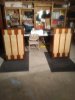
Two problems with stacking speakers like this.
(1) When speakers are stacked the lower cabinet, a hollow chamber, resonates and re-radiates the input energy input, distorting the overall signal in the room. In this case it is like placing the speaker on the floor and having the structure of the house — floor, sub-floor, joists, and rest of the home structure — absorb, damp, frequency shift, and re-radiate sound energy. This, again, is distortion. The resonance points can cause dips or peaks in the overall frequency response, and because smaller cabinets tend to be thinner and less rigid, those points may be higher up in the frequency response.

(2) The cone of the lower speaker is moved, both absorbing sound and re-radiating it. Both are distortion. Such an outcome occurs whenever speakers are in the same room, of course, but in this case the baffles form a contiguous surface, coupling the sonic energy between the two baffles, first from the upper to the lower as the drivers in the upper cabinet emit sound, then from the lower to the upper as the sound is re-radiated by the lower drivers.​

If speakers are to be stacked:
(1) Both speakers must have small sound-breaks (gaps) or isolation pads between the speakers to reduce the vibrational coupling. Isolation prevents the lower cabinet from acting as a resonant chamber, absorbing some frequencies and re-emitting at others.

(2) The lower speaker must have its cone covered to prevent it from absorbing and re-radiating energy because the baffles form a contiguous surface.

(3) The lower cabinet should be stiffened to avoid resonance, absorption, and re-radiation issues.

(4) The lower cabinet should be decoupled from the floor.​
 
Usually, shorting the terminals of the lower cabinet (the speaker cabinet being used as the stand), will prevent most resonant behavior. It shunts the voice coil of the woofer, which puts almost total damping on the woofer. It will absorb most vibration.

If I have more than one pair of speakers anywhere in a room- and they're not connected to an amplifier- I usually short the terminals of the unused ones, as a matter of practice. It does make thing sound better in many cases.

Regards,
Gordon.
 
I do have a sheet of sorbothane between them but you points are well taken. Then again, they are in a 36' x100' room with 4 other sets of speakers and a broad range of equipment and instruments so I'm thinking the acoustical gremlins that all presents might make such subtleties tough to spot. A carefully crafted listening room it is not, think more along the lines of a rehearsal space. Still, 'sounds pretty good all things considered.
 
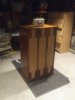
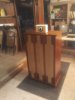
If anyone's interested, I treated the very dry and chipping wood on the bottom and backs with Minwax Wood Hardener, after a thorough scraping with a wire brush. The wood really soaked it up. The next morning, it seemed pretty solid. May need to replace those panels eventually, but for now, they seem ok.

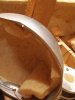
As an aside, I removed the metal 'salad bowls' from the mids, and surprisingly, they are lined with batting. Perhaps it was done after the fact by the owner.
 

Attachments

  • IMG_20201011_2033375.jpg
    IMG_20201011_2033375.jpg
    84.6 KB · Views: 70
  • IMG_20201011_2033481.jpg
    IMG_20201011_2033481.jpg
    74.1 KB · Views: 66
I’d not seen metal bowls, but that doesn’t mean much. Their design and batting is certainly Rudy’s design. Perfect!

Biggles
 
Biggles is right.

Certain appears to be something Rudy would have specified, but metal is an unusual choice for Bozak. What's the date code?

I'm speculating that it was an early design using a spun-metal dome which was then replaced with the far less expensive cast-acrylic, and very brittle, plastic.

Curious.

I'm reminded of this:
Rule 19 of Bozak Cult: The glaring inconsistencies, continual revisions, and seemingly randomized assemblages present in Bozak's nomenclature, driver and crossover numbering, years of use, crossover points, cabinet designs, quality, and manufacturing techniques, and units found, all combine to make it perfectly natural to be routinely confused, if not outright baffled, and have evolving understanding, so do not sweat it if once in a while your assumptions prove incorrect or if it takes multiple attempts to understand any particular configuration.
 
first two are the year, last is the month: August of 1963, fairly early I would think.

PS: nice work on the cabinet I've not used that product but it sounds interesting. And, as has been said, if you have metal domes with batting, I would leave well enough alone.
 
1963 would have been early enough in the cycle that the metal domes are original.

I suggest lining the outsides of the domes with cotton batting to prevent reflections. Hard surfaces highly reflect. The reason the surface padding was omitted was not for sonic reasons, but because, like every other aspect of a manufactured product, such labor and materials cost money and reduced profits.

We, as hobbyists, can fix such decisions — notably nearly sixty years on — rendered by managers trying to keep a company afloat instead of yielding optimal results.
 
After a month of working on the cabinets, I'm getting there. Recently installed Tobin modified crossovers.

So, here's my opinion so far:

1. The bass is much tighter and precise. Outstanding
2. The highs, much smoother. (I'm playing with a couple of DIY supertweeter enclosures. They do really add a bit of sparkle. (Fostex)
3. The mids (I think) is where I'm ambivalent.
They just seem recessed, subdued or perhaps muddled is a better description. Not nearly as forward as before the mod. I've spent some time playing around with the taps to see if that made a difference. Placing the mid on the further tap of the crossover seems to have brought them forward somewhat.
Perhaps its the attenuated tweeters are affecting what I'm hearing and not any change to the mids.

Still trying to decide if I like the original voicing better. Yep, I do. Not that they don't sound good, but that velvety 'something' that was there before the mod is gone. They sounded special, if a bit harsh, before. Now they just sound like really good speakers.

Think I might try and get another set of crossovers, original, recap/l-pad the y-tweeters only, and try them, and keep these for another project I'm soon to start.

So much time with my head in the back of these things, my wife thought I had dandruff. I told her not to worry, just Bozak batting dust. The look I got from her was priceless.
 

Attachments

  • IMG_20201107_2024548.jpg
    IMG_20201107_2024548.jpg
    74.2 KB · Views: 47
  • IMG_20201115_1205126.jpg
    IMG_20201115_1205126.jpg
    59.4 KB · Views: 44
  • IMG_20201115_1205557.jpg
    IMG_20201115_1205557.jpg
    63.8 KB · Views: 46
Are you using the Tobin tweeter attenuator or only an L-pad? The Tobin attenuator is of fixed value, and not actually the correct crossover point, and is therefore less desirable and the consensus is to not use it. This is well documented in the other Bozak threads.

Reversing a midrange makes it appear to be louder, hence the reason Bozak made the change. It was not an improvement, but rather a marketing trick.

The obvious test is to either boost the midrange using an equalizer or reverse the midrange, and then see if either restores the prior sound.

Much of the midrange adjustment (boosted or reversed) is preference, hearing, and room dynamics. That's not intended to be snark. Many rooms have decor which absorb the midrange. Adults tend to have hearing loss which worsens with age, and a bathtub curve, i.e. a wide dropout in the midrange, is very common. Finally, a more pronounced midrange is common and many listeners consider this alteration of sound to now be the baseline for audio.

It is easy enough to move the midrange back to 800 Hz and/or reverse it, either as a test or for permanent use. No need to purchase more crossovers.

I suggest changing only a single speaker (crossover point and reversed as separate experiments) and using a mono signal to A/B the two. That will reveal whether or not you perceive the change is beneficial. Human acoustic memory is both brief and inaccurate.
 
You're right, might be just faulty memory. I did do the A/B comparisons and it does seem slightly better with the mid on the further tap.

No L-pad on the tweeter circuit.

Would it be reasonable to try and extend the freq of the external tweeter down to compensate for what I'm not getting from the Y's. Currently I have a 1.5uF cap to the Fostex, which, I think crosses it over at 12.5k.

Thanks for the feedback.
 
The Tobin tweeter attenuator is sub-optimal and should be replaced with an L-pad.

If you look up my super-tweeter mod for the Bozak it crosses at 8,000 Hz because the B-200Y has breakup and distortion which becomes quite pronounced at ≈10,000 Hz. The goal was to move the crossover point just low enough to avoid problems, but high enough so that it would not be audible. The existing tweeter requires a band-pass filter, think of the midrange, to prevent distortion, and your setup lacks that, hence distortion from both the overlap and cone breakup. The point of adding a super-tweeter is to preserve the existing dynamics of the B-209 to B-200Y handoff, but pick up where the aluminum cone Bozak tweeter fails.

Crossing the super-tweeter at 12.5k Hz is too high given the poor performance of the B-200Y above 10k Hz. Also, the super-tweeter mod adds a band-pass (8k Hz to 25k Hz) to protect against ultrasonic oscillation or other signals which can damage the super-tweeter. First-order rolloff, so it gently fades out at the high end.
 
I like the idea of using an equalizer to pin it down. Any suggestions on a equalizer that you would recommend?
Thanks
 
I like the idea of using an equalizer to pin it down. Any suggestions on a equalizer that you would recommend?

Any parametric equalizer should be fine. More bands is, of course, superior to fewer bands, because the control is greater.

I think you may simply be accustomed to a more forward midrange, this being a common trick to sell speakers.
 
Does anyone have a schematic of the original Symphony crossover, circa 1963?

The crossover for a Symphony with a B-209 midrange will be identical to that of a B-302, B-313, or, indeed, any other Bozak three-way. The woofers are 16 Ω parallel wired to yield 8 Ω. Otherwise, no difference in the crossover.

You can readily find schematics for any Bozak model using the search feature.
 
Ahhh, yes, the Symphony with a B-800 uses different crossover points than the Symphony with the B-209. Which is why I qualified with the B-209, as this is the most common Symphony configuration.

This is messy and complicated, but it's been elsewhere hashed to death. I'm grabbing some of those bits and coalescing.

The Concert Grand with a B-800 used the N-105 crossover. This is an 8 Ω crossover. (Four woofers, series wired in pairs for 16 Ω then those pairs parallel wired for 8 Ω.) The crossover points are 200 Hz (woofer-midrange) and 1,500 Hz (midrange-tweeter), an a contour filter exists for each of the midrange and tweeters, because the midrange needs a boost at the upper end and the tweeters must lower extend to cover the falling output of the midrange with frequency.

The Concert Grand with a B-209 used the N-104 crossover and then the N-10102. The N-10102 and N-104 were different physical units, although the N-10102 could perform the N-104 function. The N-10102 was slightly more flexible and the N-104 slightly less flexible, because the N-10102 was a universal Bozak crossover. To clarify, the N-10102 in the 1950s was upgradable to the same functionality as the N-104, it was not originally the same physical layout and did not become an identical substrate until much later. I think the catalog listing from 1958 and 1959 shows that. All the N-10102 needed to become an N-104 was an additional capacitor bank, and it isn't clear where that went.

The B-800 version of the 8 Ω B-4000 Symphony uses the same N-105 crossover from the B-800 version of the Concert Grand.

For the N-104 and N-105 crossovers, i.e. B-800 versions, Bozak re-used the same physical board printed label as for the B-209 crossovers, but pasted on a small labels with "N-105" and "B-800", with the B-800 label covering the B-209 label. I cannot guarantee the value for the inductor, which ought to have changed, as I have never measured it with an accurate bridge. I think I still own one, but much Bozak gear has passed through my hands that I can't swear to it.

The B-209 versions of the Symphony then used what became labeled as the N-105A crossover, which simply was an N-10102 crossover re-badged. The crossover points are identical to the standard B-209 three-ways such as, for example, the B-302 and B-313.

At this point Bozak was still presenting the fiction that the Symphony used a N-105 crossover instead of one of a rebadged standard N-10102.

If your original N-105 crossover was rebuilt using the (incorrect) Tobin values intended for the N-10102 family of crossover (or an N-10102 re-badged as an N-105 but, nonetheless, operating at the same points as the traditional B-209 three-way) with a B-209 — i.e. originally 800 Hz for woofer to midrange, and 2,500 Hz for midrange to tweeter — the sound will be horrendous, and explain your experience of detesting the midrange. The result will (offhand) be:
(1) Gap at the low end, with the woofer crossing at 200 Hz (filter ceiling controlled by the N-105 inductor) and midrange crossing at 400 Hz (filter floor controlled by the new Tobin capacitor at the lower, and incorrect, point)

(2) Gap for much of the upper midrange, i.e. above 1,500 Hz (filter ceiling controlled by the N-105 inductor), as the midrange rolls off at 1,500 Hz but the tweeter does not come in until 2,500 Hz (filter floor controlled by a capacitor, standard point maintained by Tobin, now incorrect being too high).​

If you used a separate Tobinized crossover which has the correct inductor values then the B-800 is being used much like a B-209, which has the problem of the B-800 delivering poor performance above 800 Hz. An 8" B-800 cannot extend into the same region as the 6" B-209. So the midrange will suffer at the high end. Hence the contour filter of the N-105 to compensate.

I've attached a not particularly good scan of the N-105. I don't know if I have an actual N-105 datasheet in my print archives, but that is not handy at the moment.

Rule 19 of Bozak Cult: The glaring inconsistencies, continual revisions, and seemingly randomized assemblages present in Bozak's nomenclature, driver and crossover numbering, years of use, crossover points, cabinet designs, quality, and manufacturing techniques, and units found, all combine to make it perfectly natural to be routinely confused, if not outright baffled, and have evolving understanding, so do not sweat it if once in a while your assumptions prove incorrect or if it takes multiple attempts to understand any particular configuration.


Edit: Very slightly fixed unclear language.
 

Attachments

  • Bozak N-105 Crossover (B-4000 Symphony) (1964, Sept).jpg
    Bozak N-105 Crossover (B-4000 Symphony) (1964, Sept).jpg
    98.9 KB · Views: 30
Last edited:
Mama Mia!

I'm learning the Bozak Cult Rules the hard way.

Thanks you so much for passing on your encyclopedic knowledge!

I've got a lot to learn.
 
Back
Top Bottom