• The move to the new server is done. There are some software and database maintenance updates in process. This has us passing the hat around to help out. We appreciate any donations. Seriously, even a dollar helps. The payment page may be found here - https://www.audiokarma.org/support.html

Bozak B-4000 Questions

Haven’t seen these since the 1960s.
What’s the characteristics sound of these? What new speaker might they sound like?
 
Others more experienced than me would be able to make a comparison with modern speakers, but a standout quality for me is the outstanding, precise bass. Not muddled, just tight, quick and pants flappingly powerful. More significant, though, is the mids. They are velvety smooth. I don't have a ton of experience, and I'm sure there are many current (and expensive) speakers that have this quality as well, but, to me, it's just natural and effortless.

The high end is a bit lacking, but that's not what Bozak's are about, and there are ways to address that, as has been discussed earlier in this thread.

Even without the supertweeter mod, which is up next for me, they just sound very balanced. (But only after a lot of changes with the guidance of those on AK.)
 
I miss the old days when I could go to a hi fi store and listen to all these great speakers. Thanks. I heard them many times in the 60s, but as far as remembering the sound compared to today, forget it!
Thanks!
 
I miss the old days when I could go to a hi fi store and listen to all these great speakers. Thanks. I heard them many times in the 60s, but as far as remembering the sound compared to today, forget it!
Thanks!

Depending on where you are, they’re still there. I’ve got one 30 some odd miles from me that I plan on visiting. It’s not the same though, iam not the same either.

Biggles


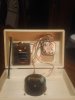
Band pass for supertweeter, in DIY enclosure.

Interestingly, the Fostex FT17H is pretty hot. To me, sounds best at about 1/3 on the L-pad, with the Y tweeters at about 1/2 on theirs.

Haven't yet added the inductor to the 200Y, so I'm sure there's some overlap, but getting better with each step.

Using the original N-105 crossover schematic with new components. Sounds perfect to me. I guess I'm in the minority. (Although the rebuild of my crossovers had some issues, as previously identified by Retrovert.)

To anyone who's restoring these, my opinion is just re-cap originals and listen for awhile before any mods. What I should have done, as was recommended by some here. For me, the N-105 with the supertweeter addition is wonderful. I know it's personal preference, but for me, it works.

Tried with a newly acquired Marantz 2270, original, and a Kenwood integrated KA-7300. Both require updating. They both sound completely lifeless when compared to my Philips 787. Frankly, I don't know why these aren't more in demand.

My wife wonders why I spend so much time in the basement. I told her, I could have worse hobbies!

Many thanks to all. In the homestretch.
 

Attachments

  • IMG_20201201_2123283.jpg
    IMG_20201201_2123283.jpg
    46.3 KB · Views: 37
  • IMG_20201201_2123568.jpg
    IMG_20201201_2123568.jpg
    71.3 KB · Views: 38
Crossover Mistakes

Ummm, to clarify, the crossovers in your speakers did not have "some issues", they were utterly ruined by totally inappropriate modifications which could not possibly have succeeded as per my explanation in No. 39 and No. 41. The filters were destroyed, which, in turn, ruined the frequency response by introducing gaps.

Drawing any conclusion from that debacle is, ab initio, doomed. Shifting the crossover points on an N-105 requires replacing bot the capacitors and the inductors, i.e. building a new crossover. The N-105 crossover points are different than the N-10102 (and related crossovers), which is why the N-105 works with a B-800 but not a B-209, and vice-versa. This is also why the Tobin changes — again, designed for a different crossover and different midrange — left large gaps in the frequency response. The Tobin modification cannot be used with the N-105 crossover; it only works with the N-10102 and related crossovers!

So it's not the case of "just listen to the original before making modifications", as it is more along the lines of "work the formulase and don't break the filters, dude".

Super-Tweeter

Yeaaaaah, this is problematic.

I suspect whomever suggested the horn tweeter didn't tell you that horns are different than soft-domes.

Not to be harshin' on your mellow, but what you built is not what I suggested and not what others have made.

The sole modification I proposed for the N-105 with a B-800 is adding a soft-dome super-tweeter, a modification which requires making a band-pass for the existing tweeter and a band-pass for the soft-dome super-tweeter.

I'm not surprise the new tweeter is louder and shoutier: the Fostex FT17H is a horn tweeter, which is going to be louder (3 to 6 dB louder than the other Bozak drivers) and also less clean than the soft-dome which I suggested. A similar difference in volume exists with the B-200Y, which is part of why I suggested an adjustable L-pad instead of the fixed-attenuator Tobin creator.

As a general rule, a horn super-tweeter, like other horn tweeters, should be higher crossed with a first-order crossover, about 10k Hz. A second- or third-order crossover to steepen the slopes might fix the issue of lower crossing, but that adds more group delay, phase shift, and components.

The FT17H is reportedly poor performing on signal below 6k Hz — reportedly the Fs ≈ 5k Hz, but I didn't find that in the datasheet, but I didn't make that research into a project so it might be there — and the first-order crossover will permit some of that signal through, causing distortion when the driver hits a resonance point. A higher-level filter may also be useful to steepen the slopes on the higher-end of the response, because the long tail will introduce signal which may be unpleasant to hear.

My super-tweeter modification — again, to be perfectly clear — never was intended to be used with a horn tweeter, ribbon tweeter, piezo tweeter, or any other kind of tweeter other than a soft-dome. It would work with certain electrostatics, such as the JansZen, without issue because those tweeters have the correct bandwidth. But not with the horns, ribbons, or piezos.

You might try swapping in a soft-dome tweeter and seeing how the sound changes. Should be much warmer and mellower, without the harshness, and a better blend for the original Bozak drivers.

Not sayin', just sayin'.

I further suggest adding the inductor to the B-200Y to remove the higher-frequency distortion components introduced by the B-200Y becoming mechanically limited and failing. This is why soft-domes are preferred to the annoying harshness of the traditional cone or horn tweeters.

The only reason to not use a soft-dome for the entire range is maintaining the driver blending and voicing created by Rudy Bozak at the midrange to tweeter handoff, which is still in a critical region where human hearing is generally excellent, at least until age-related deterioration hammers it into the typical bathtub curve. The soft-dome should maintain the blending from the B-200Y and thus maintain the sonic signature throughout the remainder of the frequency range.
 
Last edited:
Either Morel or Tymphany. Steve used the Tymphany. I will upgrade mine with the Morels when I can scrounge up more time.

Here is some of what I previously wrote on the subject last year, which is somewhat outdated given the change in models and pricing changes.
The easiest solution here is to find a tweeter reasonably flat on-axis from 8,000 Hz to 20,000 Hz at somewhere between $75 and $150 for the pair. Frequency response and price point rule out many of the soft domes and the metal domes, as well as the horns, ribbons, AMTs, and exotics, many of which poorly or irregularly reproduce above 10,000 to 12,000 Hz. Note that one may pay significantly more or less for a tweeter. Lower-cost comes with sonic abnormalities and spikey response. Higher-cost comes with increased power handling. The ideal tweeter for a standard configuration will have a very low resonance point to permit use of a first-order crossover. We are so far above the resonance point that this is not an issue, but it speaks to better design.

I have read many tweeter reviews, and the difficulty is that drivers come and go with regularity, so some of the best analysis and comparison is now a decade old and obsolete for specific models.

I hesitate to recommend a driver I have not used. as I feel some responsibility if it does not work out. Many vendors, however, will permit you to return a driver for a refund. So you can always try a few and send back the rejects.

The tweeters I was considering, but which I have not tried, are in the Morel line:
Morel MDT 22
1-1/8" Soft Dome Neodymium Tweeter
80 Watts
88 dB / Watt
2,000 to 20,000 Hz
Price: $40.00
https://www.parts-express.com/pedocs/specs/277-062-morel-mdt-22-specifications.pdf

Morel MDT 39
1-1/8" Compact Dome Tweeter
80 Watts
88 dB / Watt
2,200 to 20,000 Hz
Price: $55.50
http://www.madisound.com/loudspeaker_specifications/MDT39-msc.pdf

Morel CAT 408
1-1/8" Compact Soft Dome Tweeter
120 Watts
89 dB / Watt
Price: $79.00
https://www.parts-express.com/pedocs/specs/277-086-morel-cat-408-specifications.pdf
Difference from the lower-cost MDT 39 is the "Hexatech" aluminum voice coil.
​
Note: the inclusion of a link to a vendor is not an endorsement of the vendor or its prices, and I have no connection to any business. I routinely purchase from Parts Express, an AK sponsor and have generally found its prices to be lower than other sources. I would have used Parts Express for the specifications, except in one case it did not supply the literature.

All of these tweeters use ferrofluid. Like many, I had bad experience with ferrorfluid tweeters in the 1980s, but those dissipated much higher power and were not as well made. I do not know the lifespan, but the reports are in excess of twenty years without abuse. The ferrofluid can be replaced.

For our purposes I suspect these drivers will have identical sound reproduction. The 39 has a slightly flatter response.

We also must discuss impedance compensation. This a fancy name for a filter, either band-pass (LRC) to notch out a resonance peak or a high-pass (RC) to reduce the rise in impedance with frequency. The resistor converts energy into heat. The filter basically is a frequency-dependent resistor, and it is placed in parallel with the driver, exactly like an L-pad. One need not use impedance compensation, of course, many nice-sounding speakers do not. The exact points are determined using frequency plots of the driver.

The MDT 39 rises from a nominal 8 Ω at 8,000 Hz to 13 Ω at 20,000 Hz. This may be tamed with a RC filter aka Zobel. Separate discussion. That's a refinement, and many speakers, again, do not use it. We need not worry about the resonance peak, as energy is not going into the tweeter in that band, as it would if the tweeter were being used in a traditional configuration.​

Here are some Morel tweeters:

The Morel MDT 39, CAT 298, and CAT 408 are at the approximately price point as your existing tweeter.

As I earlier wrote, I hesitate to recommend a driver I have not used. as I feel some responsibility if it does not work out. Many vendors, however, will permit you to return a driver for a refund. So you can always try a few and send back the rejects.
 
Added inductors to 200y legs of each crossover. Bandpass completed for both 200ys and supertweeters.

Still waiting for the soft domes I ordered from PE, but using the Fostex horns turned WAY down. Not bad, but only when barely turned on. I keep the 200y L-pad at about 1/2. (Those y tweeters really are loud, as has been mentioned many times.) I love having L-pads on both the 200ys and the supertweeter. Can tweak it for the type of music, preference, etc.

Even though not complete, re-discovering music that I've listened to for years. What I've also noticed is that bad recordings can't hide. Good, bad or ugly, these will show it.

Many thanks to all, especially Retrovert, for your help.

Final pics to follow when complete.

Now to talk my wife into letting me put these behemoths in the living room.
 
You're welcome.

The bandpass on the B-200Y should clean up the sound by eliminating the cone distortion and comb artifacts, well, once you get those horn tweeters out of the cabinet.

Yeah, horns are really shouty, plus ring like bells, plus distort when not damped or used with higher-order filters, plus couple said ringing into the cabinet, plus, oh, the joy of horns...

Add a third Bozak speaker as the center channel and obtain the ultimate setup for home theater. Try it with any movie which has lower-frequency sound effects. Presto! Instant movie theater!
 
So, finally changed out the horns for a pair of Morel soft dome tweeters.

Very nice!.

Thanks to all, especially Retrovert. They sound great!.

Unfortunately, I fried my Philips 787 (my personal favorite receiver), due to my stupidity. (messing with the speaker wires while the switched outlet had popped out a little. Sparks....then nothing....oh well.

A Kenwood KA-7300 integrated doing OK, but I sounds a little flat compared to the Philips, which was recapped. The Kenwood needs a good going over.

Anxious to try the Marantz 2270 which is out for a full restore, with the Symphonys.

I heard Retrovert's mention of a five-way, using a B-800 as a mid-woofer.

Now that's a project I might enjoy!.

(I wanted a hobby...Now I've got one!)
 
Your amplifier likely only needs new output transistors. It's not an insurmountable or hideously expensive issue. I always say that changing speakers when the amplifier is on is a good way to send output transistors to Valhalla.

Which Morel soft-dome did you select? Did you add the inductor to band-pass the existing tweeters? That is crucial to eliminate overlap, which causes comb artifacts (distortion) and excessive volume.

If you want to build a five-way I'll dig out my notes on my candidate crossover points and values. The crossover is not a hideously complicated build. Inductor for the woofer, band-pass for the mid-woofer, then a band-pass for the midrange, band-pass for the tweeter, band-pass for the super-tweeter. It's band-pass filters all the way down!

The five-way project, of necessity, requires construction of a new crossover. New inductors, new capacitors, etc. Some of the capacitors could be repurposed into the new banks, but that's likely more work than it is worth. The super-tweeter band-pass may be re-used, as it does not change. Every other point, however, will be different than in any three-way using the B-800 as a midrange instead of the B-209.

Also, if you have the B-800A that is mechanically limited at the low end and I'm not sure exactly how much damage the damping does to the driver's response curve when used as a midwoofer. Not sayin', just sayin'. It ought to be verified.
 
The band-pass filters are:
(1) Existing B-200Y, using the existing 8.2 µF capacitor (or whatever value is present) and add a 0.159 mH inductor to filter (2,500 Hz to 8,000 Hz)
(2) For the supertweeter use a 2.5 µF capacitor (technically 2.49 µF) and a 0.05 mH inductor to filter (8,000 Hz to 25,000 Hz)

Used the above values for the two band passes.

Went with the Morel MDT 22 and it seems to be working well. As recommended, much smoother than the Fostex. Since the range is so limited, I didn't think it would make a huge difference, which soft dome I used. They seem fairly fragile though. Built two new separate enclosures with the bandpass, L-pad and terminals. Experimenting a bit with the position of the enclosures. Sound seems smoothest when aligned with the 200ys, about three inches from the edge of the cabinet. I'm very happy with these as they are and this is how they'll stay.

Re: the five-way:

What I'm considering is building new cabinets, each with 1-B199, 1-B800, 1-B209, 2-200'ys and one soft dome.( I have one 209B and a couple of 200ys., The 209b is NIB, actually. Saw it and grabbed it. In original Bozak packing. ) Time to start acquiring drivers and designing the cabinet. (or find empty symphony cabs, perhaps?)


If you want to build a five-way I'll dig out my notes on my candidate crossover points and values. The crossover is not a hideously complicated build. Inductor for the woofer, band-pass for the mid-woofer, then a band-pass for the midrange, band-pass for the tweeter, band-pass for the super-tweeter. It's band-pass filters all the way down!

That would be great!. But absolutely no rush. I'm a long way off from that part.
 
Haven’t seen these since the 1960s.
What’s the characteristics sound of these? What new speaker might they sound like?

uhm, 'lost track of this thread & bumbled back upon it looking for something else. Since you asked, to me they sort of sound like vintage KLH, a very smooth and involving midrange w/soft top. That said, the bass is much better than any vintage KLH I've heard (not JBL prominent but authoritative: if the recording called for it, it is there. If not, not). The midrange is better too, it just sort of reminds me of some of Henry's work. I would describe the midrange sound of many vintage KLH speakers (properly functioning) as creamy. A B4000, 'butter-very rich and lovely. Perhaps they are out there but I have not encountered a modern speaker that has quite that signature. Something about when recordings shifted from analog to digital, tweeters got much better with much more extended ranges.
All of that is well and good and there are of course some lovely modern designs but nothing that quite captures the lush sound of a properly set up vintage speaker. I guess I think of it a bit like digital v. analog or perhaps tubes v solid state. 'Pretty sure SS and digital measure better and thus technically are more accurate, but I don't listen to music for technical reasons, I listen to it to feed the soul. IMHO, vintage speakers like the big Bozak's do that very, very well in a way that more modern, advanced kit just seem to miss, YMMV.
 
Fjdds,

A Klipsch Cornwall's cabinet can be repurposed to your needs without too much effort. Or build new from Cornwall plans. The 15" hole holds a B199 with the early adapter ring. FYI

Biggles
 
IMHO, vintage speakers like the big Bozak's do that very, very well in a way that more modern, advanced kit just seem to miss

I am far from an expert. What I will say, though, is that these are so listenable. Had them going for four hours today, No sense that I wanted to turn them off.
 
A Klipsch Cornwall's cabinet can be repurposed to your needs without too much effort. Or build new from Cornwall plans. The 15" hole holds a B199 with the early adapter ring. FYI

What would be the recommended internal volume for a sealed box with one B199?

Thanks
 
Back
Top Bottom