• The move to the new server is done. There are some software and database maintenance updates in process. This has us passing the hat around to help out. We appreciate any donations. Seriously, even a dollar helps. The payment page may be found here - https://www.audiokarma.org/support.html

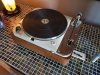
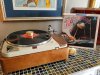
Budget Alternative to TD124

Nice one!! Im thinking of doing a DIY version of that counterweight for my basik arm that im in the process of rewiring. Would u believe this arm has 4 separate connections in the wiring - from the cartridge to the headshell, the headshell to a 4 pin plug, the 4 pin plug to the internal wiring, the internal wiring to another 4 pin plug, 4 pin plug to external cable!!!! Im doing continuous run of wire from cartridge clips to rca jack lol......and im going to epoxy the headshell to the arm wand and expoxy glue the arm wand to bearing yoke to make it more rigid - should be a much better arm when im done lol. Im hoping it will then take an MC cart. In the mean time i have basik plus to use........how significant a difference does the counterweight mod make in your experience??? Oh and what is the approx lenght and diamtre of that brass barrell???


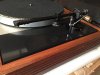
I’ll dig it out soon and take some measurements for you, and the improvement was tracking, it shifts the pivot point of the arm as the weight is lower than the cart. It really helped balance the arm out, it felt like it gave it more heft too. I ran my BP No.2 on it for a good while and really loved the combo. It’s in the closet right now. I’d say buy one on eBay, it’s worth the investment. I think they run $70-80 bucks. Well worth it.
51C60F04-C41F-404B-AE75-01DA6C156351.jpeg
 
If you want an Ortofon SPU then a modified AR XA is really not going to be the table to use it on. You want a high mass arm for this cartridge. A Denon DP 75 with an Acos GST 801, or the Ortofon arms, Fidelity Research, some of the Audio Technica, the longer Jelco, those are the arms that are better suited for them. If going a modern SPU you should gather up the compliance info, but I believe you are still looking at a medium to higher mass arm.

One of the Denon DP 75/80 would be a good choice, or one of the previous generation non quartz locked Denon series of tables would also work well. Or go for the gusto, save some money and buy the TD 124. There is a member here goes by the tag name hirscwi that had a couple of lovely restored 124 for sale in Bartertown. Those were things of beauty and the prices were reasonable for what you got. But they were not cheap, and a TD 124 is hardly likely to ever be cheap. Even a beater one gets expensive once you start finding parts to restore it, if they can be found when you need them. But then for many this is an end game table worth investing the money into.

Good luck on your journey! Many people fall in love with those SPU cartridges.

Cheers
Mister Pig

Thanks!

I working my way thru this this thread:
https://audiokarma.org/forums/index...to-get-the-best-performance-out-of-it.832218/

There is two on fleabay right now but I have to see about plinths and switching the psu to american voltages. They seem to be sold without plinths.

I think the first thing I'm gonna do is contact Mr Morrin to start a cost analysis. I might go this way first and see if the shure m3d + goldring 1006 (not into the idea of fine line stylus at this point) would make me happy.

there has been a lot of variaty in the spus recently. I checked vinylengine chart and the spu classic NE would match with the rega rb300 compliance. I will post an update to this thread to let you know which direction I am going in.
 
I have had many TTs over the years. Decided try the 124 mk I . I am glad I did, it's the best sounding TT I have owned. I did read the " cement mixer" comments used to describe its operation. All I can say is many have come to their conclusions by either going by hearsay or listening to poorly maintained examples.

Mine has had several audiosilente upgrades, bearing upgrades and the standard motor support upgrade.
It sits on a slate plinth with a slate armboard. It is extremely quite. Absolutely no idler or bearing rumble. The SME 3009 unimproved is a very nice arm. It currently fitted with a re-potted DL-103 with a SUT using two Altec lansing 4722s. As an alternative I run ADC-TRX3 MM. A great sounding cart designed by Hisayoshi Nagkatsuka of ZYX fame.
20190720_131213.jpg 20190525_163844.jpg
 
If you ask me your not talking about a significant amount of money over what some of the other tables your considering and that of the TD124. Why don't you just wait a bit longer, and save the difference to get what you really want. Shop around when you get your money saved, and then later on as time progresses you can do the upgrades, such as plinths, arm boards, bearings, arms, carts, and SUT's. I my case when I purchased something that wasn't what I really wanted I always kept thinking about that item and ended up buying one later. And in the long run you spent more money on all the other stuff that really wasn't what you really wanted.
 
I’ll dig it out soon and take some measurements for you, and the improvement was tracking, it shifts the pivot point of the arm as the weight is lower than the cart. It really helped balance the arm out, it felt like it gave it more heft too. I ran my BP No.2 on it for a good while and really loved the combo. It’s in the closet right now. I’d say buy one on eBay, it’s worth the investment. I think they run $70-80 bucks. Well worth it.
View attachment 1611788

Hey thanx!! Btw not sure if its the angle of the photo but your headshell azimuth seems out?? I know it was on my basik plus - i had to undo the two screws at the end of the arm wand to rotate it so that the headshell was level with record.. Not uncommon on Linn arms.....
 
Hey thanx!! Btw not sure if its the angle of the photo but your headshell azimuth seems out?? I know it was on my basik plus - i had to undo the two screws at the end of the arm wand to rotate it so that the headshell was level with record.. Not uncommon on Linn arms.....

No it’s dead on it’s just the pix. :) that’s the VSX arm. The plus is on a shelf collecting dust.. lol
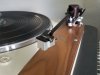
 
I have had many TTs over the years. Decided try the 124 mk I . I am glad I did, it's the best sounding TT I have owned. I did read the " cement mixer" comments used to describe its operation. All I can say is many have come to their conclusions by either going by hearsay or listening to poorly maintained examples.

Mine has had several audiosilente upgrades, bearing upgrades and the standard motor support upgrade.
It sits on a slate plinth with a slate armboard. It is extremely quite. Absolutely no idler or bearing rumble. The SME 3009 unimproved is a very nice arm. It currently fitted with a re-potted DL-103 with a SUT using two Altec lansing 4722s. As an alternative I run ADC-TRX3 MM. A great sounding cart designed by Hisayoshi Nagkatsuka of ZYX fame.
View attachment 1612094 View attachment 1612095

Love that head shell. I like the logo on the early ones :) good looking set up!
1735FCF9-AFB6-465A-AC7E-587580F7EBCC.jpeg
 
I have had many TTs over the years. Decided try the 124 mk I . I am glad I did, it's the best sounding TT I have owned. I did read the " cement mixer" comments used to describe its operation. All I can say is many have come to their conclusions by either going by hearsay or listening to poorly maintained examples.

Mine has had several audiosilente upgrades, bearing upgrades and the standard motor support upgrade.
It sits on a slate plinth with a slate armboard. It is extremely quite. Absolutely no idler or bearing rumble. The SME 3009 unimproved is a very nice arm. It currently fitted with a re-potted DL-103 with a SUT using two Altec lansing 4722s. As an alternative I run ADC-TRX3 MM. A great sounding cart designed by Hisayoshi Nagkatsuka of ZYX fame.
View attachment 1612094 View attachment 1612095

Damn that looks great what did you use before slate?
 
I'm puzzled by the repeated opinion (and I'm condensing) that if you get the noise down to zero, tables sound the same. Perhaps by noise you mean all aberations, but noise is a specific set of defects. Noise tends to be a weakness of idlers, but their devotees are more concerned about their tight control of dynamics and speed. There is an urgency, grunt, drive, or whatever you want to call it, that idlers have that most belt drives tend to smooth out, sweetening the sound and lowering noise, perhaps, but losing something important in the process. Good direct drives are closer, but with both, high platter mass goes a long way to minimizing the difference, but it makes them more expensive. The issue isn't noise, it's constant speed under dynamic conditions with different groove modulations.
There are not many great turntables that aren't expensive, but you can get a taste, cheap, with a surprising number of idlers. The AR also gives you this taste, but then you have a pretty big jump in prices to achieve the same 'thing' what ever that is.
 
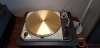
It's a skeleton plinth, typical of the standard Thorens plinths. Actually it sounded pretty good but the solid slate plinth does a better job.
 
I'm puzzled by the repeated opinion (and I'm condensing) that if you get the noise down to zero, tables sound the same. Perhaps by noise you mean all aberations, but noise is a specific set of defects. Noise tends to be a weakness of idlers, but their devotees are more concerned about their tight control of dynamics and speed. There is an urgency, grunt, drive, or whatever you want to call it, that idlers have that most belt drives tend to smooth out, sweetening the sound and lowering noise, perhaps, but losing something important in the process. Good direct drives are closer, but with both, high platter mass goes a long way to minimizing the difference, but it makes them more expensive. The issue isn't noise, it's constant speed under dynamic conditions with different groove modulations.
There are not many great turntables that aren't expensive, but you can get a taste, cheap, with a surprising number of idlers. The AR also gives you this taste, but then you have a pretty big jump in prices to achieve the same 'thing' what ever that is.

When you have a direct coupling of drive train it increases the amount of noise that will be transferred to the platter, which of course is picked up by the cart. No matter how perfect your drive wheel, bearings on the drive wheel, motor shaft bearings, motor noise, your going to get some noise. Perhaps it won't be easily heard over the dynamics of the music. Belts by the nature help to decouple the motor from the platter, and direct drives as well as they don't have a direct coupling in the fact that the only coupling they have is a magnetic field.

As far as having more "urgency, grunt, drive or whatever", I think it is something that has yet to be shown in a factual report. If a table plays at the correct speed, and has no real measurable speed deviations, what ever is spinning the platter is meaningless. "Punch, urgency, grunt, drive, is really only someone's description of what they think is happening. If that platter, is spinning constant, accurately with no deviation, and without any added noise being transferred no matter what method of drive, its going to sound the same, at least that is what my experience has been. I own examples of all types of drives, and if executed well you should be able to enjoy any method of drive. Hell in fact I have seen many examples of units with rather poor examples and owners still enjoy them.
 
I don't think its that hard to find concrete evidence of the effect of groove modulation on speed. Obviously it is a transient thing, but it can be documented/shown, and has been. Belts do decouple the platter from motor noise (assuming that the the suspension of the motor is completely effective, which is a nice idea) but any compliant material has some frequency at which it oscillates, and the compliance of belts get into a fight with the inertia of the platter mass when groove modulations affect the speed. (Jean Hiraga had some interesting ideas about platter mats that could allow some motion of the record relative to the platter without oscillation, but that's another topic.) With suspended subchassis tables, the motion of the subchassis is also a source of speed variation, which is why the Mission tables had motors mounts that rotated as well as suspending the motor, and this seems to be effective.
Direct drives also have oscillation, both because of the motor poles and because any moving system is sensitive to changes in drag. Of course, idler drives do too, though I believe the compliance in an idler is mostly in/out rather than froward/back, so the transient behavior is quickly past.
With all of these drive systems, getting the forces, compliances, and masses to work together to minimize the effects of groove modulation and acoustic input makes a big difference. Designer smarts matters a lot, but usually heavy platters are helpful, assuming competent design. That might be less true of the unique Weathers designs of the early 60s, which had essentially sponge idlers driving a very light platter, the platter's small mass allowing for quick response and cessation of speed variation.
 
Nice one!! Im thinking of doing a DIY version of that counterweight for my basik arm that im in the process of rewiring. Would u believe this arm has 4 separate connections in the wiring - from the cartridge to the headshell, the headshell to a 4 pin plug, the 4 pin plug to the internal wiring, the internal wiring to another 4 pin plug, 4 pin plug to external cable!!!! Im doing continuous run of wire from cartridge clips to rca jack lol......and im going to epoxy the headshell to the arm wand and expoxy glue the arm wand to bearing yoke to make it more rigid - should be a much better arm when im done lol. Im hoping it will then take an MC cart. In the mean time i have basik plus to use........how significant a difference does the counterweight mod make in your experience??? Oh and what is the approx lenght and diamtre of that brass barrell???


57mm X 18.5mm


;)
 
@Amorphous1 Your original question roughly asked whether you could find TD124 quality without breaking the bank.
This opens up a whole discussion about idler v belt v DD etc etc as you have seen.
Probably unique among members here I worked for a good few years for some well known Scottish turntable manufacturers mostly doing product development.
So , let me tell you , to give you some insight into what makes it all tick that every single part that you build into a deck will alter the sound. Every material that you change , could be Brass v Mild Steel V Stainless steel it all changes how the deck will sound. Every spring or damping medium will change the sound for good or bad. Every part that is in the mechanical construction will have an influence on the resultant sound , good or not so good.
How do you quantify this , how on earth can you measure the activity of a specific material in the context of a bunch of other materials. I don't think you can. Yes you can do wow and flutter and rumble and FR measurements but that is not the whole picture.
Allow you to give you an example , on one fairly high end TT the motor ( belt drive ) was a papst DC as used in many decks of that era. It had on board DC regulation etc to make it work but it ' sounded' much better with a stiff linear PSU with twin transformers. I was trying to refine the original design and made a test jig with switch on the fly variations between transformers. Using toroidal trannies I could switch between small med and large single or double. The turntable was running all the time and the audible changes were quite apparent.
Talk me through that , the voltage supplied to the deck was always the same , it was smoothed in the psu and the motor had its own regulation.
Anyway , it's all very subtle but decks do have a huge influence on the basic clarity and presentation of the record being played.

To answer your first question , best bang for the buck is a TD160 super If you are wedded to the SPU you may have issues with a high mass arm that will fit in the 160 and work OK with the suspension. Alternatively the Denon DP variants can be had for sensible money , can't remember the model no's but again if you are wedded to the SPU find the one that will take a Jelco / Acos arm.

You can go down the Linn rabbit hole but thats a never ending tale of ' upgrades '
If you are in the US SOTA , VPI and Oracle make fine decks.
 
Thanks to everyone for replying to this thread. After much consideration I decided to buy a Denon DP-75. I got one for about $630 plus shipping which was expensive (a little much but ... safety). Much deliberation went into this decision.

I keep trying to do the math but the TD124 setup I wanted always pushed the price to $4000. So I had to look at my system. Every time i listen to the SPU(all two times haha, in real life anyways) it was on a three way system. I don't plan on going bigger than the JBL 4301b in the foreseeable future. That plus the special nature of the associated equipment to make it sing, I decided that I must dream a little smaller and have my dream differed <sob, sob>. So I decided to optimize for my second choice cart, DL-103.

I bought the DP-75 and a Fidelity Research FR54, both recently services and the sellers specialize in Japanese hifi. For now Im gonna use the schiit mani that I have on hand. The mani has many testimonials saying it works good with the DL-103. I know for a fact that Mike Moffat only added MC option to the mani for the the DL-103. Eventually I will upgrade to a hause SUT and EAR 834p, but my bank account will need to recover. Currently I am looking for a plinth for my table. When looking at the DP-75s, the only one that specified its repair nature was the one I bought, and that was plinthless. I am reading up on Denon DP threads here on audiokarma. If anyone knows a good plinth builder feel free to PM me.
 
Congratulations on the Denon, couldn’t be more pleased with my 75, fantastic turntables plus you’ll love electronic brake

There’s a 2000 plinth on eBay now and also some interesting looking custom teardrop shaped plinths for Denon

No nothing about them, just noticed them when I was looking for a Denon headshell
 
Back
Top Bottom