

You are using an out of date browser. It may not display this or other websites correctly.
You should upgrade or use an alternative browser.
You should upgrade or use an alternative browser.
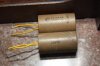
Chicago Condenser Corp capacitor value?
Register to hide this ad

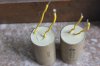
no idea, those numbers aren't any sort of value or voltage. One is an EIA code with an impossible date, no idea what the other is. 135 is Chicago Condenser, but 765 is week 65, 1957. Unless those are from some other planet with a Chicago Condenser Corp and a longer year I call nonsense on that.

The N2400 Revealed (audioheritage.org)
has a schematic for the N2400 crossover, and pics that show the same style caps. Schematic calls them out as 6 microfarad with the same part number shown on yours.
has a schematic for the N2400 crossover, and pics that show the same style caps. Schematic calls them out as 6 microfarad with the same part number shown on yours.


I wouldn't assume that the values in that hand-drawn schematic are correct. There are tons of schematics on the Internet with all sorts of errors. If those caps don't show significant DC leakage, I would assume the values you're measuring are correct. It doesn't seem likely they would both be bad and both still read the same. You could also calculate the crossover frequencies to determine if they seem correct.
Jack
Jack

kvflyer
Super Member
Exactly what Tom said. Keep in mind that they would be non-polar, similar to a film capacitors. I’m not sure of their size, but if they are large, they are probably film capacitors.Leakage can make a cap read high on many LCR meters. If you have access to a capacitor bridge (GR, Heath, Sprague, Knight etc.) they may still show close to the original value. But having removed them, I'd replace them.

Jxmos
Member
I've replaced these caps with 6uf capacitors. The new crossovers sound great. I didn't compare the old caps to the new caps for audio differences but here are the measurements of the old caps.
There are 4 Chicago Condenser Corp caps in the crossover. They're all measuring around:
Capacitance - 11.5uf
Dissipation (D) - .229
Quality (Q) - 4.35
Resistance (ESR) - 26.4 ohms
Phase angle - -77.0
Testing with a DE-5000 LCR meter. Meter set to test at 120hz.
I'm assuming capacitance and D are too high. So, the other results are out of line as well for wax paper caps?
There are 4 Chicago Condenser Corp caps in the crossover. They're all measuring around:
Capacitance - 11.5uf
Dissipation (D) - .229
Quality (Q) - 4.35
Resistance (ESR) - 26.4 ohms
Phase angle - -77.0
Testing with a DE-5000 LCR meter. Meter set to test at 120hz.
I'm assuming capacitance and D are too high. So, the other results are out of line as well for wax paper caps?
Last edited:

it is much higher than you'd expect on a modern cap, but honestly not sure if its unreasonable for a really old one. I've never measured ESR on a multi-microfarad paper cap.
may need to play with the L pad to get the tweeters sounding right. I'd expect them to be brighter with caps that have lower ESR
may need to play with the L pad to get the tweeters sounding right. I'd expect them to be brighter with caps that have lower ESR

Bradbrews
Super Member
I have caps similar to that in some JBL L36’s. Somewhere here I found they were film capacitors and seldom needed to be changed.
I checked mine for leakage and they were fine IIRC. I never did change them and have no complaints with the crossover.
Their size vs capacitance would seem to support that.
I checked mine for leakage and they were fine IIRC. I never did change them and have no complaints with the crossover.
Their size vs capacitance would seem to support that.
Jxmos
Member
Well, the speakers did work with the vintage caps. However, the crossover schematic from the link above shows them as 6uf rather than 11-12uf. I have changed them out and added two resisters to the crossover for tweeter protection. This upgrade was also mentioned in the link above.
I've only seen one JBL N2400 crossover schematic. So, I assume it is correct in that these old caps should read 6uf and not 12uf. But, if someone finds a schematic showing 12uf caps, I might consider reinstalling the old caps.....
The L pads did need just a little cleaning. Between the L pad and the preamp treble settings, I have a lot of range on the high end.
As always, thanks to ALL for your assistance!! Jeff
I've only seen one JBL N2400 crossover schematic. So, I assume it is correct in that these old caps should read 6uf and not 12uf. But, if someone finds a schematic showing 12uf caps, I might consider reinstalling the old caps.....
The L pads did need just a little cleaning. Between the L pad and the preamp treble settings, I have a lot of range on the high end.
As always, thanks to ALL for your assistance!! Jeff
The concern in this situation is whether anything reported by the LCR meter is legitimate. If we believe the caps are 6 uF, why would the meter report 11.5 uF? Capacitance doesn't increase with age unless the dielectric constant of the insulation has also increased. Personally, I've never seen that happen. And if the meter is interpreting some other characteristic as capacitance (e.g. leakage), none of its measurements can be assumed to be accurate. Not ESR, not dissipation, nothing. This also raises the question as to whether the schematic in the article above is accurate. Are the caps 6 uF, or are they 11.5 uF? The latter is within 5% of 12 uF, which might be the intended value.
Without valid technical data from JBL, only additional testing can resolve this issue. The original caps can be resonated with an inductor and their value calculated. Minor DC Leakage won't generally affect that type of measurement. The caps could also be tested for leakage, perhaps with a "real" capacitor tester or variable DC supply set to apply 50 VDC or so. That might indicate whether the digital LCR meter is being "fooled." Also, given all this uncertainty, the frequency response of the crossover should have been measured before tearing everything apart. Even if 6 uF at both capacitor locations produces a working crossover, the frequencies may be considerably skewed from their original values.
Jack
Without valid technical data from JBL, only additional testing can resolve this issue. The original caps can be resonated with an inductor and their value calculated. Minor DC Leakage won't generally affect that type of measurement. The caps could also be tested for leakage, perhaps with a "real" capacitor tester or variable DC supply set to apply 50 VDC or so. That might indicate whether the digital LCR meter is being "fooled." Also, given all this uncertainty, the frequency response of the crossover should have been measured before tearing everything apart. Even if 6 uF at both capacitor locations produces a working crossover, the frequencies may be considerably skewed from their original values.
Jack
Similar threads


- Replies
- 4
- Views
- 853

