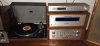
On turntables, the great can be the enemy of the good. I have a vintage Technics SL-20 in one of my systems. It was the budget table in Technics’s product line in 1977. It has no suspension, and the fixed tonearm is indeed rather loose and rattly.
It’s easy to do much better. But, at well under a hundred bucks, and with a properly aligned and adjusted $35 Grado cartridge, it takes care of the LPs and it makes music.
My main table is a Thorens TD-166 Mk II. This was the lower-line table in a line of high-quality tables. It’s very easy to spend more and do better. But when properly set up, it takes a LOT more to be noticeable better, even with its TP-11 tonearm. I paid $300 for it. $35 for a new belt, a few hours making adjustments (including just the slightest tightening of the tonearm bearings), and a $90 Grado cartridge and for around $400 it makes music.
The next step up might be something like a VPI Scout, or a used and carefully reworked Linn. But I doubt I’ll take that step.
35 years ago, the high-end audio shop in my locale demonstrated three tables to me: My Technics SL-20 (on which they had just installed and aligned the Grado cartridge), a Rega Planar 3, and a Linn Sondek LP-12. Each one was noticeably better than the one lower down. The better tables added clarity, like cleaning dirt off my glasses. But we all agreed that even the cheapie allowed the beauty of Rachmaninoff’s 3rd Piano Concerto, and the sensitivity with which it was being played, to be revealed.
That’s why I say there is a reasonable solution at just about any price point.
Rick “who kept his old LPs” Denney



 .
.