
Mystic
We're all born mad
This is what my brother uses and I think it sounds great.My Biforst has more clarity on both ends, mids are about the same.


This is what my brother uses and I think it sounds great.My Biforst has more clarity on both ends, mids are about the same.
I have a JVC 6+1 changer. It works fine, and it has RCA and DAC outputs. The fact it has a DAC output is what got me to thinking about an external DAC.A CD player can be substandard in at least two ways:
1: Its internal DAC, obviously.
2: How well it mechanically acts as a transport.
If it is a substandard transport mechanism I don't think an external DAC will help that much, at least in my experience. Garbage In, Garbage Out.
FWIW I'm very happy with my Schitt Modius, (and I rip my CDs to a hard drive and use a Raspberry Pi for the source).
JVC XL-M705. I think it was about their totl circa 1990s.Which CD player do you have? -This is key to answer your question properly.
Thanks for the tip and the link. Haven't decided yet but this may be the way I go.I've had 6 DACs and still have 3 including the two cheapies. My current DAC is a Topping E30 that does HiRez and may be my destination DAC as it suits me well and allows me to listen to HiRez and DSD files. It's probably about 3 years old and I doubt I'll be upgrding unless there's a quantum leap in technology that opens new doors and provide real and noticably substantial differences to my old tired ears.
Here's a listing for the newer E 30 II version. It's very reasonably priced considering the marvelous world of HiRez streaming it opens. No affiliation and it provides musch tech info too.

One of our fellow AKers had pretty much given up on CDs until he got a TOL "vintage" player. Seems to have changed his view of CDs. If you already have one you may be golden.JVC XL-M705. I think it was about their totl circa 1990s.
Nice CD player, shame it doesn't use their K2 technology, despite that, I think you'll be surprised by how good the onboard DAC really is.

This limiting of potential you speak of. Is that;Try some other DAC's ..
Use your ears ..
It's all a system .. What you're listening to is limited in one way or another by every piece in the system ..
The JVC is your source component .. If the JVC"S DAC is limiting (likely) what you hear, you'll never know the potential of the rest of the system.
Try a couple DAC's that allow returns .. and I'd recommend a pair of good interconnects to go along with it ..
If everything sounds better, it'll be well worth it ..
This limiting of potential you speak of. Is that;
-Noise
-Distortion
-Dynamic range
-Frequency response
?
Also; I couldn't find any information about the DAC in his CD transport other than it was a special JVC chip. It seems you know more about it than I could find if you think it is a bottle neck in his system.
Of course. But that hardly answers the questions why you seem to think the existing CD player/DAC is "garbage". JVC made some pretty great CD transports.Garbage in ... garbage out ..
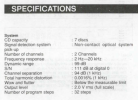
Surely it means that it is technically capable of exceeding the DR of a red book CD std. so that the chip and circuit is not the limiting factor of the source. The chip is 20-bit.I can't see how a 16bit system can have '99dB dynamic range' so I wonder how it was measured.

Tone and timbre, being two sides of same coin, can be measured just fine. Impact.. What do you mean by this?I've listened closely to many DAC's ..
They all differ in tone, timbre, and impact ..
Depending on the resolution of the downstream, and the listener's hearing acuity, those differences may or may not count to the listener ..
Music is subtle and most of what's musically important isn't measurable with anything but an ear ..
Which measurement differentiates a Martin guitar from a Gibson ??
I can certainly hear the difference and I like a system that is good enough to reproduce those subtleties ..
Try a different DAC or three .. It's the source component that produces the details, and the rest of the system can't reproduce what isn't there. ..
(and incidentally those CD player's DAC's have been sounding different from each other since their introduction in the 80's)

I've listened closely to many DAC's ..
They all differ in tone, timbre, and impact ..
Depending on the resolution of the downstream, and the listener's hearing acuity, those differences may or may not count to the listener ..
Music is subtle and most of what's musically important isn't measurable with anything but an ear ..
Which measurement differentiates a Martin guitar from a Gibson ??
I can certainly hear the difference and I like a system that is good enough to reproduce those subtleties ..
Try a different DAC or three .. It's the source component that produces the details, and the rest of the system can't reproduce what isn't there. ..
(and incidentally those CD player's DAC's have been sounding different from each other since their introduction in the 80's)
yes, +2 for comments. The better DACs blow away any chip set you are going to find in a stand alone CD player. There are many more factors besides the chip set that impact sonics such as PS noise, clock accuracy, components used in the analog out section. It becomes one of those 2 second tests.

FWIW, For over 10 yrs. I`ve been using a high quality INDAY 4X1 switcher (DA4X-R) that is made on the west coast of the USA.Even if the DAC only has one digital in it's fairly easy to add a switch for another device ..
