Does adding weight to headshell increase tonearm effective mass?

Marc: Imo, that's a semantical debate - i.e. it depends, whether "friction" is supposed to refer to the friction coefficient or rather to the friction force. So more mass on the sled certainly means higher friction in the sense of friction force, just not due to a higher friction coefficient, but due to a higher normal force.

Greetings from Munich!

Manfred / lini
 
@tnsilver. If we keep aside footfalls, which is a totally separate problem, and most might not have any problems with that, I have none; and look at the res freq as a measure of the output at very low frequencies. What we will see is that the res is decided by record warps, vertically. The bass output at low freq is lateral.
That means it can be very beneficial to have a totally different eff mass laterally than vertically. Record warps have a peak velocity at 4Hz, and at say 12Hz there is very little left of the warps. Therefore 12Hz vertical res could be good.
Laterally possible disturbing frequencies are much lower, there would no problems choosing a res freq at 4Hz for the lateral resonance. This would make the arm much more sturdy for low bass reproduction.
So I would say, 12Hz vertically, 4Hz laterally, FWIW.
 
Marc: Imo, that's a semantical debate - i.e. it depends, whether "friction" is supposed to refer to the friction coefficient or rather to the friction force. So more mass on the sled certainly means higher friction in the sense of friction force, just not due to a higher friction coefficient, but due to a higher normal force.

Greetings from Munich!

Manfred / lini
Nope, confusing friction with the inertia to overcome it. trying to use, understand two different forms of energy with one formula won't work. One must understand both forces of energy, apply both sets of rules. Friction is overcome at the "moment of motion" , mass is overcome at the "moment of inertia"

Strong force, weak force, electromagnetic, gravity. Them's the four. The first two have nothing to do with this conversation. The second two are about 99.999999999999999999999999999999999999999% of every thing else. Adding mass does not add friction, it adds downforce, and the amount of inertia to overcome the downforce. Friction is ruled by the electromagnetic force, inertia(mass) is ruled by the force of gravity.

To move some mass, or to accelerate it, it´s about force.
 
=Friction is ruled by the electromagnetic

So when I generate friction by my palms together quickly to the point they get hot, how is that electromagnetic? Tires rolling on pavement? Nothing electromagnetic that I can see

and Gusten,once a object is in motion, there is still surface friction ??
 
So when I generate friction by my palms together quickly to the point they get hot, how is that electromagnetic? Tires rolling on pavement? Nothing electromagnetic that I can see

and Gusten,once a object is in motion, there is still surface friction ??

Yes, if we´re talking about an object sliding on a surface, there will be a friction coefficient that has to be overcome, in translation motion, it will need a force to continue sliding; but moving a TT arm, it´s very much acceleration and retardation forces.
 
So when I generate friction by my palms together quickly to the point they get hot, how is that electromagnetic? Tires rolling on pavement? Nothing electromagnetic that I can see

and Gusten,once a object is in motion, there is still surface friction ??

Hmmmm. what do you suppose is causing the heat?. Regarding rolling tires. Rolling resistance of a tire, provided the rubber is not slipping on the pavement, the friction of the rubber is static friction, and not kinetic friction. in (most) every case, kinetic friction is lower than static friction.
To move some mass, or to accelerate it, it´s about force.
Correct, the force to cause either it to pass that "moment" either in "moment" of inertia, or "moment" of motion. once either is passed, it is no longer "static", but "kinetic"
 
I don't see it being electro magnetic being flesh and bone

what's the force in the universe that hold two atoms together to form a molecule? hint, it's not gravity.

edit: although it may appear in print as such, I'm not trying to be an a$$hole with my replies.
 
Correct, the force to cause either it to pass that "moment" either in "moment" of inertia, or "moment" of motion. once either is passed, it is no longer "static", but "kinetic"

We need a force to set things in motion, which is an acceleration force, we also need a force to be able to continue that motion, which is a static force.
 
what's the force in the universe that hold two atoms together to form a molecule? hint, it's not gravity.

edit: although it may appear in print as such, I'm not trying to be an a$$hole with my replies.


Never thought you were, it's be almost 30 years since I was in college and have forgot most of it LOL

From what I remember, it is kinetic friction, not electromagnetic
 
@tnsilver. If we keep aside footfalls, which is a totally separate problem, and most might not have any problems with that, I have none; and look at the res freq as a measure of the output at very low frequencies. What we will see is that the res is decided by record warps, vertically. The bass output at low freq is lateral.
That means it can be very beneficial to have a totally different eff mass laterally than vertically. Record warps have a peak velocity at 4Hz, and at say 12Hz there is very little left of the warps. Therefore 12Hz vertical res could be good.
Laterally possible disturbing frequencies are much lower, there would no problems choosing a res freq at 4Hz for the lateral resonance. This would make the arm much more sturdy for low bass reproduction.
So I would say, 12Hz vertically, 4Hz laterally, FWIW.

The Dynavector tonearm is designed with this in mind.
 
The Dynavector tonearm is designed to address this.

Yes, there are also others, like Moerch. Personally I think this design is very good. I have also done tests of this design myself, but only down to 6Hz laterally and about 10Hz vertically, combined with some damping, I like it.
 
I don't see it being electro magnetic being flesh and bone

That's where you get into my kind of physics. ;)

Friction is absolutely electromagnetic.

But it's at the atomic level.

Generally, it's like this.

Every atom of everything you can see, or not, has a nucleus and electrons.

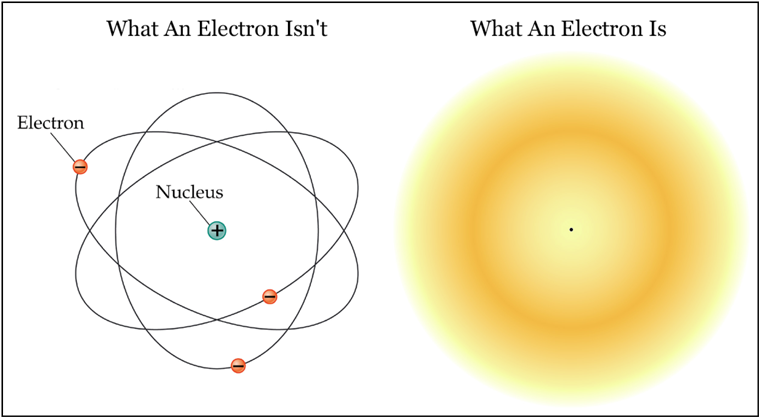
We'll borrow this image from Northwestern to help convey the idea.

e-clouds.png


Though throughout the 'Atomic Age' it was conveyed to the general public like the image on the left - a lot of MCM designs used that idea - Jetsons and George Nelson atomic clocks - it was actually only sort of correct.

The electrons of an atom actually form more of a cloud(shell) around the nucleus, like the image on the right. We know where the shell is for each level of electrons. Finding the electron in that shell has been a bit more challenging - has a bit to do with Heisenberg's Uncertainty Principle. And in the case of that cloud, MCM designs would never have looked as cool as they did.

Hydrogen being one proton, and one electron is first in the periodic table (PT). Its one electron floats around the nucleus in a shell. Oxygen, being 8, has 8 electrons. Two of those electrons float around on an inner shell, and the other six, float around on a second shell farther out. The higher we go up the periodic table, the more electrons and shells we get. There's an order to it though. The first shell always tries to have 2 electrons in it, the second wants 8, and so on. Hydrogen only has one electron, but it tries to fill its empty electron by creating a bond by borrowing an electron - in the case of another hydrogen it forms a hydrogen bond H2 - or in the case of water, H2O the two electrons of the paired hydrogen fill the two empty spaces in the oxygen's shell - they share the electrons, creating a bond. The more electrons they share, the stronger the bond.

Ok enough of the boring nerdy stuff.

Now that we've explained atoms and the electron shells, here's how it applies to friction and heat:

When your hands are rubbing together to create heat, they're actually not really touching. Nor are you touching your chair when you're sitting. The electrons have a negative charge and are repelling each other, like trying to push the same poles of two bar magnets together.

When the electron clouds of the atoms of your hands, it this case, encounter each other, they squash in a bit because they are trying to repel each other. As you move your hands, the clouds are constantly squashing in repulsion and then springing back. This mechanical energy of the electron clouds squashing and expanding creates heat as a by-product. Spread over the enormous amounts on atoms on each hand, there's enough heat from this mechanical energy to be sensed by nerve endings which then trigger electrical impulses to inform the brain that it feels heat - and that's where you get into biology, and I start to drift from my realm of science. LOL

 
Never thought you were, it's be almost 30 years since I was in college and have forgot most of it LOL

From what I remember, it is kinetic friction, not electromagnetic

correct, it is friction, which is in the study of electromagnetism, and not in the study of gravity.
 
Friction is a really messy topic. Published numbers rely on various standardized tests, and are typically at much higher loads than you 'll find in a tone arm. They also use big enough samples that surface finish can be more or less factored out. Even with everything well controlled, getting identical results from any given test is rare. We usually take coefficient of friction as a constant, but it's far from it. It's surface finish dependent, lubricant dependent (and there's always some form of lubricant present, intentional or not), temperature dependent, humidity dependent and even load dependent. One interesting case is with plastic bearings. As the load goes down, the coefficient of friction goes up, sometimes a lot. In something as small as a tone arm bearing, and at the low loads they work at, I'd be wary of making any blanket statements or predictions, preferring to just get the friction as low as possible and minimize the number of bearings. Unipivots have a huge advantage there.

We have a local lab that does friction measurements. For the curious, they show an equipment list and have some published papers- http://www.budlabs.com/ (no affiliation, though my employers have used their services in the past).
 
Back
Top Bottom