• The move to the new server is done. There are some software and database maintenance updates in process. This has us passing the hat around to help out. We appreciate any donations. Seriously, even a dollar helps. The payment page may be found here - https://www.audiokarma.org/support.html

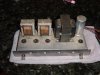
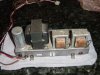
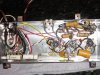
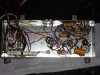
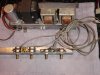
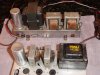
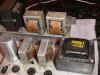
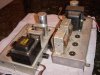
Does anyone recognize this??

Wharfcreek

Jack of all trades, master of none!!
Staff member
Moderator
Subscriber
Trying to identify Make, Model, and possibly find a schematic. SE EL84 stereo (console?) amp. Had 12AX7 driver, 6CA4 rectifier. Many thanks, WC
 

Attachments

  • DSC00167.jpg
    DSC00167.jpg
    80.5 KB · Views: 148
  • DSC00168.jpg
    DSC00168.jpg
    87.3 KB · Views: 86
  • DSC00169.jpg
    DSC00169.jpg
    113.8 KB · Views: 99
  • DSC00170.jpg
    DSC00170.jpg
    93.3 KB · Views: 74
  • DSC00171.jpg
    DSC00171.jpg
    75.2 KB · Views: 82
Register to hide this ad
Probably a record player or console amp, but I'm thinking it's had some serious rework. Really old caps etc, newer wiring. Transformers are good sized, bolted to chassis, holes not in right place for wiring. Just guessing of course. Could be a real performer.
 
Hi tom3,

Thanks for the response. Actually, I think this thing is 100% in it's original condition. You're probably right..... probably an old console record player amp of some sort. It came with a 'control' head...... a completely passive unit with no tubes in it at all. I found that rather odd, as it didn't seem to me that a control head without any 'gain' in it would be all that effective....... unless it's matched up to some kind of higher gain 'crystal' type phono cartridge maybe?

Anyway........ hopefully someone will know this unit and provide a 100% ID.

WC
 
Based on the 606 028 on the output transformers they are Woodward-Schumacher mfd (EIA code=606), and probably circa 1960.

Is the same EIA code on the power transformer?
 
Capitol Records 928 is very close, with controls on chassis. 932 is even closer, with no controls. BUT the position of the can cap and PS transformer are swapped. I'll look it up and see if the transformer number (AT-61) agrees.
 
Last edited:
I'd have guessed its out of a portable. That cord would be what I expect to see plugged into a record changer. Might be out of a small or cheap phono-only console though. Ceramic cartridge, all that jazz. Would be a dead simple stand-alone conversion I expect. Find the proper 2 wires in that cord to put a switch between, stuff some tubes in, off you go. Probably two 6bq5 and a 12AX7 plus a 6CA4 rectifier.
 
I've never seen a 'dolly' before.......but seems it's got the makings of a pretty nice little amp! Probably got the biggest OTs of any little SE EL84 amp I've ever run across. I'm hopeful I can come up with a 'formal'' ID....... but I'm anxious to 'plug it in' too. Guess hearing it will be the moment of truth!! WC
 
Judging from the layout and spacing of the tube sockets....chassis looks to be about the same size as a Magnavox 8601 amp....5" x 8 1/2", but the OPTs look to be more than twice as big as the ones on the maggi.

They look very beefy. :D
 
Here's some shots that kind of A / B this mystery amp w/ a Maggie SE EL84 cousin. Also including a shot of the passive control section. Still can't find any ID marks. The OTs on this amp look nearly twice the size of those on the Maggie. 'Interesting!!' WC
 

Attachments

  • DSC00199.jpg
    DSC00199.jpg
    100.9 KB · Views: 34
  • DSC00195.jpg
    DSC00195.jpg
    99.5 KB · Views: 28
  • DSC00196.jpg
    DSC00196.jpg
    93.2 KB · Views: 24
  • DSC00197.jpg
    DSC00197.jpg
    89 KB · Views: 21
  • DSC00198.jpg
    DSC00198.jpg
    86.8 KB · Views: 38
If the output transformers are also Woodward-Shumaker (EIA code 606), you may be pleasantly surprised. I have a Hoffman console with a set that I like very much. They are the largest 6bq5 push-pull console transformers I've ever seen. It actually looks like a real transformer, not one of the typical mighty-midget types you see on a typical console. My Pilot SA-260 also sports a set of Woodward iron on it.
 
The Capitol 928 does look similar, but transformer numbers are different. Power is 200-001, outputs are 205-004. Same arrangement, with a separate passive control panel, and AC and changer cords, input and 3-pin speaker jacks are in the same locations. Though transformer and cap / EZ81 positions are swapped. Somebody else probably built Capitol's equipment for them - I doubt they set up their own manufacturing.
 
Hello Tom,

Well, who ever built the Capitol unit probably built a 'mirror' unit for someone else? Do you by any chance have...... in that massive information vault of yours..... a 'schematic' for the Capitol 928? If so, maybe I could compare it to my unit and see if 'electrically' they match up? Just a thought.........

Thanks Tom!

TSD
 
Bit of an update on this 'Mystery' amp: I finally gave it some time on a Variac, then took it for a test drive. Unfortunately, it didn't quite live up to my hopes and expectations. However, I'm a bit 'suspect' of the multi-cap.....and have gone ahead and ripped the thing half apart in order to 'extract' the current one, do some 'testing' on it alone, as well as evaluate the rest of the amp. The multi-cap spent some time on the Tel-O-Mike Cap tester.....re-forming and basically being brought back into 'spec'. And, while it now passes the Cap-tester process, I'm still not sure but what it's the source of the problem. I've had other multi-caps that have shown to be 'good' as related to leakage...and even show as having the proper 'uf' on the other tester. BUT, when loaded and working....they break down. Replacement cures the symptoms.......so I think I'm going to simply replace this one. I also did some checking on the 6CA4 rectifier....and according to the data sheets, when used with a 'cap' input on a PS filter...the MAX cap load is rated as 50uf. This amp had the first stage as being 60uf. Perhaps that's because the voltage was down a bit from there the 6CA4 is rated? Anyway, I found that JJ makes a 47 uf at 385VDC....which seems about perfect for this amp. The original can cap had the first section at 400 V.....so....I'm just going to rebuild the PS with one 'can' cap in the original position, and use a few axial's to complete the re-build. Plenty of room underneath.

What I do NOT understand....is the REALLY complex feedback circuit in this amp!!! I took a couple of close-ups of that part of it...which I will post shortly. But, if you take a look at the prior pics, you can see some wax caps and resistors, all of which are part of the feedback network. There are two .01 disc caps used for coupling the AX to the O-tubes. But, there are more passive parts in the feedback network than there are in the signal path in the amp itself. And, I'd like to 'simplify' that as well.........so if anyone has any ideas about that, as always, please let me know.

OK.....that's it for now. Nearly 4 am, and I should probably try to get some sleep.


WC
 
Having a higher than rated value might make the rectifier die an early death. Thats about it. Thats also only if its at maximums for the other ratings. If you're not pushing the voltages to the limit, then you can get by with a little more value on the cap. Also, consider the tolerances on those old caps. One marked 50uf may well have tested at 60uf and still been considered fine. Then again, a 60uf may test OK at 50uf.
 
I'll send you the Capitol schematic - may be close. The caps in the feedback network should go - they're used to equalize the overall response of the record player - this includes the cartridge, passive controls (when centered, they're not flat) and the speakers. You want a flat response with the amp alone.
 
Saturday Update to Friday Work: Nearing being 'done' with the amp! Spent a great deal more time on it yesterday, and now have it 'almost' completed! I believe Mr. Bavis has properly ID'd this amp as being a Capitol, so hence forth I shall refer to it as such. Thanks Tom!! So, I reinstalled the OE multi-cap after much time on the Tel-O-Mike pretty well confirmed that all 3 of the HV sections were good. HOWEVER, I also found that the LV section for the Cathode Bypass on the output tubes was shot. So, in re-installing the cap, I clipped that lug off of it. It was a 50uf/25V section, and I had a 47uf/50V axial here so; Problem Solved!!

Once all that was re-connected, I put tubes back in and gave it another test drive. Aside from some low-lever PS related hum, it sounded pretty good. A bit 'screechy'....or too-much-bite on the high end, but a reduction in my treble settings took care of that. So, on to the all-important A/B test against the venerable Magnavox 8600. Out came the tubes, and the 8600 went on to the bench. I'd note that some time back I'd completed my 8600 and also re-wired the driver tube socket for a 12AX7. It also had a bad multi-cap, the exact opposite of this one; all the HV sections were bad, but the LV section was good. Anyway.....in hooking up the Maggie, I noted that I again had to turn my treble control back 'up' in order to get my desired level of HF. Maggie sounded good! I then remembered that in doing some past tube-rolling with the Maggie and yet another SE-EL84 amp, I found that using a 12AU7 as a driver improved the sound even more. So, I pulled the AX and plugged in an AU, and 'YUP!!' ...... big improvement! For some reason,t the AX 'over-drives' more quickly than the AU. With the AU in the front end, I'm able to get more gain and better frequency response (more bass with less distortion). The Maggie was now CLEARLY sounding better than the Capital amp.

So, I now pulled the tubes from the Maggie, and reinstalled them in the Capitol amp, using the AU instead of the AX. Hooked up the speakers, turned it on, and 'SMOKE' from underneath!! DAMN!! I'm an IDIOT! I neglected to remember the tube line up in the Capitol was NOT the same as the Maggie....and I had a 6BQ5 reversed with the 12AU7 and I smoked the PS feed resistor in the B+2 to B+3 stage! Fortunately, it was a 1200 ohm / 1W, and I had a 1500 ohm / 5 W. So, all is now back to good!

With the 12AU in place, the Capitol sounded MUCH better as well. I then decided to supplement the PS B+2 and B+3 stages by bridging a 22uf/450V cap across each. This not only helped reduce the existing PS hum to now nearly inaudible levels, but also helped with providing further PS reserve for some added bass and transient response. In all, the Capitol now sounded better than the Maggie: it played louder, and basically had the same bottom end. HOWEVER, the 'sibilance' issue still exists....and I'm not sure just what that is. I still have to turn down the treble some in order to reduce the perceived 'bite' on the high end.

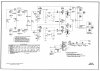
I'm posting the schematic for this amp....and maybe someone can take a look and see if they note anything that might be affecting this. I'm also wondering about the significance of the dotted-line boxed-in K1 and K2 sections? What's that all about about? Those look a bit 'complicated' for this kind of amp, and I'm thinking maybe some simplification here would help with the 'tonality' of the unit.

So, after finally installing a 4-lug screw terminal for the speakers....it's now pretty much 'done'!! I'll also post some final pics....but let me end here by thanking everyone for their contributions. As always, I appreciate the help!! Tom D.
 

Attachments

  • Capitol_932_sch.jpg
    Capitol_932_sch.jpg
    283.6 KB · Views: 23
try a 5751 sometime. it has the proper plate resistance and such for a 12ax7 sub but with less gain.


Did you take out the caps in the feedback loop that Tom suggested? Those would be C4 and C5 and C8 and C9. I think you'd want to jumper C5 and C9, and remove the other two. I might also consider replacing the PEC assembly with individual parts, or at least making sure the resistors and the coupling cap test OK. The small value caps aren't critical values. They should be there for stability reasons.

That 6.8 meg resistor on the input grids is also a bit higher than I'd use. Its probably more for the passive tone circuit, but you could make that a 1 meg and not affect anything. Might make it less sensitive to hum pickup though.

Another hum reduction suggestion. Not sure how practical it would be, but maybe re-wire the heater circuit from having a "hot" and a chassis ground to having 2 wires for the heater circuit without a connection to ground. Take a 100 ohm resistor from each heater leg to the cathode of the output tubes. That will balance the heaters relative to ground, and give some DC voltage on the circuit. It also gets rid of all that current running through the chassis to induce noise in other things. Make sure you twist the wires if you do this, it will help cancel out the hum fields.
 
Gadget,

I completely overlooked Tom's suggestion on those caps. I'll make those changes shortly.

When you mention 'Pecs'..... this unit doesn't have those, but perhaps that's what was indicated by the 'K1' and 'K2'? Mine is all discrete parts......no PECs.

I was wondering about that 6.8 myself. I'm used to seeing something like a 470K to ground off the input, with either a small cap to the RCA, a 47K, or even just a straight wire. So, maybe some more attention in that area.

Finally, the amp is wired with discrete filament leads...... so no common wire on the chassis even though it's shown that way on the Schematic. But, no 100 ohm resistors on the ends.....so, that's a good idea. I'll give that a try as well. The 'hum' is noticeable even with the inputs 'grounded'....which is my usual test for PS hum vs 'input' hum. But, I often fail to consider the affects of hum through the filaments.....as you've aptly pointed out to me in the past. So, again, I thank you for again bringing this very important consideration area to my attention!!

I'll up-date again after changes. ..... OH, '5751'..... pretty readily available? I have none of such tube..... so guess I'll go try to score a couple....

TSD
 
yeah, the dotted box things would be the PEC. Discreet parts are a plus, you can actually test those


5751's aren't terribly hard to source. I picked up a pair of nice GE ones at an antique radio show for 10 bucks each that had been tested and marked with the results for each triode section. They're an industrial low noise type, but have a gain of 70 vs 100 for the 12ax7. They are otherwise about identical.
 
Back
Top Bottom