• The move to the new server is done. There are some software and database maintenance updates in process. This has us passing the hat around to help out. We appreciate any donations. Seriously, even a dollar helps. The payment page may be found here - https://www.audiokarma.org/support.html

Dual Binding Posts a Marketing Gimmick?

My thought exactly. Probably more of manufactures trying to please those that base part of their opinion on if the speaker has dual posts than trying to fool people into thinking it is something special.


Every test I've seen of Klipsch bookshelves show they are about average for efficiency; 8 dB or so below what they claim. Apparently they use a different method for figuring their speakers efficiency that makes them look better.

Wow. Never seen this claim before.

What method do they use?
 
I've never tried bi-amping anything but I tried bi-wiring my B&W CDM-1s and could hear absolutely no difference in running single speaker cables and jumpers between the two sets of binding posts.
 
Focal has done away with dual binding posts on all of their newer speakers except for their Utopia III Evo line, and that's just extra lipstick that people who are able and willing to spend $100k plus for a speaker system expect. That should be an indication on how important they really are. Not much.
 
Last edited:
Some like to use tube power for the tweeters and ss power for the woofers.
Tubes for the high end and midrange, SS for bass. You need a stiff power supply with a SS rectifier and big power tubes to get good controlled bass at higher volumes in a tube amp. One of the best tube setups I ever heard was all cutom built by a sound engineer. Top end down to upper bass was all tube, midbass down was SS.
 
Regarding bi-wiring, it would be interesting to see how many speaker manufacturers actually recommend bi-wiring in their manuals/literature -- that might provide more insight into whether they believe there is any benefit to bi-wiring.

There is very different current flow going down each pair of wires with bi-wiring -- whether that makes any audible difference (beyond halving the resistance) is very much open to question. I don't put too much thought into these types of decisions -- I just bi-wired my mains with 10-gauge for 8-foot runs. Complete overkill, but only cost about $60 to build, so why not? I didn't expect much difference, so I didn't even try to compare "before and after" sound. Pure copper non-esoteric speaker cable is very inexpensive, not much reason to not go with larger gauge and even bi-wire if you have the space for the bulkier wires.

I'm so much happier with the clarity of that system now, after moving to a tube amp that, if I were to do the speaker cable change now, I would definitely try do more of a before and after test to see if I could hear any difference. However, it isn't easy to switch physically back and forth between 14-gauge single wire and 10-gauge bi-wire (which are essentially the size of jumper cables).
 
Tubes for the high end and midrange, SS for bass. You need a stiff power supply with a SS rectifier and big power tubes to get good controlled bass at higher volumes in a tube amp. One of the best tube setups I ever heard was all cutom built by a sound engineer. Top end down to upper bass was all tube, midbass down was SS.

I've never had the inclination to bi-amp. In fact, having never owned electrostatic or other highly inefficient speakers, I've never felt like I ever owned an amp that didn't have enough power, even with smaller amps. I have 13-wpc tube power for my main system, and I've never felt like I've needed more. Of course, I have a powered sub in that system, which would seem to largely emulate bi-amping, since a separate, high-power SS amp is powering the deepest frequencies.

Having never tried bi-amping, one question I've always had is: How do you ensure you have the exact same gain when using different amps to drive the bass and high frequency speaker circuits? It seems like any tiny mismatch in gain would cause bass/treble balance to vary as you change volume level.
 
I've never had the inclination to bi-amp. In fact, having never owned electrostatic or other highly inefficient speakers, I've never felt like I ever owned an amp that didn't have enough power, even with smaller amps. I have 13-wpc tube power for my main system, and I've never felt like I've needed more. Of course, I have a powered sub in that system, which would seem to largely emulate bi-amping, since a separate, high-power SS amp is powering the deepest frequencies.

Having never tried bi-amping, one question I've always had is: How do you ensure you have the exact same gain when using different amps to drive the bass and high frequency speaker circuits? It seems like any tiny mismatch in gain would cause bass/treble balance to vary as you change volume level.
My favorite tube amp is a 17wpc Dynaco ST-35 clone.
 
Definitely just marketing. It started several years ago, and really solves nothing.
But speakers manufacturers are now expected to have them.
 
You would have to see a schematic of the entire network to know what exactly the dual binding posts are doing to determine if it is cosmetic, gimmicky, functional….

In some cases highly functional, in other cases utterly useless.
 
Having never tried bi-amping, one question I've always had is: How do you ensure you have the exact same gain when using different amps to drive the bass and high frequency speaker circuits? It seems like any tiny mismatch in gain would cause bass/treble balance to vary as you change volume level.
Never noticed a mismatch that changes with volume level. But the each amp having its own gain, I set-and-forget with an rta looking for a flat response. Then adjust volume on the fly with a “master volume” which is really “input level” on the active crossover.
 
Regarding bi-wiring, it would be interesting to see how many speaker manufacturers actually recommend bi-wiring in their manuals/literature -- that might provide more insight into whether they believe there is any benefit to bi-wiring.

I read your question and it made me really curious, so I turned to a couple sources that I personally have really enjoyed and trust and might call "no-BS" or close to it ... Snell, Polk, and Vandersteen (each of which have speakers with dual binding posts I would hope not as a gimmick...)

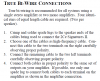
First, I was curious to see what Snell might have said, given how impressive Snell products are (especially while Peter Snell was alive) and I found this tidbit in an owner's manual available here: https://www.audio-occasion.qc.ca/pdf/manuels/Snell_acoustics.pdf.

upload_2022-7-23_15-23-37.png

Second, here's what Polk has to say in its SDA 1.2TL / 2.3TL / 3.1TL owner's manual:

upload_2022-7-23_15-33-44.png

upload_2022-7-23_15-34-15.png

And from the Vandersteen 2CE Signature II owner's manual ...

upload_2022-7-23_15-36-42.png upload_2022-7-23_15-37-40.png

upload_2022-7-23_15-38-26.png

All that said, it's interesting because I've run bi-wire and not bi-wired and my ears aren't good enough to notice any difference at all ... but maybe I haven't been listening critically enough? But, I use the same kind of cable for low & high, and there's reference of different cable optimization for different frequencies. Maybe that's what I've been missing.

 
Last edited:
I read your question and it made me really curious, so I turned to a couple sources that I personally have really enjoyed and trust and might call "no-BS" or close to it ... Snell, Polk, and Vandersteen (each of which have speakers with dual binding posts I would hope not as a gimmick...)

First, I was curious to see what Snell might have said, given how impressive Snell products are (especially while Peter Snell was alive) and I found this tidbit in an owner's manual available here: https://www.audio-occasion.qc.ca/pdf/manuels/Snell_acoustics.pdf.

View attachment 2622274

Second, here's what Polk has to say in its SDA 1.2TL / 2.3TL / 3.1TL owner's manual:

View attachment 2622283

View attachment 2622284

And from the Vandersteen 2CE Signature II owner's manual ...

View attachment 2622285 View attachment 2622286

View attachment 2622287

All that said, it's interesting because I've run bi-wire and not bi-wired and my ears aren't good enough to notice any difference at all ... but maybe I haven't been listening critically enough? But, I use the same kind of cable for low & high, and there's reference of different cable optimization for different frequencies. Maybe that's what I've been missing.

In the first example above the only difference, I see is instead of the jumper strap on the speaker connecting the highs from the lows you are just putting it at the amplifier as both are still connected into the same output. so this wouldn't isolate them as described, it just moves the jumper to a different point.
 
In the first example above the only difference, I see is instead of the jumper strap on the speaker connecting the highs from the lows you are just putting it at the amplifier as both are still connected into the same output. so this wouldn't isolate them as described, it just moves the jumper to a different point.

The current is definitely different and isolated for the low/high wires in bi-wiring. I know it all seems like one big short circuit and it doesn’t matter whether you do it at the speaker or the amp outputs, but that is not the case at all because current is drawn from the individual and unique speaker loads, not pushed from the amp. The low and high wires will have only the current for the low and high speaker elements, whether that makes an audible difference I don’t know.
 
Gimmick all the way! Noted designer John Dunlavy said his speakers only included them to satisfy market demand.

Active biamping is an entirely different topic!
 
My thought exactly. Probably more of manufactures trying to please those that base part of their opinion on if the speaker has dual posts than trying to fool people into thinking it is something special.


Every test I've seen of Klipsch bookshelves show they are about average for efficiency; 8 dB or so below what they claim. Apparently they use a different method for figuring their speakers efficiency that makes them look better.

Yes, at the lower end of the market dual binding posts are bling.

Most specifications are fudged to get the marketing desired. Klipsch has always banked on sensitivity and horns. In the old days when big boxes were tolerated, life was easy. These days with much smaller enclosures and smaller drivers, not so much.

Fun story. I used to get spec sheets from the engineers for new speakers. They would have very modest power ratings. Knowing that power ratings are largely irrelevant, I would ask about rating them higher to placate the ignorant. (Used to be a much more important spec years back) I would toss him a number and we would arrive at a number we were both ok with. Sausage being made.
 
I read your question and it made me really curious, so I turned to a couple sources that I personally have really enjoyed and trust and might call "no-BS" or close to it ... Snell, Polk, and Vandersteen (each of which have speakers with dual binding posts I would hope not as a gimmick...)

First, I was curious to see what Snell might have said, given how impressive Snell products are (especially while Peter Snell was alive) and I found this tidbit in an owner's manual available here: https://www.audio-occasion.qc.ca/pdf/manuels/Snell_acoustics.pdf.

View attachment 2622274

Second, here's what Polk has to say in its SDA 1.2TL / 2.3TL / 3.1TL owner's manual:

View attachment 2622283

View attachment 2622284

And from the Vandersteen 2CE Signature II owner's manual ...

View attachment 2622285 View attachment 2622286

View attachment 2622287

All that said, it's interesting because I've run bi-wire and not bi-wired and my ears aren't good enough to notice any difference at all ... but maybe I haven't been listening critically enough? But, I use the same kind of cable for low & high, and there's reference of different cable optimization for different frequencies. Maybe that's what I've been missing.

Thanks for doing the research!! Very interesting to read their comments.
 
Back
Top Bottom