

You are using an out of date browser. It may not display this or other websites correctly.
You should upgrade or use an alternative browser.
You should upgrade or use an alternative browser.
Effects of MC Loading
- Thread starter JP
- Start date


AvFan
Super Member
I suggest this one as it is the range where most manufactures recommended loading occurs but is big enough to be able to draw a conclusion from the normalized audio.1000R vs. 10R,

My phones are embedded in my listening chair.Oh, I have an excuse: I'm a lazybag.
I.e., after JP had notified me of this thread (or respectively after I had read his notification, to be more exact), I simply googled the generator data of the Kleos and did a quick calculation - with the result being an expected ca. 0.06 dB roll-off at the upper limit of my hearing, even if the Kleos was loaded down to 1 Ohm only. So practically no chance for me to hear any difference whatsoever - and hence no need to get up from the sofa for fetching a decent headphone.
Greetings from Munich!
Manfred / lini


That's why I only use audiophile fuses. The "blown" sound is much more dynamic.A blown fuse causes a dramatic sonic alteration.
YMMV!
AvFan
Super Member
Using a SUT was touched on in the parallel thread to this one on another site and the idea was discussed that there was some benefit to using a SUT. I use Wyn Palmer's MM and MC phono preamps and I did a little experiment with three setups using my Benz Micro LP-S loaded at 750ohms: 1) MC preamp loaded at 750ohms, 2) MM preamp with 75kohm load resistor and Peerless 1:10 SUT and 3) MM preamp with 1Mohm load resistor then 900ohms primary load on a 1:15 Hashimoto SUT.
I did not make digital recordings that could be level matched but listened generally over several days to lots of records in the same volume range. I preferred the two SUT options. Is this more the design of the SUT being highlighted versus a technical advantage of having a SUT in the chain of gear?
I did not make digital recordings that could be level matched but listened generally over several days to lots of records in the same volume range. I preferred the two SUT options. Is this more the design of the SUT being highlighted versus a technical advantage of having a SUT in the chain of gear?

JP
7480 74111110101115
Using a SUT was touched on in the parallel thread to this one on another site and the idea was discussed that there was some benefit to using a SUT. I use Wyn Palmer's MM and MC phono preamps and I did a little experiment with three setups using my Benz Micro LP-S loaded at 750ohms: 1) MC preamp loaded at 750ohms, 2) MM preamp with 75kohm load resistor and Peerless 1:10 SUT and 3) MM preamp with 1Mohm load resistor then 900ohms primary load on a 1:15 Hashimoto SUT.
I did not make digital recordings that could be level matched but listened generally over several days to lots of records in the same volume range. I preferred the two SUT options. Is this more the design of the SUT being highlighted versus a technical advantage of having a SUT in the chain of gear?
SUTs are a whole different can of worms. I haven't dealt with them for many years as they don't bring anything to the table for me, but in the distant past I'd feed them with a square wave with a source impedance that approximated the DCR of the cartridge and tuned the secondary loading until the square waves were as pretty as I could reasonably make them. I didn't do much for audibility tests on any of that, but an audible interaction between a SUT and phono stage wouldn't be completely surprising.
If you can do laybacks, I'd recommend it. Without basic controls there's no way to know if what you're perceiving is in the signal.
JP
7480 74111110101115
Here's a frequency response data set for an OC9XML loaded at 1000R, 100R, 30R, and 10R. The first plot is the levels as recorded, and for the second plot the levels have been normalized at 1kHz. Before anyone gets too excited about the small variations apparent in the second plot, be sure you look at the third plot which shows three different iterations loaded at 100R- the dates/times are in the plot legend. The joys of how variable vinyl is.
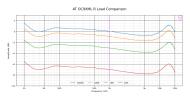
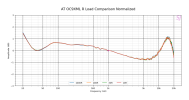
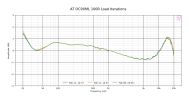
JP
7480 74111110101115
And here are the listening tests broken out so there's only two options:
Bill Evans - 1k vs. 100R
Bill Evans - 1k vs. 10R
Bill Evans - 1k vs. 1R
Steely Dan - 1k vs. 100R
Steely Dan - 1k vs. 10R
Steely Dan - 1k vs. 1R
Smashing Pumpkins - 1k vs. 100R
Smashing Pumpkins - 1k vs. 10R
Smashing Pumpkins - 1k vs. 1R
Had to skip Norah as there are a couple tracks with small tells.
Bill Evans - 1k vs. 100R
Bill Evans - 1k vs. 10R
Bill Evans - 1k vs. 1R
Steely Dan - 1k vs. 100R
Steely Dan - 1k vs. 10R
Steely Dan - 1k vs. 1R
Smashing Pumpkins - 1k vs. 100R
Smashing Pumpkins - 1k vs. 10R
Smashing Pumpkins - 1k vs. 1R
Had to skip Norah as there are a couple tracks with small tells.
AvFan
Super Member
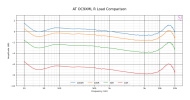
I imagine that most folks could not hear the difference in volume with the load at 100R and 1000R as it looks like they are only about 0.75dB apart. This chart matches my experience with my Benz LP-S; I couldn't hear any difference above a certain load. @JP : Do you think this pattern of changes in volume with loading occurs with most MC carts?

lini
just me...
(...) Do you think this pattern of changes in volume with loading occurs with most MC carts?
It's a pretty predictable matter of voltage division. For example, in this case cart impedance is 12 Ohm - so for the volume drop between 1000 and 10 Ohm load impedance, you'd simply calculate 20 x log ((10 Ohm / 22 Ohm) / (1000 Ohm / 1012 Ohm)) = ca. -6.75 dB.
So basically yes - but the exact pattern will depend on the specific impedance of the particular cartridge and the chosen load impedances.
Greetings from Munich!
Manfred / lini

Indeed it is. I've seen numerous plots of mc cartridge outputs with different loads and they're always as could be predicted. Unlike a moving magnet cartridge, the source impedance of a LOMC is almost pure resistance. The series inductance is just a few microHenries, ie practically nothing. That makes things very simple, with no resonant peak within the audio band to fine tune with resistance/capacitance loading.It's a pretty predictable matter of voltage division.
Last edited:
I like this!Indeed it is. I've seen numerous plots of mc cartridge outputs with different loads and they're always as could be predicted. Unlike a moving magnet cartridge, the source impedance of a LOMC is almost pure resistance. The series inductance is just a few microHenries, ie practically nothing. That makes things very simple, with no resonant peak within the audio band to fine tune with resistance/capacitance loading.

The 10X impedance ratio is an industry-standard for loading a source. Turntable to pre-amp. Pre-amp to amp.Followup questions: If loading is really just a matter of loudness, why do cartridge manufacturers specify either a minimum load or a load range for their cartridges? And why is the minimum load typically around 10X the cartridges internal impedance?
Sine wave impedance source-to-load ratio. As far as I know.
10X seems to be the most efficient ratio for audio signals --- with the least bad effect on bandwidth and noise injection.
At 10X the source impedance the signal loss (dropped across the source impedance rather than the load) is just under 1dB. I presume 1dB is arbitrarily selected as an acceptable loss.Followup questions: If loading is really just a matter of loudness, why do cartridge manufacturers specify either a minimum load or a load range for their cartridges? And why is the minimum load typically around 10X the cartridges internal impedance?
That's what I gather --- with the least amount of noise issues.At 10X the source impedance the signal loss (dropped across the source impedance rather than the load) is just under 1dB. I presume 1dB is arbitrarily selected as an acceptable loss.
Industry-standard, forever.
AvFan
Super Member
At 10X the source impedance the signal loss (dropped across the source impedance rather than the load) is just under 1dB. I presume 1dB is arbitrarily selected as an acceptable loss.
So minimizing signal loss is the lone reason to have adjustable cartridge loading? Given that most cartridges fall between 3ohm and 50ohm internal impedance then a range of cartridge loading between 30 and 500 ohms would seem sufficient. I suppose there could be a discussion of how granular those load options need to be given they just result in changes in loudness.
JP
7480 74111110101115
So minimizing signal loss is the lone reason to have adjustable cartridge loading? Given that most cartridges fall between 3ohm and 50ohm internal impedance then a range of cartridge loading between 30 and 500 ohms would seem sufficient. I suppose there could be a discussion of how granular those load options need to be given they just result in changes in loudness.
Could be helpful if one has a phono stage that has issue with RF - would still like to know of one as it could be interesting to play with. There's also the notion of "dynamic braking", i.e. a higher load damping the cantilever, which I've also not seen any strong evidence for. And as previously mentioned, the target market thinks it's needed and that it makes a big difference.