

You are using an out of date browser. It may not display this or other websites correctly.
You should upgrade or use an alternative browser.
You should upgrade or use an alternative browser.
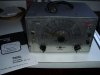
Eico 377Audio signal generator...
- Thread starter knockbill
- Start date
Register to hide this ad

knockbill
Lunatic Member
Got it cleaned up pretty good, even got some of the deep scratches sanded out... Best part, tho is the voltages are not too far off, probably due to higher line in...Let it run for a few hours, and it stayed pretty stable, so I calibrated it... Generates nice crisp waveforms... I'm not sure how old it is but it uses all octal tubes and they are marked Eico...
Now to study the manual, and make good use of it!!!
Now to study the manual, and make good use of it!!!
Attachments


I had one as a teenager back in the 60's that my grandfather passed down to me. That was a long time ago, but as I recall it used a couple of 6K6's, a 6SJ7, 6SN7 as a clipper for square wave generation, and a 6X5 as the rectifier. Worked very well at the time, but I have no idea how accurate it was or what its distortion content was. At one time, I had the matching RF generator as well. Good luck with it!
Dave
Dave

rave0035
Disassemble first, ask questions later.
I have a 324 which is the RF version, but also generates a pure sine wave AF - useful for signal injection and for testing instrument amplifiers without the instrument handy.
$5 is perfect for something so handy! Throw another $5 towards making some different test leads for it, and you're set.
-Mike
$5 is perfect for something so handy! Throw another $5 towards making some different test leads for it, and you're set.
-Mike

I have the later signal generator that has rotary switches to dial in the frequency rather than the fully variable control. Mine clocks in somewhere around 5% THD, but it needs a re-cap. I can see some 60hz hum riding on whatever frequency I have it set for. Its still fine for signal tracing though.
For audio frequencies one can do much better just with audio card in computer. Software like TruRTA handles this job (even free version ) just fine. For higher frequencies it is better then get modern DDS based device.
Tube based measurement gear cannot be really trusted.
Tube based measurement gear cannot be really trusted.
rave0035
Disassemble first, ask questions later.
For audio frequencies one can do much better just with audio card in computer. Software like TruRTA handles this job (even free version ) just fine. For higher frequencies it is better then get modern DDS based device.
Tube based measurement gear cannot be really trusted.
"Better" depends on what you're doing. For non-scientific signal injection/tracing, give me a sweet old tube unit every time. In addition to being a useful and easy-to-operate tool, they look great even when they're not in use.
The Eico manual claims that the metal case can withstand even "Car Trunk Abuse". Let's see a DDS device do that.
FWIW, I love it when people are able to restore and use old test equipment, particularly when working on contemporary (old) gear. It's a new lease on life for these fantastic, inaccurate beauties. Bring it on!
Mike
You will want to recap your 377. As I recall, some of those discrete electrolytic caps under the deck are in the signal path. If they have dried up, that can really increase the distortion level significantly.
Dave
Dave

knockbill
Lunatic Member
I have the later signal generator that has rotary switches to dial in the frequency rather than the fully variable control. Mine clocks in somewhere around 5% THD, but it needs a re-cap. I can see some 60hz hum riding on whatever frequency I have it set for. Its still fine for signal tracing though.
Th RF scope I got for my buddy, was the newer one, don't remember the model, but he had been looking for that one... Maybe I can calibrate it against that "high end" one you got...
Last edited:
knockbill
Lunatic Member
For audio frequencies one can do much better just with audio card in computer. Software like TruRTA handles this job (even free version ) just fine. For higher frequencies it is better then get modern DDS based device.
Tube based measurement gear cannot be really trusted.
This oughta work OK for what I'm doing... Just working in the audio range ...I don't have a portable computer, regardless!!
knockbill
Lunatic Member
You will want to recap your 377. As I recall, some of those discrete electrolytic caps under the deck are in the signal path. If they have dried up, that can really increase the distortion level significantly.
Dave
Good advice,,, I will recap it, and confirm the resistors,, want it to last a while!!!
knockbill
Lunatic Member
Cool that it still works! I gave one like it away back in 1980 along with a magic eye cap tester and a huge old Eico scope.
I like vintage tube test gear,,, its what they used to set up amps back in the day, gotta work good enough for that... Pretty easy to work on too!!
knockbill
Lunatic Member
"Better" depends on what you're doing. For non-scientific signal injection/tracing, give me a sweet old tube unit every time. In addition to being a useful and easy-to-operate tool, they look great even when they're not in use.
FWIW, I love it when people are able to restore and use old test equipment, particularly when working on contemporary (old) gear. It's a new lease on life for these fantastic, inaccurate beauties. Bring it on!
Mike
Totally agree!! they designed the tube gear we cherish with this equipment, and it lasted 50-60 years,,, It can't be useless!!! I'm more or less retired at this point, so I have the time to rebuild or restore... Just continuing education, I guess...
Th RF scope I got for my buddy, was the newer one, don't remember the model, but he had been looking for that one... Maybe I can calibrate it against that "high end" one you got...
well, the ST isn't quite dead-nuts in terms of frequency either. I can cable it into my HP RF generator (that one from Kutztown last fall) to use it's frequency counter to confirm. If I need accuracy, I have to use my computer sound card. The distortion levels are better on the ST piece, but if you need a highly accurate signal at some specific frequency, it won't quite do it. I had to use the sound card to align a multiplex adapter. It wanted a 19,000 hz tone, +/- 0.1%. I couldn't hit it without using the computer. I did try, and the results were not very good. It aligned dead-nuts with the computer though, and I have proper FM stereo now.
All that said, for basic "where does the signal stop" work, I still use the Eico. Its smaller and easier to use. Its not accurate, its not stable, and its not low distortion, but its plenty good enough for finding where in the signal chain things break down.
Didn't remember that was RF... I hear using a sound card is the way to go, but I don't have a portable computer!!!! Vista won't work with wireless...This Eico will be close enough for what I do anyway...
Thanks
You can get a new laptop on sale for $300 today. Even without external audio interface it should be good enough for most audio work (up to 22kHz with 48kHz sampling). It will likely have less distortion that any tube audio generator. 20 MHz DDS function gen can be obtained for another $200 or less (that one can be used for your favorite tracing job).
When you do repair, one thing you want to be sure - your test gear just works and you can rely on it. I can't say this about tube equipment.
Old tube test gear tends to be more repairable though. I've owned more than one piece of early solid state gear that just can't be fixed due to obsolete parts. An audio oscillator is not a really complicated piece of gear. A couple of tubes, some caps, and some resistors are basically the whole thing. Not the most accurate, stable, or clean piece of test equipment but its a fair bet that with minor restoration work it will spit out a sine wave any time you throw the switch. If it ceases to do that, its probably some part that is easy to get for small change.
I actually do find that aspect of tube equipment endlessly amusing. I can fix gear from 50+ years ago usually without a huge amount of trouble, but 15-20 year old equipment is trash because you can't get the parts.
I actually do find that aspect of tube equipment endlessly amusing. I can fix gear from 50+ years ago usually without a huge amount of trouble, but 15-20 year old equipment is trash because you can't get the parts.


