

You are using an out of date browser. It may not display this or other websites correctly.
You should upgrade or use an alternative browser.
You should upgrade or use an alternative browser.
Empire Thread of Inductance & Resistance for 2000 style bodies
- Thread starter desertrat748
- Start date
Rolls-Royce
Active Member
The Vici DM4070 is what I normally use as well. I've measured its inductance test frequency at 296 Hz, so pretty much 300 cps...

Doug G.
Lunatic Member
Good to hear of another inexpensive meter that works.
Veni Vidi Vici, y'all.
I came, I saw, I left.

Doug


ve7kilohertz
Active Member
Hi all,
I just stumbled on this thread while looking for a thread I could help someone with, and as I have a few 2000/4000 carts and various styli, without reading the 19 pages of thread could someone please quickly tell me the importance of measuring the inductance? I don't have a meter but may be able to come up with one or a way to measure mine.
Thanks!
I just stumbled on this thread while looking for a thread I could help someone with, and as I have a few 2000/4000 carts and various styli, without reading the 19 pages of thread could someone please quickly tell me the importance of measuring the inductance? I don't have a meter but may be able to come up with one or a way to measure mine.
Thanks!

Empire either goofed or did a production change when switching from the 66 series cartridge bodies to the later more famous 2000E bodies. Whichever it was, many of the 2000Es wound up having the same inductance as the 66s, and the difference is roughly 2:1. That much difference is audible, so for folks who are sticklers for flat response through the top two octaves, a measurement can tell which styli will deliver that.
That was far more important back when there was still an abundance of original (made in USA) genuine styli. These days, it's still good to know because many aftermarket styli can be brightish, and a high-inductance body can help tame that. The inductance meters we've recommended over the years can also test the capacitance of cables, which is also good to know.
Vive le 2SK134.
That was far more important back when there was still an abundance of original (made in USA) genuine styli. These days, it's still good to know because many aftermarket styli can be brightish, and a high-inductance body can help tame that. The inductance meters we've recommended over the years can also test the capacitance of cables, which is also good to know.
Vive le 2SK134.
ve7kilohertz
Active Member
Thank you. I just setup my digital microscope this weekend and inspected all my styli, for the most part they look good, just dirty.
I'll read thru the thread as I get time and post my results of my 2000/4000 carts.
cheers
ps yes 2SK134/2SJ49 pairs rock. I have 2 flats of them from the 80's, I have lots of ideas for them but am down to about 20 years of time to complete before my best before date is reached.
I'll read thru the thread as I get time and post my results of my 2000/4000 carts.
cheers
ps yes 2SK134/2SJ49 pairs rock.
I have 2 flats of them from the 80's, I have lots of ideas for them but am down to about 20 years of time to complete before my best before date is reached. 
desertrat748
Super Member
quickly tell me the importance of measuring the inductance?
You never know what you have with Empire until you measure. Besides what Walt described with mixing up 66/2000 blobs, Empire had a fun time making literally dozens of different model numbers for those two carts.
It gets a little more complicated with a few more different specialty carts designs and then into the chunky models. I particularly like when they change colors of the cart bodies and give them fancier colors for the stylus grips.
Armed with a Walt and a meter, you can figure out what is what no matter what the cart says it is or what color it is. It truly does help when you’re trying to get a properly voiced stylus.
This thread and the big Empire thread are great reads to figure out what is what when dealing with Empire carts. Lots of good advice and ways to learn about getting the most from them.
Best of luck with your Empire adventures,
DR
Rolls-Royce
Active Member
I can second that. I have a 2000E that has 66-series resistance and inductance numbers. It also has the printed model number with interlinked zeros.Empire either goofed or did a production change when switching from the 66 series cartridge bodies to the later more famous 2000E bodies. Whichever it was, many of the 2000Es wound up having the same inductance as the 66s, and the difference is roughly 2:1. That much difference is audible, so for folks who are sticklers for flat response through the top two octaves, a measurement can tell which styli will deliver that.
That was far more important back when there was still an abundance of original (made in USA) genuine styli. These days, it's still good to know because many aftermarket styli can be brightish, and a high-inductance body can help tame that. The inductance meters we've recommended over the years can also test the capacitance of cables, which is also good to know.
Vive le 2SK134.
Rolls-Royce
Active Member
Last week, I received a 2000E/I body in virtually new condition, sans stylus. In contrast to my older 2000E mentioned above, it has the correct resistance and inductance for that series.
desertrat748
Super Member
Last week, I received a 2000E/I body in virtually new condition, sans stylus. In contrast to my older 2000E mentioned above, it has the correct resistance and inductance for that series.
Isn’t it crazy how this happens. I’m at the point where I don’t even worry anymore about the original Empire stylus if it is a bit brighter or less so. Finding original styli is hard enough how it is.
Having both bodies gives you the chance to see how a mismatch sounds in your system. If you don't hear the difference-- it's beyond the midrange in any case-- it effectively doesn't matter, at least at this stage in the training of your ears. Warning: don't become addicted to headphones. There are things human ears should not hear.
Last edited:
desertrat748
Super Member
I can hear the difference, swapping out bodies, especially with the higher end ellipticals. It’s subtle for the conicals. I just don’t care if I have a little bit extra sparkle. Conicals are more forgiving and I don’t even think twice about them. The few aftermarket ones I have picked up lately have delivered. Headphones for me are just a tool for consistency for the most part, if the headphone was towards my direction. They are extremely consistent no matter where I am sitting unlike horn tweeters.
Last edited:
It's impossible to accurately predict what sort of effect a bit of more or less energy in the top two octaves will have, because things vary so much between owners, but in the early days I decided to err on the side of caution, especially with Empire being a cartridge brand new to so many, including me. I figured it was best to start with flat response, make judgments from that and adjust from there, but that stargedy depended on having access to genuine-original styli, which we all know are now mostly out of reach.
We can still use measurements to identify the different inductance families and if the aftermarket gives us styli that are bright in a low-Z body, we know which bodies have more inductance to help shave off the excess top end. If that isn't enough, we know how to parallel resistances in Y-adapters to lower the resistive loading, and so on. We're tough, we will survive.
We can still use measurements to identify the different inductance families and if the aftermarket gives us styli that are bright in a low-Z body, we know which bodies have more inductance to help shave off the excess top end. If that isn't enough, we know how to parallel resistances in Y-adapters to lower the resistive loading, and so on. We're tough, we will survive.
Last edited:
Rolls-Royce
Active Member
I purchased the 2000E/I body specifically for its numbers. I had asked the seller to check, and he kindly obliged. My interlinked-zeros 2000E had come with an original NOS 2000E stylus, but as that cart was a 66 in drag, the combo was definitely bright, even to my post-44-years-around-aircraft ears. So I was curious about the difference. There's still a slight bump in the higher frequencies, but it isn't objectionable. Time to experiment a bit with resistive loading.
Important as it is, especially in giving a first impression, there's more to enjoying a cartridge than the frequency response. I don't want to give the impression that we can afford to push aside tracking ability, separation, IM distortion, damping of the moving system, etc etc etc.
Aw rite, as you were, carry on.
Aw rite, as you were, carry on.
No, though that's the identification advice that's often given-- "Empire? Must be a 2000!"
As it turns out, most-- not all-- of the numbers beyond 4000 are clones of the 66 family. A few are clones of the other "real" models, including the 2000Es. It can all become rather confusing, really..
Thus this thread, which bravely seeks to tear off all the false beards and put those naughty clones back with the originals that birthed them. To be clear, we're talking about the socalled Blob (Blob-On-A-Clip) family of Empire cartridges that lived from model year ~1974 to ~1982.
The nutty fake model names Empire used to disguise the true nature of most 5000/7000/8000s are a constant source of hilarity around here.
As it turns out, most-- not all-- of the numbers beyond 4000 are clones of the 66 family. A few are clones of the other "real" models, including the 2000Es. It can all become rather confusing, really..
Thus this thread, which bravely seeks to tear off all the false beards and put those naughty clones back with the originals that birthed them. To be clear, we're talking about the socalled Blob (Blob-On-A-Clip) family of Empire cartridges that lived from model year ~1974 to ~1982.
The nutty fake model names Empire used to disguise the true nature of most 5000/7000/8000s are a constant source of hilarity around here.
Last edited:

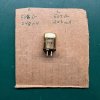

That is a very close match.