• The move to the new server is done. There are some software and database maintenance updates in process. This has us passing the hat around to help out. We appreciate any donations. Seriously, even a dollar helps. The payment page may be found here - https://www.audiokarma.org/support.html

ESS AMT3 Heil Sickness-Continuing Saga Of Changes And Improvements

Yes, the monopole Heils are perfectly okay, as are the monopole Linaeums, but once again I agree strongly that the dipole is the thing that swings. And it doesn't even have to be the Great Heil. The Littlest Heil dipole is very effective too. In my opinion, of course.

Sure, it's all about driver integration.
I agree-that the Great heil is not really considered a omni direction speaker, and I don't recall ESS or the German ESS marketing this way. But if you look at my posted 1975 review of the AMT3-the 3 response curves are fairly close to each other (omni/hemisperical/on-axis). The AMT3's image way better then most of the omni's I have heard-as most have nice air and space, but fuzzy imaging in instrumentals etc. In fact it images better then most speaker I have heard.
This article didn't have the "8", and I found the review that has it-and they are a little cleaner then your post-but more or less the same.
 
Last edited:
Good heavens, no. It's just that dipoles have this really cool extended-soundstage-effect, and the Heil is inherently a dipole, so we rag on ESS for using monopole Heils.

In fact, there really isn't any such thing as a monopole Heil; there are only Heils where the backwave is blocked, as in the amt-5, or soaked up by a box of cotton and basically thrown away, as in the amt-Bookshelf or amt-10b.
 
Good heavens, no. It's just that dipoles have this really cool extended-sound stage-effect, and the Heil is inherently a dipole, so we rag on ESS for using monopole Heils.

In fact, there really isn't any such thing as a monopole Heil; there are only Heils where the backwave is blocked, as in the amt-5, or soaked up by a box of cotton and basically thrown away, as in the amt-Bookshelf or amt-10b.

Sure-I think most of us are aware of their design, and that even the small one if open backed could be dipole-no real "new" news here.
However-you better off using one with out the rear casing/enclosure if you want dipole radiation.
If back wave blocked Heils suits you better-great.
There are a few here who prefer the smaller Heils implemented in a blocked back wave configuration, for a variety of reasons, so which ever suits your taste.
I had a nice pair of PS1220's with a blocked rear smaller Heil. Very nice, and a well integrated sound with the midrange driver/3-way design. The sound still had plenty of float and air and a wide sound stage (and similar fairly narrow vertical radiation)-not all the air of the Great Heil-but darn close
Lienaums are okay-the RS versions anyway-but IMHO can't hold a candel to the Heil-for example the tonal correctness of a piano solo-and attack and decay-nothing approaches a Heil in this department.
 
Last edited:
If back wave blocked Heils suits you better-great.
There are a few here who prefer the smaller Heils implemented in a blocked back wave configuration, for a variety of reasons, so which ever suits your taste.
automojo, did I somehow give you the impression I preferred "blocked" Heils? Also, kindly keep in mind that I was responding to Trek, not you.
.
 
Last edited:
Viva la Difference

I like this 360 degree dispersion tweeter/super tweeter:)
It's quite amazing crossed over at 2000Hz on up, sweet sounding and ultra detailed.
 
Last edited:
Thanks, Bill. Great picture. How deep (thick) are those blocks of foam? I'll try your suggestion this weekend.

They're 2" thick. Make sure the foam fits snugly side to side as well as against the top of the Heil area.
 
I have a pair of AMT 3's and they are the sealed version. I was wondering does anybody have any thoughts to share about the sealed version?
 
I tried blocking the ports, and liked them at first, but I found the right combination with the rear ported Dayton ST255-8's as woofers, and the Eminence Alpha 6A.
If you do your homework on these, they will easily out perform the stock ported or sealed AMT3's in 5 key areas. Lower bass and mid bass distortion. Increased bass efficiency. Superior transient mid bass and bass response.
Increased bass output and efficiency. A more flat bass response.
Modern woofers, or should I say the right modern woofer now has the stuff to truly keep up with the Heil.
 
Resuscitating the AMT3

I picked up a used set of AMT3s locally today for not a whole lot of money. So I figure it would be a worthwhile project.

Cabinets are in decent shape. One of the grill frames need to be redone. The Heil tweeters are there but the original owner replaced all drivers except one of the midranges (need refoaming). What is the latest thinking in resuscitating these and bringing them up to today's standards? I am looking at replacing the drivers and redoing the crossovers.
 
AMT3 drivers

l hope this is not impolite, but I'm selling four AMT-3 woofers elsewhere on this site if anyone is interested:

http://www.audiokarma.org/forums/showthread.php?t=435894

Please ask any questions on the "Barter Town" thread and not this discussion thread. Sorry for the imposition, but I would like to see them put to good use. People have been contacting me to use them in generic speaker projects, not ESS. Thanks.

Sorry but the above link did not work for me and I can't find similar thread on barter town other than a bunch of posts from tinkerbell. If these are still available can you contact me via messages? I am planning to use them for an AMT3 restore project. I picked up a set of cabinets and would like to consider this route.

Thanks
 
Going back to reworking AMT 3 crossovers, I want to do mine today and found that my crossovers are substantially different from any I have seen illustrated. It is a 3 choke, but the parts layout is somewhat different.
My main issue is the values. The larger capacitors have actually been marked with values. There are two different types. Two caps are marked ~ 47, one is 52 and the other is unmarked. My initial assumption is that these were all nominal 51uF and I can use a 51 in all 4 positions (in one speaker the 47 is on the circuit board and on the other it is on the main board which is why I am guessing they are interchangeable). The tricky part is the "small" value capacitors. These are two 20uF in parallel. Should I use the 33uF I bought or should I do 40?
The main board is also unusual, it is fiberboard not plastic and will be difficult to remove as it is heavily glued. I may just solder the new caps in place as the lesser of evils.
 
Last edited:
For two 20uF caps in parallel I'd replace them with either two 20's or a 40. I'd also use closer tolerance parts than the originals. If you're going to rebuild crossovers you might as well go with the high priced spread. Only you can decide how high the cost of that spread will be.

I have a buddie with >$1200 in parts for his MG-3.6R crossovers.
 
Perhaps posting a picture would be helpful.
If it's a 3 coil they should have 2 x 33 uf, and 2 x 51uf caps.
I'm assuming you have a circuit board, and it's not all hard wired.
The woofer cap (51uf) is off the main pc board, by it's inductor, and the fuse and input terminals.
The other 3 caps should be on the circuit board.
Hopefully the pc (circuit) board is not glued to the backing board. If it's just silicone, you can remove it (carefully).
My 3 coil set had the pc board attached with silicone, along with 2 pegs..
I picked up a second set of 3 coil crossovers of E-bay, that thankfully didn't use the silicone.
The 2 peg plastic peg attachment is questionable. I used a Dremel to remove mine and used some regular threaded metal standoffs in place of those.
I think the reasoning for the silicone in later models is some of the pc board probably fell off, as the push on nuts had little material on the peg to work with. The pc board sports 2 of the 3 inductors-which aren't super light.
When you take them off-one will break-so use standoffs.
There is a company that makes silicone remover specifically for pc boards.
It's expensive, and requires soaking, but works well.
http://audiokarma.org/forums/showthread.php?t=381633
I agree on the tolerance-even though ESS speced 10% (at most did back then), tighter tolerance caps will yield much more stable imaging with the Heil.
You should be able to stcak all your poly caps on the main board if you lay them out right.
I will try to post a pic.
 
Last edited:
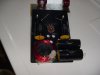
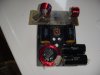
This will be my "close to stock" crossover-Dayton caps-stock inductors, Dayton resistors, and new input terminals, and 18 gauge internal wiring. The other one is totally hard wired, with Erse caps and new/custom wound inductors, and Mills resistors, new brightness switch, and new terminals as well. The hard wired version will be slightly more efficient-lower ESR, and tighter tolerances, and sport 14 guage internal wiring.
I will use a thick ABS sheet for the board (from Industrial Plastic Supply) for the hard wired set-along with felt for the rear gasket/damping material.
I used P.E. nylon ties with the screw eyelet and silicone to attach the caps-very solid. I cut the protruding screw ends off with a Dremel, and used epoxy to make sure they don't loosen/back out.
This leaves a relatively smooth surface on the outboard side, that will seal perfectly with a felt gasket, with out twist tie bands coming through.
The standoffs, washers and screws are from Digakey.
As you will notice-this was a supposedly "mint pair of AMT3 crossovers" of Ebay. One of the stock resistors over heated and burnt the top of the board. Luckily the traces where intact, and just required a re-flow. I used epoxy on the top burned area to seal and strengthen the affected area.
It's also helpful to have one of those mini drill bit sets/pin vise to clear out the terminal holes with out excessive heat on the traces.
The O.E. 3 coil crossover from my first set of AMT3's (with it's siliconed board served as a test mule set for experimenting with different values/components etc.
 

Attachments

  • ESS Etc 121.jpg
    ESS Etc 121.jpg
    39.6 KB · Views: 45
  • ESS Etc 122.jpg
    ESS Etc 122.jpg
    42.4 KB · Views: 46
  • ESS Etc 123.jpg
    ESS Etc 123.jpg
    40.5 KB · Views: 42
Last edited:
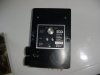
Took the woofer out again to take a photograph, luckily my baffle is in good shape. You'll see two sets of stacked 20uF, one on each side. There is an incredible amount of glue used which is why I doubt whether I can non-destructively pull this apart.

The reason I am tending to doubt whether I should use 40uF to replace the stacked caps is if you look at the cap off the circuit board it is stamped 55uF but it is hand graded by ESS at 47uF in the other speaker. This means it is 15% low from nominal. The large capacitor on the board is larger than the one off board and it is hand graded at 47uf in this speaker and 52.8uF in the other speaker. If I apply this to the 40uF cap I get 34uF. Now I don't know that the smaller caps are similarly over-rated but they are the same manufacturer so it seems a reasonable guess. Thoughts? Can't think of a way to be certain on this without talking to production personnel so it is a guessing game.

You can see one resistor over-heated but it still measures good. The resistor would be very hard to replace in place.

As to caps, I am using Axon polys. Not real fancy but they are one of the smallest ones out there which helps in this situation.

P.S. I tried embedding the pic but wasn't able to, so I used an embedded link above.
 
Last edited:
Back
Top Bottom