• The move to the new server is done. There are some software and database maintenance updates in process. This has us passing the hat around to help out. We appreciate any donations. Seriously, even a dollar helps. The payment page may be found here - https://www.audiokarma.org/support.html

Heathkit W6 testing and issues

I definitely removed the damping control components on my W-6s. You might check the actual FB level present. Mine measured at 23 db.

Dave
 
You might also scope the drive to the output tubes to see what’s happening there. There is a little bit of grid current happening at the onset of clipping, so the peak drive signal should slightly exceed the bias voltage.

Dave
 
I'm getting the second amp delivered from my friend this afternoon. Thought I would check that one before making any modifications. Hopefully it behaves better but if not I'll begin by removing the damping circuit and see if that helps. It's a little baffling as I have compared the installed circuit to the schematic and I can't find a flaw. Not ready to give in yet. If this second unit shows the same bad behavior it seems like there must be something wrong in the restoration because these amps must have worked ok in days past.

Thanks and I appreciate the advice and comments.
John
 
I disconnected the shelf network and the feedback but the amp oscillated so badly I had to reinstall them to quell it. I did not bypass or disconnect the damping control. It didn't occur to me that jumpering all three connections on the current feedback pot would bypass it completely. Thanks for that. I'll try it. If these pots are wirewound could the inductance in the cathode of the first stage cause an oscillation?
If all feedback is removed, it shouldn't oscillate. There has to be a signal path of some sort from output to input for oscillation to take place. It might be unintended, such as poor decoupling or unwanted coupling between stages, but there has to be a path. What you're seeing may in fact point to the problem.
If these pots are wirewound could the inductance in the cathode of the first stage cause an oscillation?
The inductance of those pots is insignificant at audio frequencies. If the oscillation is below 1MHz, they're unlikely to be contributing. Spealking of which, do you know the approximate frequency?

Jack
 
I definitely removed the damping control components on my W-6s. You might check the actual FB level present. Mine measured at 23 db.

Dave
That seems like a lot of GNFB, especially considering the feedback additionally provided by the UL connections. The OPTs must have a very wide bandwidth!

Jack
 
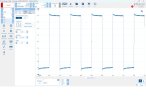
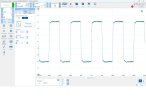
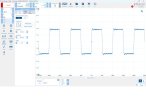
Well, have some progress to report. I removed the damping circuit from one of the W6's and that seems to have largely resolved the issues. Square waves at 10k are much squarer. The still have a little wobble across the top but it's minor. FR is very smooth with -3dB at just over 100k. I haven't made the other measurements requested but I will still have them for a couple of days. Hope to get the other damping circuit removed this afternoon.

I also have another question. The rebuilder that did these amps sold my friend to bias the 6550's at 56mA. This seems a bit cold to me. The GE data sheet says 75mA at zero signal. Any suggestions for a "good" bias current?

This is with an input equal to what a 1W sine requires.
W6 10k square 8 ohm 100mV input.jpg
This is with mid level power
W6 10k square 8 ohm 600mV input.jpg
And this is with approx a 1W output
W6 FR no damping circuit.jpg
 
You still have feedback connected somewhere, or has everything been removed?

Jack
 
I had to rework the cathode bias resistor load for the input tube since the pot is disabled and the original feedback is still connected.
 
That seems like a lot of GNFB, especially considering the feedback additionally provided by the UL connections. The OPTs must have a very wide bandwidth!

Jack
The W6 OPTs tested better than any other, I believe, in the John Atkinson tests with only the Cit II being competitive.
 
There is still a bit of wobble in the top of the 10k square that doesn't show in the original manual so not sure where that comes from but it's a big step from where I was yesterday. If Dave G hadn't said that he definitely would remove the damping circuit I wouldn't have been positive that I needed to do it.
 
I'm not convinced this troubleshooting has gone the right direction. The amplifier must have worked at one time with the damping control connected. In this case, it doesn't appear that the amp can even meet spec in the factory configuration. Is that normal for a W6? If not, I think it's still essential to disconnect all the feedback, damping, and compensation, and check for a problem. Square waevs aren't necessarily useful for this, mostly gain and frequency response.

Jack
 
I had that thought about the original config. If I have time before my friend wants them back I can dig more into this.
 
Did the damping pots measure anywhere close to correct value? That would screw this up, especially if they weren't going fully to "0"

What sort of plate voltage does this run at?
 
There is still a bit of wobble in the top of the 10k square that doesn't show in the original manual so not sure where that comes from ...
The manual plot relates to a 16 ohm load, and you were using 8 ohm, and feedback is from the 4 ohm. Can you clarify if 'removing the damping circuit' means the 300 ohm pot wiper was at the cathode end?
 
The manual plot relates to a 16 ohm load, and you were using 8 ohm, and feedback is from the 4 ohm. Can you clarify if 'removing the damping circuit' means the 300 ohm pot wiper was at the cathode end?
Yes, wiper was at the cathode for max damping.
 
Did a little more testing after removing the damping circuit from the second unit. Did an open loop and closed loop comparison which calculated at about 20.97dB of feedback. Unfortunately I forgot to disconnect the shelf network so the FR I measured open loop isn't accurate. Maybe I'll get motivated again this afternoon to do more.
 
Did a bit more work this afternoon and found something very interesting. The load resistor I've been using is a big aluminum casing and rated non inductive for 100W. I moved it out of reach so I grabbed a Dale 50W gold casing type non inductive resistor and now the amp seems to work fine. Another lesson learned for me.

Except for the damping control which is already gone so to late to try it with this load but with otherwise all of the stock values for feedback, shelf and input resistor I get these results:
1kHz
W6 #1 1kHz sq 10k 47p fdbk and 390k input 1k 910p shelf.jpg
10kHz
W6 #1 10kHz sq 10k 47p fdbk and 390k input 1k 910p shelf.jpg

FR
W6 #1 FR 10k 47p fdbk and 390k input 1k 910p shelf.jpg
I can tweak the HF extension by playing with the phase advance cap and the shelf but it seems good as is and very smooth.
 
Back
Top Bottom