Sorry I'm late to the party, but thought I'd give some reference data from one of my W-6M units for comparison. For the purposes of this conversation, the amplifier is completely stock, with the single exception being that the Damping circuit is disabled, and the fractional Ohm load resistors associated with it are shorted out. With only insignificant differences, the results very similar and in keeping with that of its mate. In keeping with the test standards of the day, all testing was done on the 16Ω tap. Very good tubes were installed, with new matched Sylvania tooled 6550A output tubes set for a balanced 65 mA quiescent current. The relevant results include:
1. Operating from a 117 vac line, the amplifier would develop just over 70 watts RMS at the onset of clipping from 20 Hz to 20 kHz (72-74 watts).
2. Frequency response (biggest area of deviation with the unit of this thread) was -0.1 db at 20 kHz, and down 1 db at 53 kHz. From my notes, the response of this amplifier mate's was also down similarly at this frequency (-0.75 db).
3. The amplifier is absolutely stable into a cap only load, with no value up to 1.0 uF causing any tendency towards (or even being close to) outright oscillation. No value was tested over 1 uF.
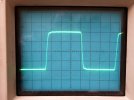
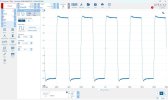
4. Into a non-inductive 16Ω resistive load at 1 watt, a 10 kHz square wave is very square, with no top or bottom ringing displayed (pic provided). This too is at odds with the amplifier presented.
With the exception of #2 above then, the tests of my amplifier are in full compliance with the specifications published by Heath. They indicate that the HF response of the amplifier is within +/- 0.5 db of 70 kHz, which neither of my partially restored amplifiers will do -- although a very slight tweak to the phase advance cap would likely resolve that. Partially restored means all components are good or replaced and matched as necessary, but the new work is only tacked in place at this point for testing purposes. A permanent restoration effort is in the works for later this year.
It would appear that the specification of HF response is the sticking point for the amplifier presented in this discussion. With an effective flat response out to over 100 kHz, there is less control of circuit response being applied -- for whatever the reason -- either as compared to the Heath specifications, and certainly my own units as well. The 390K input network, 910pF/1K step network, and 10K/47pF NFB network components control the HF response of the amplifier, and are all still currently in place. Other variables include the output transformer, which is a bonafide Peerless model 16431, and construction of the amplifier (lead dress), which is well in keeping with the instructions in the manual. If the build and network components in the subject amplifier are the same as in mine, yet response is so much greater, then the likely variable relative to this discussion is the output transformer,
which if ture, would be extremely unusual for true Peerless products.
I'm hardly suggesting that the transformer in the subject amplifier is defective or has been tampered with (can restuffed?), but with such a difference between Heath specifications/my unit's performance, and this amplifier's performance relative to HF response, HF transient response, and power output -- for the typically near identical performance normally produced from Peerless products -- it is certainly worth a thought, all else being equal.
Granted, the effort of this discussion is chasing that nth degree of performance, so from a practical standpoint it may all be academic anyway, but the differences are noted herein for reference.
The W-6 amplifier is the one Heath really got right. Absolutely superb and properly applied transformers, low impedance power supply, Class AB2 drive capability, a well executed stability scheme that got the job done without throwing the baby out with the bath water, and specifications that by in large are quite accurate. There are a couple of minor points I will address in my own restoration efforts, but straight out of the box, the Heath W-6 set a performance standard that to my knowledge, no other amplifier of similar type design can approach.
Dave
Below: A 10 kHz Square Wave from the W-6, produced as described in #4 above.