• The move to the new server is done. There are some software and database maintenance updates in process. This has us passing the hat around to help out. We appreciate any donations. Seriously, even a dollar helps. The payment page may be found here - https://www.audiokarma.org/support.html

HH Scott Owners Thread

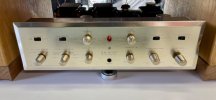
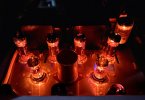
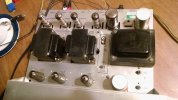
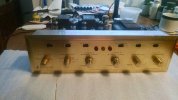
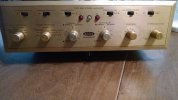
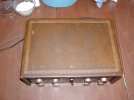
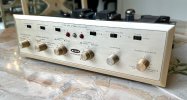
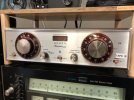
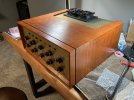
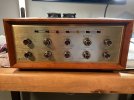
Here's my Scott 222C, and have to say I really enjoy the music it produces. Currently have a few tube amps and preamps in the rotation, but the 222C always stays the longest; just pulled out a MC225, then a Marantz 8b and the 222C is back in.
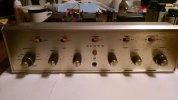
Recently I bought a refurbished 299 by NOS but I preferred my 222c by quite a bit, as the 222c has a little more oomph, and bravado than the 299, which was a little nosier and bass shy, perhaps becasue of its recap by NOS. The 222C also weighs a bit more than the 299 due to the bigger iron so that could be it also.

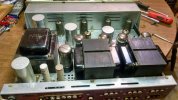
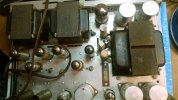
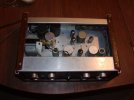
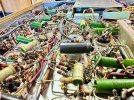
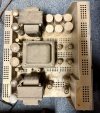
Also included is a pic of the 299 that went to another home, you can all see the worked done inside, it's little busy under the hood. Hoping the new owner is enjoying it.

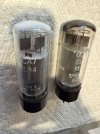
* * Did Scott ever make a dedicated 7189 mono amp?


IMG_0438.jpegIMG_0383.jpeg
 

Attachments

  • IMG_0554.jpeg
    IMG_0554.jpeg
    148.5 KB · Views: 25
  • IMG_1293.jpeg
    IMG_1293.jpeg
    380.2 KB · Views: 24
Last edited:
I always try both plug polarities on audio gear that doesn't have a modern NEMA or three-connector AC plug. I use the polarity that gives the lowest AC voltage from circuit ground to earth ground. The component under test should be on but not connected to any other component.

I was startled to find that one polarity on my Eico 2200 gave 120 VAC! I looked at the schematic to see how to solve the problem.

I found a very similar problem today on a Scott LT-111/370 tuner. Once I have more details I will post them here.

The 2200 has a single capacitor, C1, on one side of the primary winding of the power transformer. It is connected to chassis ground.

It appears this capacitor has shorted out. Modern safety capacitors are chosen to become open circuits when they fail. The problem went away on the Eico when I removed that capacitor.

I'd recommend replacement of this capacitor on any vintage gear. Please see Film capacitor - Wikipedia

 
Recently got a Scott 333b tuner
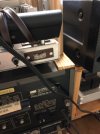
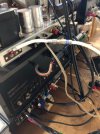
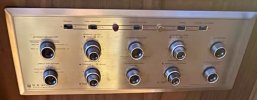
I connected the original “bar” (300 twin lead) antenna and also a Tune Trapper (75ohm left rear panel) antenna for which I have included pictures. Do I have the antennas connected correctly? Also on the right rear panel I have connected the two screws with the swivel bar that can be used to join the screws or allow them to be separate, do I have this done properly? Thanks
 

Attachments

  • IMG_1343.jpeg
    IMG_1343.jpeg
    152.8 KB · Views: 24
  • IMG_1344.jpeg
    IMG_1344.jpeg
    130.8 KB · Views: 24
  • IMG_1347.jpeg
    IMG_1347.jpeg
    176.1 KB · Views: 24
  • IMG_1346.jpeg
    IMG_1346.jpeg
    112.9 KB · Views: 24
  • IMG_1345.jpeg
    IMG_1345.jpeg
    122.6 KB · Views: 24
Recently got a Scott 333b tuner
I connected the original “bar” (300 twin lead) antenna and also a Tune Trapper (75ohm left rear panel) antenna for which I have included pictures. Do I have the antennas connected correctly? Also on the right rear panel I have connected the two screws with the swivel bar that can be used to join the screws or allow them to be separate, do I have this done properly? Thanks
I think the coax needs a 300 ohm transformer adapter for twin lead
 
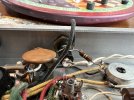
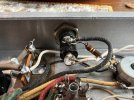
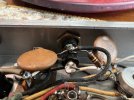
I took some photos while removing the "death caps" from an H.H. Scott LT-111 tuner. They are attached to the primary side of the AC transformer. The photos below are taken with the tuner upside-down on the workbench with the bottom removed. The fuse holder is at the center of the photos. Even after removing them, you should still check your plug polarity to make sure you plug in the unit with the lowest voltage between chassis and ground. The voltage should be measured with the unit turned on but not connected to any other gear.
 

Attachments

  • C2 removed.JPEG
    C2 removed.JPEG
    150.7 KB · Views: 11
  • C1 and C2 removed.JPEG
    C1 and C2 removed.JPEG
    157 KB · Views: 11
  • C1 left C2 right.JPEG
    C1 left C2 right.JPEG
    135.4 KB · Views: 11
I was looking through my old correspondence and found the following from Mr. Foster Blair, the Scott expert who passed away last year. I had sent him a 370 for repair. I wanted to share what he wrote for the use of the community:

"The tuner arrived on Monday and I was able to test and do a very minor readjustment of the 38KHz coil on the multiplex section to get it back into alignment. The Scott 370 and LT 111 tuners were HHScott’s answer to a lower cost tuner employing three compactron tubes as a means to reduce the parts count. When they are working properly, they sound great. Unfortunately achieving the proper alignment is very tricky and can be easily knocked out of alignment by shipping stress and vibration. The most vulnerable part is the shorter of the two transformer cans on the multiplex section. After I aligned it, your unit was sounding great. I listened to it for about three hours with no problems. If however, the problem recurs probably due to shipping induced vibration, readjustment of the 38KHz coil is very easy using a standard hex cross section tuning tool inserted into the top of the transformer. I only had to move the slug a few degrees to get it back into alignment. If the unit starts to give you a burbling sound in stereo, you insert the tool into the top of the transformer and ever so slightly rotate the slug in one direction. If it fixes the problem carefully remove the hex tool straight out of the transformer being careful not to change (i.e. rotate) the slug position. If the sound got worse, rotate the tool in the opposite direction until the burbling stops and you get a stable stereo image, then remove the tool."
 
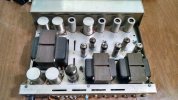
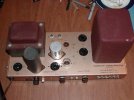
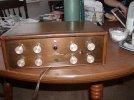
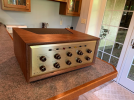
Congratulations! These 272 amps are probably the top-of-the-line integrated offerings by Scott (alongside maybe the 296) and are based on the EL34 power pentode. They have more knobs (controls) than just about any other Scott offering. They are powerful and sound very good. I've restored a couple of these, one of which I own (picture). I need to get it back in the listening room (very challenging to carry around at over 50 lb weight).

Yours does look unmolested. The two I did were not (one was really hacked up) and I have a couple of threads you can find by searching in this forum. It was worth it to me and the guy who owned the other one I did. If you have it gone over (which you probably should), there are quite a few things to look for, not least of which is potential heat damage. The amp has four EL34's, two 5U4GB rectifiers, and two 20W power resistors all in a row behind the (huge) output transformers and that throws a lot of heat back there, particularly on an amp run in a cabinet.

It also has a bunch (six) of can filter electrolytic caps that ought to be replaced. Good luck with your prize! They are fine amps and pretty rare.
Dave

1774721357344.png
 
Back
Top Bottom