• The move to the new server is done. There are some software and database maintenance updates in process. This has us passing the hat around to help out. We appreciate any donations. Seriously, even a dollar helps. The payment page may be found here - https://www.audiokarma.org/support.html

How many watts is your Amplifier @8ohms

How Many Watts is Your Amplifier @8 ohms


  • Total voters
    426
Added an Onkyo M506RS - Power output: 150 watts per channel into 8Ω (stereo)Frequency response: 1Hz to 100kHz / Total harmonic distortion: 0.002%

,Mike.
1Hz that's pretty cool. You could use it a a sweep generator , 1Hz to Edit: 100kHz
 
Last edited:
Emotiva XPA-2 Gen2 2 channel power amp main system. 300wpc

Sony STR-D990 receiver in bedroom. 65wpc
. (has very convenient built in sleep timer)

Phase Linear 400. Blew it up so being rebuilt for spare room. 200wpc
 
image_preview
678828-emotiva_xpa1l_monoblockspair.jpg

Emotiva XPA-1L Mono blocks
High Current amps
250 watts @ 8 ohm
500 watts @ 4 ohm
 
Pioneer Elite VSX-55TXi ------- 100W x 7
NAD C 275BEE ------------------- 150W x 2
Marantz NR1602 ------------------ 50W x 7
Marantz MM7025 ----------------- 140W x 2
Akai AM-U5 ------------------------- 60W x 2
Sherwood R-4105 ----------------- 100W x 2
Onkyo M-282 ----------------------- 100W x 2
Onkyo CR-325 --------------------- 14W x 2
 
Last edited:
2 Kenwood basic M2a's 220wpc
Carver Black beauty mono blocks 305wpc
3 Carver TFM45's 375wpc
1 Carver TFM75 750wpc
1 Carver PT2400 750wpc
Silver seven mono blocks 540wpc
 
Current Amp talley
Yamaha CR-2040 - 125 wpc into 8Ω
Yamaha AX-570 - 100 wpc into 8Ω
Yamaha - R v902 - 90W + 90W into 8Ω
Sony - ta f55 - 65Wpc into 8Ω
Sony - STR DA2 es - 100 wpc 8Ω
Rotel - R X -s200 - 10W/10W (8Ω)
HH Scott 340b - 30 watts per channel into 8Ω
NAD - 3150 - 50wpc into 8Ω
NAD - D3020 - 20 wpc into 8Ω
SMSL - SA50 - 25wpc 8Ω
Denon - Avr-2700 80 watts per channel into 8 (stereo)
 
Current Amp talley
Yamaha CR-2040 - 125 wpc into 8Ω
Yamaha AX-570 - 100 wpc into 8Ω
Yamaha - R v902 - 90W + 90W into 8Ω
Sony - ta f55 - 65Wpc into 8Ω
Sony - STR DA2 es - 100 wpc 8Ω
Rotel - R X -s200 - 10W/10W (8Ω)
HH Scott 340b - 30 watts per channel into 8Ω
NAD - 3150 - 50wpc into 8Ω
NAD - D3020 - 20 wpc into 8Ω
SMSL - SA50 - 25wpc 8Ω
Denon - Avr-2700 80 watts per channel into 8 (stereo)
Now that is a selection of amplifiers !
 
Now that is a selection of amplifiers !

And lots of power to play with as well... from the selection of posters!

Its been said more power, provides more headroom at upper levels of performance.. and maintains "clean" sound.

Is this a false conception.. or just an accepted "dynamic truth" for higher power levels?

Excuse if this is off-topic.
 
And lots of power to play with as well... from the selection of posters!

Its been said more power, provides more headroom at upper levels of performance.. and maintains "clean" sound.

Is this a false conception.. or just an accepted "dynamic truth" for higher power levels?

Excuse if this is off-topic.

Headroom to cover peak demands is relative to average power. It is not the exclusive domain of high power amps.

There can be plenty of headroom left in a low power amp as long as the average power is low; such as it might be with a small amp running very sensitive speakers.
 
And lots of power to play with as well... from the selection of posters!

Its been said more power, provides more headroom at upper levels of performance.. and maintains "clean" sound.

Is this a false conception.. or just an accepted "dynamic truth" for higher power levels?

Excuse if this is off-topic.
This is a fairly true statement, but should be worded differently: To increase loudness by 3dB, it takes 2x the power. This meaning, theoretically a 200 watt (RMS) power amplifier can out 3dB greater output then a 100 watt (RMS) amplifier.
 
Amber Series 70 - 70 wpc @ 8 ohms. I'm running two in bridged mono which can handle 200 watts at 8 ohms and 400 watts at 2 ohms. I've been searching for the owner's manual to back this claim, but the only proof (aside from hearing them) is this blurry screen shot of a brochure:

amber.jpg

I don't see too many Amber owners/enthusiasts.. If you're out there speak up!

FWIW these are powering B&W DM12's and in mono are a really good match. Off a single amp they needed more power but currently they are getting a good amount off current and are actually pushing some dB's! Someday down the road I will complete my Tangent RS-8's and will have them on the main stage.
 
This is a fairly true statement, but should be worded differently: To increase loudness by 3dB, it takes 2x the power. This meaning, theoretically a 200 watt (RMS) power amplifier can out 3dB greater output then a 100 watt (RMS) amplifier.

And, +3dB is only a little bit louder in terms of volume. Takes +10dB (10x power), all other things equal, to sound twice as loud.
 
And lots of power to play with as well... from the selection of posters!

Its been said more power, provides more headroom at upper levels of performance.. and maintains "clean" sound.

Is this a false conception.. or just an accepted "dynamic truth" for higher power levels?

Excuse if this is off-topic.

Mixed actually.

In theory if all things are equal (they never are), this would apply. But you really need to consider other factors like the S/N ratio and distortion.

A "cheap" amp may list its power at 200 watt RMS/channel with an S/N ratio of 70 dBA. This represents a "useable power range" of 10,000,000:1. A "nice" 100 watt RMS/channel amp may have an S/N ratio of 90 dBA and this represents a usable power range of 1,000,000,000:1 representing 50 times more "headroom" than the cheap amp.

Similarly, the 200 watt/channel amp may produce this power at 1% distortion whereas the 100/watt/channel amp may produce this power at 0.01% distortion. You may not run the 200 watt amp at 200 watts because you may not like the sound with that level of distortion. Furthermore, even turning it down may result in more distortion than the 100 watt/channel amp.
 
Mixed actually.

In theory if all things are equal (they never are), this would apply. But you really need to consider other factors like the S/N ratio and distortion.

A "cheap" amp may list its power at 200 watt RMS/channel with an S/N ratio of 70 dBA. This represents a "useable power range" of 10,000,000:1. A "nice" 100 watt RMS/channel amp may have an S/N ratio of 90 dBA and this represents a usable power range of 1,000,000,000:1 representing 50 times more "headroom" than the cheap amp.

Similarly, the 200 watt/channel amp may produce this power at 1% distortion whereas the 100/watt/channel amp may produce this power at 0.01% distortion. You may not run the 200 watt amp at 200 watts because you may not like the sound with that level of distortion. Furthermore, even turning it down may result in more distortion than the 100 watt/channel amp.
Spot on! Excellent explanation!
 
Spot on! Excellent explanation!

Yes, but it is a different sort of headroom than what keeps you out of clipping. S/N ratio is important but much more so if running high sensitivity speakers. It then becomes a very high priority. The point is, depends which "headroom" one is talking about.

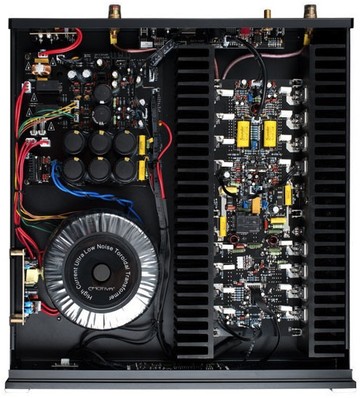
On another note, here's the guts of a Levinson No. 23. This is not my amp but I have one like it (except not with the guts laid out). Each of the two toroids weighs probably 45 lbs, give or take, for a 200wpc-rated amp. Each of the large caps is 36,000uf. There are two smaller cans each side between those bigger ones too.

Mark_Levinson.jpg
 
Back
Top Bottom