
I'm glad my poll is getting activity. It is interesting to see the stats - spread in amplifier power.Carver? This is exactly what my C-500's are.


I'm glad my poll is getting activity. It is interesting to see the stats - spread in amplifier power.Carver? This is exactly what my C-500's are.

Good thing for multiple vote optionFisher CA-35 20WPC
Pioneer SX-636 25WOC
Fisher RS-881A 50WPC
Sherwood RV-5030R 85WPC
Sherwood RX-4109 100WPC
Sansui A-1100 120WPC


Clarification, multiple votes for the different range selections.where are the options for multiple votes... anyway, I have three and they're all 100w+
Pioneer SX-1250: 170w/ch
Pioneer SX-1050: 110w/ch
Cambridge 851A: 120w/ch

Not sure I agree with capacitance being the main consideration here. It provides filtering for sure, but it's only a very short term temporary buffer. It's up to the transformer to supply the primary grunt.
Then, the SOA, yes impedance is an important factor but I think phase angle is really what makes the "amp killer" speakers. The higher dissipation that it creates in the outputs at 45-deg is twice that of a purely resistive load.

Carver? This is exactly what my C-500's are.
Old Bob Carver made some great amps. Not positive, but I think he was the first in Audio to develop the Down Converting Tracking Amplifier.That's a nice amp you have and it's THD is 0.05%...
Though your amp has the best signal to noise response of 100db together with a decent THD gives you a pretty good sound.

Judas Priest: Now that is real fan support ! Cool screen name and Avitar!My TDA8932 DIY amp has around 30W/ch; QSC GX5 500W/ch.
i love them both, but the chip amp serves my daily needs very well.

what - only 1.7hp/ch? slacker ...On my main rig I have 1000wpc on tap from my strapped Mac mc2500's rated by Mac's conservative standards into any load from 1/2ohm to 8ohms. My lower powered 2500 (clipping lights always flash first on this one) has been bench tested at 650 wpc so 1300 wpc would be more truthful.


I must confess to a personal weakness. I get somewhat irritated at loudspeakers with funny impedance/frequency plots. There is little reason to have loudspeakers sinking to rediculously low impedances with modern simulator programs. As a design EE I object to have to sort out impedance problems in amplifier design which should have been dealt with at the loudspeaker design end. (Not talking of 'normal' to be expected kind of spreads, but a nominal 8 ohm loudspeaker taking a quick dip somewhere to below say 3 ohms ... 'no-no'.) I have not viewed that many brands' frequency characteristics, but wonder how many "good" loudspeakers there are out there dipping off the graph here and there. (Perhaps some members can advise a website where such is shown?)
As said, this has mainly to do with power supply 'extra' capacitance. But if frequently having to go there semiconductor safe operating area also comes into the picture.
This was my response to this member:I can think of a number of good speakers that dip below 2 ohms, and they were built by very creditable engineers. Why they choose to build them that way I can't tell you but I own a few and I know of a few others as well that were some of the most sought after speakers of the time.

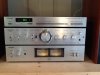 Toshiba 65 WPC
Love the vintage!View attachment 808716 Toshiba 65 WPC


