


You are using an out of date browser. It may not display this or other websites correctly.
You should upgrade or use an alternative browser.
You should upgrade or use an alternative browser.
How much wattage do you use, on average?
- Thread starter b-rider
- Start date
- Status
- Not open for further replies.


Poultrygeist
Lunatic Member
These Zenith OB's are around 98 dbs and are using no more than a fraction of a single watt from their 3 watt SET amp to reach a good listening level. The 15 inch H-frame woofers I believe are 91 dbs and probably never use more than 4 or 5 watts from their 100 watt plate amp.
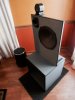
With my old KA-80 most I every remember using was about 10 o'clock on the dial, maybe occasionally higher, but I'm not a guy that listens to rock and obscene volumes. With my "new" KA-900, it rarely goes over 10% on the slider (not marked for power). Driving HPM-500s or HPM-900s, both pretty efficient speakers.
I'd guess for normal listening a couple watts.
The point about "headroom" is important -- doesn't take much transient sound to require a lot of voltage, and when you exceed the clipping limit you get distortion. Unless the bass and treble are split (bi-amped), it's easier than you think to drive into clipping.
200 watt amp running at 1 or 2 watts is probably wasteful, but 80-120 for normal listening with occasional "entertaining" is probably good.
I'd guess for normal listening a couple watts.
The point about "headroom" is important -- doesn't take much transient sound to require a lot of voltage, and when you exceed the clipping limit you get distortion. Unless the bass and treble are split (bi-amped), it's easier than you think to drive into clipping.
200 watt amp running at 1 or 2 watts is probably wasteful, but 80-120 for normal listening with occasional "entertaining" is probably good.

whoaru99
Epic Member
I think that a lot of people who report sonic improvements when switching to a higher-power amplifier credit the increased wattage, and nearly forget that they switched amplifiers. Unused watts in reserve contribute nothing towards sound quality.
That's certainly a possibility. That said, I think a lot of people who report sonic improvements with higher power amp had been exceeding the capability of their lower powered one.

45rpmspinner
Super Member
I think that a lot of people who report sonic improvements when switching to a higher-power amplifier credit the increased wattage, and nearly forget that they switched amplifiers.
I have an amp which allows me to adjust operating voltage between 24VDC and 48VDC....which corresponds to a range of 30 wpc to 120 wpc [into 8 ohms].
I have the ability to hit most any power output in between those numbers.
Thus, I have a pretty good idea of what kind of power is needed with this particular amp in order to get the best sound out of my speakers.
And that's because I can hear the difference.
When I run at low voltage, many of my speakers can sound thin-ish, unbalanced.
When I pump up the voltage to around 36VDC [65-70 wpc into 8 ohms] the overall tonal balance improves, the bass fills-in noticeably.
65-70 wpc suits most of my relatively inefficient speakers fine.
If I drop the voltage much below 32VDC [55 wpc], the sound generally starts to suffer.
I only own two sets of speakers which appreciate 100+ wpc....and they like it a lot.
I should mention that this amp will double-down into 4 ohms at any voltage with a sufficient psu.
Something I consider increasingly important as time goes on.
Last edited:



My opinion is that the ratio of assholes to opinions isn't equal in this case (and, yes, I know the cliché...). Lots of opinions, but fortunately fewer assholes. Not to say none, but fewer. LOL.
I was giving us all the benefit of the doubt and referring to the cliche and our anatomy. All good guys as far as I can tell!

I was giving us all the benefit of the doubt and referring to the cliche and our anatomy. All good guys as far as I can tell!
I agree, I’m a DH anyway not an asshole

whoaru99
Epic Member
I have a new to me set of Bose 901 Series VI. Out of curiosity, I played them at a level of 80-85dBa at distance of ~13ft from the speakers. The meters on the Yamaha P-2200 amp were bouncing upwards of 100W. It was certainly more than a library-like playback level, but by no means an ear-bleeding level.

sqlsavior
Lunatic Member
Since I rarely play the Quads louder than low 80's dBA, and they are 84 dB for 1 watt sensitivity, I think that I could use a one or two watt amplifier with them and be fine, which would make the average at maybe 1/10 of a watt. That's when I'm playing at my loudest. I tried the miniwatt SET amp, but it didn't really match well with the Quads and sounded a little funny. I've read that the Quads really appreciate a little negative feedback, though. If I can get my ~30-40 watt PrimaLuna Dialogue Premium tube amp fixed, that will be PLENTY. For me.
whoaru99
Epic Member
For another experiment, I changed the amp to Crown XLS1000. That's a 200wpc amp with LED level indicators.
Playing at the same 80-85dBA level the -10dB indicators were flashing quite regularly but the clipping indicators (which are the next LED up the scale) never flashed. That seems consistent with what was showing on the Yamaha meters.
Next I pumped up the jams to 90-95dBa, same distance, the LED clipping indicators were occasionally flashing on drum beats.
For further reference, I had originally connected the 901s to a HK PM650 integrated. In itself a pretty solid mid power integrated amp. The 901s sucked that dry and asked for more, so to speak.
Playing at the same 80-85dBA level the -10dB indicators were flashing quite regularly but the clipping indicators (which are the next LED up the scale) never flashed. That seems consistent with what was showing on the Yamaha meters.
Next I pumped up the jams to 90-95dBa, same distance, the LED clipping indicators were occasionally flashing on drum beats.
For further reference, I had originally connected the 901s to a HK PM650 integrated. In itself a pretty solid mid power integrated amp. The 901s sucked that dry and asked for more, so to speak.
Last edited:
Next I pumped up the jams to 90-95dBa
That’s my normal listening level with my 6wpc tube or 10wpc Class A.
whoaru99
Epic Member
That’s my normal listening level with my 6wpc tube or 10wpc Class A.
Not with Bose 901s at 13ft.

Which is precisely the point of the "it depends" sort of answers.
Not with Bose 901s at 13ft.
No sir
whoaru99
Epic Member
It would be fun to repeat with my Yorkville CU15s or JBL SR4732s or Cerwin-Vega D9s, all having rated sensitivity 98dB or higher*. But those are all at a different location and that's a lot of work to haul all that stuff over.
(*and without a heap of bass boost centered around 35Hz like the 901s)
(*and without a heap of bass boost centered around 35Hz like the 901s)
Last edited:

Tom Bombadil
AK Member
I doubt my SO has ever broken 0.1 watt.

JoeESP9
ESL's & tubes since 83
As long as I have enough power to cleanly play whatever I want at any volume I desire, the wattage outputs of my amplifiers simply don't matter. Besides, I don't have any meters on anything but a RtR and cassette decks. IME very few output power level meters have any semblance of accuracy anyway (McIntosh excluded).

I think that a lot of people who report sonic improvements when switching to a higher-power amplifier credit the increased wattage, and nearly forget that they switched amplifiers. Unused watts in reserve contribute nothing towards sound quality.
This^^.
Stated another way, more power than is necessary to achieve maximum desired listening level without clipping* provides no benefit. The power required to achieve this status varies widely, depending primarily upon speaker sensitivity.
And of course, the amp must have the ability to deliver the current demanded by the speakers...which is where the money is!
* more accurately, with minimal clipping.
whoaru99
Epic Member
IME very few output power level meters have any semblance of accuracy anyway.
More accurate, I'd opine, than the finger in the wind estimates typically relayed in the anecdotes.
Last edited:
- Status
- Not open for further replies.