

You are using an out of date browser. It may not display this or other websites correctly.
You should upgrade or use an alternative browser.
You should upgrade or use an alternative browser.
How much wattage do you use, on average?
- Thread starter b-rider
- Start date
- Status
- Not open for further replies.


Tom Bombadil
AK Member
After many years of running 200wpc+ solid state amps, I must admit that I was surprised by how loud a 5 watt tube amp could play. Now, over the years I've lowered my preferred listening level (I clipped those amps a few times) and now have my setup in a smaller room, but still surprised. Speakers are 91dB.


whoaru99
Epic Member
As I've taken to saying in other threads of same/similar topic.
Pick your number; 1/4 watt, 1 watt, 1kW. Any one of them is enough until it isn't.
Personally, like many of you, I currently own many different power amps. As long as I stay within SS or tube, the single biggest difference I hear between any of them is when any given one reaches its limit.
Pick your number; 1/4 watt, 1 watt, 1kW. Any one of them is enough until it isn't.
Personally, like many of you, I currently own many different power amps. As long as I stay within SS or tube, the single biggest difference I hear between any of them is when any given one reaches its limit.

JoeESP9
ESL's & tubes since 83
More accurate, I'd opine, than the finger in the wind estimates typically relayed in the anecdotes.
I can't argue with that.

How loud is it?
It's so loud my dog leaves the room.
Are you sure it's not the music you're playing?

My main amp doesn't have power meters. Some time ago I swapped an amp that had peak-reading meters into that system for an audition. The amp was rated at 200 WPC; the meters never went above 50 W, even when I set the volume well above my normal listening level. I concluded that my main amp's 120 WPC was probably overkill for my listening preferences.

arts
Addicted Member
I crank it until my ears ring.

Ah,but is that a "Golden" Ear Ring ?


And yeah, I guess my original question(s) were answered this far; for my listening environment, my current 60 WPC is waaaay good enough, so I can consider other receivers/amps I'm looking at as MORE than adequate if they're around that range. Won't go lower, though.
See, there's an absolute that well......... here's a little Kenwood KA-4006 with 34watts per channel that drives these Klipsch Heresys to concert levels with ease. And it's warm signature works well with the Heresy, 34watts is actually more than most would ever need.

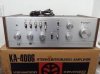
Purchased one of these for my brother in law and liked it so much I now have three lol.

ScottFan355
Super Member
Don’t trust anyone under 30"Why does dad have to listen to the music so loud?"


Pyrrho
Super Member
Like many people, when I'm looking for used receivers (applies to amps also), I generally look to get the highest-powered version of what I'm looking for, whether I really need it or not. I think it's natural to do that.
But on my main vintage receiver, it has power meters, and at my normal listening level, thru pretty efficient speakers, I'm using UNDER 10 watts output, actually much less than that.
The thing is, you need the power for every time you play your system, not just "normal" times. If you ever crank it up, then you need power for those occasions. Or, to put this another way, it is not the average power that matters; it is the peak power that matters. Whatever is the highest peak you ever want to listen to is the amount of power you need. Anything less and you cannot play it that loud on that occasion.
So, if once a year you decide to play things very loud, then, for that once a year, you need whatever power it takes for that occasion.
Since it can be difficult to know precisely how much power that is, typically, it will be a good idea to get a little more capability than you ever actually need. Having more power capability than you need does not hurt the sound, but having less than you need does.
So how many of you are listening at, or utilizing, 30, 40, 50+ WPC?
And, if we're talking about vintage speakers, where some of the oldie acoustic-suspension variety sacrificed efficiency for low-end performance @ higher power inputs, if they recommend, say, 20w input, what happens when you drive them less than that?
Just trying to come to an understanding about the NEED for high power, vs the DESIRE for high power, vs a sustained "safe", enjoyable listening level.
Many years ago, I picked up a Pioneer SX-780 receiver that had power meters, and it was instructive, in that, most of the time, with the speakers I was using with it, it would be under a watt. But when I wanted to turn it up, the meters kept me from going as loud as I wanted, because I was reaching the specified limits of it. When the demand for more power occurs, it rises very rapidly due to needing to double the power for each 3dB increase in volume. Most of the time, with those speakers, it was enough power. But it was not enough all of the time. I sold the SX-780 a few years ago.
In my main system, I am presently using different speakers than I used with that receiver, of lower sensitivity, and nominally (and honestly) 3 ohms. Because I previously did not have an amplifier rated for such a low impedance, I bought a power amp to drive them that was rated for such use (and lower). Since I wanted to make sure I had enough power, and because I wanted to not have to upgrade in the future, for any speakers I might reasonably own in the future, I bought the most power I could get at what I considered to be a reasonable price, with certain other requirements (e.g., I did not want anything with fans, because passive cooling is quieter, etc.).
So my current amplifier is probably more powerful than I need it to be. That, however, is not a problem. What is a problem is not having enough power, because then you risk problems due to clipping and you do not get the volume you want.
As for what people need, speaker sensitivities vary so much that the amount of power that different people need can be vastly different from each other, based on that alone. Additionally, the size and acoustics of the room, as well as how far one is from the speakers greatly affects the amount of power needed. And then, of course, different people have different inclinations for how loud they want their music to be, which, again, significantly affects the power that different people will require.
As for what is safe, you might want to get an SPL meter (there are also apps for smart phones, though I have no idea how accurate that would be) and look at various sites, such as:
https://www.osha.gov/laws-regs/regulations/standardnumber/1910/1910.95
One thing to keep in mind with such sites is that they do not tell you what is safe; they tell you what is KNOWN to cause damage, and the standards for OSHA allow for what they regard to be an acceptable amount of hearing loss. In other words, if you do not want any damage to your hearing, you need to be more careful than those standards. How much more careful is difficult to know. Part of the reason for that is that some of the damage to hearing is typically not immediately apparent, and shows up later in life. In that way, hearing damage is a lot like brain damage from things like boxing and football, in that the full effects are typically only apparent years later.
SS amps typically become more linear the closer they get to rated power, the opposite of tube amps, added to that it's not great to have your speakers hit their max peak output at just a crack of the volume output, meaning 1 on a scale of 11 lol.The thing is, you need the power for every time you play your system, not just "normal" times. If you ever crank it up, then you need power for those occasions. Or, to put this another way, it is not the average power that matters; it is the peak power that matters. Whatever is the highest peak you ever want to listen to is the amount of power you need. Anything less and you cannot play it that loud on that occasion.
So, if once a year you decide to play things very loud, then, for that once a year, you need whatever power it takes for that occasion.
Since it can be difficult to know precisely how much power that is, typically, it will be a good idea to get a little more capability than you ever actually need. Having more power capability than you need does not hurt the sound, but having less than you need does.
Many years ago, I picked up a Pioneer SX-780 receiver that had power meters, and it was instructive, in that, most of the time, with the speakers I was using with it, it would be under a watt. But when I wanted to turn it up, the meters kept me from going as loud as I wanted, because I was reaching the specified limits of it. When the demand for more power occurs, it rises very rapidly due to needing to double the power for each 3dB increase in volume. Most of the time, with those speakers, it was enough power. But it was not enough all of the time. I sold the SX-780 a few years ago.
In my main system, I am presently using different speakers than I used with that receiver, of lower sensitivity, and nominally (and honestly) 3 ohms. Because I previously did not have an amplifier rated for such a low impedance, I bought a power amp to drive them that was rated for such use (and lower). Since I wanted to make sure I had enough power, and because I wanted to not have to upgrade in the future, for any speakers I might reasonably own in the future, I bought the most power I could get at what I considered to be a reasonable price, with certain other requirements (e.g., I did not want anything with fans, because passive cooling is quieter, etc.).
So my current amplifier is probably more powerful than I need it to be. That, however, is not a problem. What is a problem is not having enough power, because then you risk problems due to clipping and you do not get the volume you want.
As for what people need, speaker sensitivities vary so much that the amount of power that different people need can be vastly different from each other, based on that alone. Additionally, the size and acoustics of the room, as well as how far one is from the speakers greatly affects the amount of power needed. And then, of course, different people have different inclinations for how loud they want their music to be, which, again, significantly affects the power that different people will require.
As for what is safe, you might want to get an SPL meter (there are also apps for smart phones, though I have no idea how accurate that would be) and look at various sites, such as:
https://www.osha.gov/laws-regs/regulations/standardnumber/1910/1910.95
One thing to keep in mind with such sites is that they do not tell you what is safe; they tell you what is KNOWN to cause damage, and the standards for OSHA allow for what they regard to be an acceptable amount of hearing loss. In other words, if you do not want any damage to your hearing, you need to be more careful than those standards. How much more careful is difficult to know. Part of the reason for that is that some of the damage to hearing is typically not immediately apparent, and shows up later in life. In that way, hearing damage is a lot like brain damage from things like boxing and football, in that the full effects are typically only apparent years later.
So yes, you can have "too much" power, and why the SET guys run flea watt amps.

AudioGMan
Well-Known Member
On average one uses about 0.1 watt at normal listening levels. Since power demands increase exponentially your requirements will depend on your speaker’s sensitivity as well as the material you are listening to. My main speakers with 15” woofers are rated at 94dB and my amp powering them is rated at 80wpc. I can turn the volume up until I start to detect distortion and at that point my speakers have not reached their full potential. Especially with very dynamic or bass heavy music. That’s when I have to hook up my 450wpc pro amp.
if your ears ring, that is evidence of hearing damage.
If your ears begin to attenuate the volume, it's doing damage.
Pyrrho
Super Member
SS amps typically become more linear the closer they get to rated power...
Do you have any links to documentation in which measurements were taken to back up that claim?

On average one uses about 0.1 watt at normal listening levels. Since power demands increase exponentially your requirements will depend on your speaker’s sensitivity as well as the material you are listening to. My main speakers with 15” woofers are rated at 94dB and my amp powering them is rated at 80wpc. I can turn the volume up until I start to detect distortion and at that point my speakers have not reached their full potential. Especially with very dynamic or bass heavy music. That’s when I have to hook up my 450wpc pro amp.
One tenth of a watt is certainly not my average.
Not sure how you would come to this conclusion, given the wide variances in speaker sensitivity, room acoustics, listening distances and preferred listening levels.
Last edited:
- Status
- Not open for further replies.