• The move to the new server is done. There are some software and database maintenance updates in process. This has us passing the hat around to help out. We appreciate any donations. Seriously, even a dollar helps. The payment page may be found here - https://www.audiokarma.org/support.html

Ideal Speaker Wire Gauge

Springs? Didn’t consider those because none of my equipment uses them. Also there’s no torquing involved since it is what it is, no adjustment there unless I’ve missed something.

A lot of the less expensive or older equipment use spring loaded speaker terminals, and even some on the back of receivers and AVRs. They are tight openings and it is hard to even get 14 guage wire to fit the hole.
 
A lot of the less expensive or older equipment use spring loaded speaker terminals, and even some on the back of receivers and AVRs. They are tight openings and it is hard to even get 14 guage wire to fit the hole.
Oh absolutely, didn’t mean to sound like I didn’t know about them. I was only speaking to the “torque” comment, with a spring loaded terminal there is no torquing. It’s a spring, it is what it is. I’ve had to shave a few strands of copper off a 14ga wire to get it in my Marantz in fact.
 
That's because they're not usually much over a foot or two long.

I had to build a center channel cabinet just because the speaker manufacturer of my mains and surrounds sold to a different company. I wanted to keep the timbre intact so no choice. Luckily there is still parts available so everything is the same.
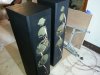
Being crazy not stupid but I admit crazy for sure, I wired the internal wiring with 12 guage OFC. Just couldn't resist to do it. And the rear surrounds that I had totally rebuilt, drivers and crossovers, I did the cabinets sanding and painting to match the front mains, and also did the internal wiring in 12 guage OFC. All I can say is they seem to be a tiny bit louder. I mean more sensitive. Compared to the internal factory wiring on the mains, with the same signal applied to the rears and center it does increase the volume. The original factory wire seems to be silver though.

20150517_154650.jpg

The old wire from the factory is on the floor on the right.

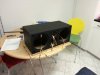
103.jpg

The center channel with the 12 guage too.


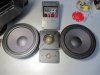
083.jpg

These are factory matching drivers for the center channel. And a matching crossover too.

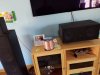
20211203_111530.jpg

So this is the current system before I hang the height speakers with brackets. So wire makes some difference. Not that big but on long runs it does make a difference.
My rears and rear heights have over 20' on some wire. Some day I will clean up my act and go in wall with a conduit. That way I can run ANY wire I want and doesn't have to be wall rated. The local building inspector told me this. Without a conduit it has to be wall rated. The heaviest wall or CL rated I have seen is 12 guage.
 
I'm like Roadrash on this one. I always use 10 gauge, and OFC, and as many individual strands that you can find. My stuff comes from Parts Express and is fairly cheap. 413 individual strands per side. Remember electrons flow along the outside of the wire. Not through the wire like water through a hollow pipe. So the more strands the more flow and less resistance. The 8 ohms you state is a nominal rating and fluctuates up and down above 8 and below 8 with frequency variations. But all posters are correct that such a short run is able to handle even 16 gauge. So go with your pocketbook, and if your equipment can reveal tiny improvements, and B&W is one of the finest speaker brands out there, only spend extra if your hearing is good and the equipment is good. But here is some reading for you.

https://www.newenglandwire.com/wire-and-cable-101/

View attachment 2442105

View attachment 2442106
Just bought another roll to hook up the height speakers on my Atmos system. This is cheap and good sounding.

A huge rabbit hole, but always better to know more than less. Merry New Year :blah::beerchug:


You can do better for less money. I use the 12 gauge. I found that 10 gauge gets unweildy. These guys are in the USA and I get my shipments in a couple days.

https://www.ebay.com/itm/124551367953?hash=item1cffd70d11:g:cggAAOSwYodgFNQN

*Stranded 100% OFC (Oxygen Free Copper), with Clear PVC Jacket, Flexible
**Come in One Continuous Length, High Purity, Low Signal Loss
**High Resistance to Heat, Oil, Chemicals and Abrasion, Low Electric Resistance
**Available Gauge: 8, 10, 12, 14, 16, 18, 20, 22, 24 Gauge,
**All in Full Amercan Wire Guage, Gauge Available:
8 AWG: Each Conductor in 742 Strands of 0.12mm Copper
10 AWG: Each Conductor in 469 Strands of 0.12mm Copper
12 AWG: Each Conductor in 301 Strands of 0.12mm Copper
14 AWG: Each Conductor in 189 Strands of 0.12mm Copper
16 AWG: Each Conductor in 117 Strands of 0.12mm Copper
18 AWG: Each Conductor in 72 Strands of 0.12mm Copper
20 AWG: Each Conductor in 48 Strands of 0.12mm Copper
22 AWG: Each Conductor in 29 Strands of 0.12mm Copper
24 AWG: Each Conductor in 19 Strands of 0.12mm Copper

 
You can do better for less money. I use the 12 gauge. I found that 10 gauge gets unweildy. These guys are in the USA and I get my shipments in a couple days.

https://www.ebay.com/itm/124551367953?hash=item1cffd70d11:g:cggAAOSwYodgFNQN

*Stranded 100% OFC (Oxygen Free Copper), with Clear PVC Jacket, Flexible
**Come in One Continuous Length, High Purity, Low Signal Loss
**High Resistance to Heat, Oil, Chemicals and Abrasion, Low Electric Resistance
**Available Gauge: 8, 10, 12, 14, 16, 18, 20, 22, 24 Gauge,
**All in Full Amercan Wire Guage, Gauge Available:
8 AWG: Each Conductor in 742 Strands of 0.12mm Copper
10 AWG: Each Conductor in 469 Strands of 0.12mm Copper
12 AWG: Each Conductor in 301 Strands of 0.12mm Copper
14 AWG: Each Conductor in 189 Strands of 0.12mm Copper
16 AWG: Each Conductor in 117 Strands of 0.12mm Copper
18 AWG: Each Conductor in 72 Strands of 0.12mm Copper
20 AWG: Each Conductor in 48 Strands of 0.12mm Copper
22 AWG: Each Conductor in 29 Strands of 0.12mm Copper
24 AWG: Each Conductor in 19 Strands of 0.12mm Copper

That seller has some good prices. Thanks for posting.
 
What is the ideal speaker wire gauge for 8 ohm speakers less than 8 feet from the amp? Speakers in question are pair of B&W CM4's and pair of B&W DM-600 S3's. These are hooked up to two separate stereos, but same distances apply.
Buying speaker cable by the gauge is no different than buying a pair speakers by their frequency rating. It doesn't tell you what the resulting sound will be.
 
I had to build a center channel cabinet just because the speaker manufacturer of my mains and surrounds sold to a different company. I wanted to keep the timbre intact so no choice. Luckily there is still parts available so everything is the same.
Being crazy not stupid but I admit crazy for sure, I wired the internal wiring with 12 guage OFC. Just couldn't resist to do it. And the rear surrounds that I had totally rebuilt, drivers and crossovers, I did the cabinets sanding and painting to match the front mains, and also did the internal wiring in 12 guage OFC. All I can say is they seem to be a tiny bit louder. I mean more sensitive. Compared to the internal factory wiring on the mains, with the same signal applied to the rears and center it does increase the volume. The original factory wire seems to be silver though.

View attachment 2443238

The old wire from the factory is on the floor on the right.

View attachment 2443242

The center channel with the 12 guage too.


View attachment 2443245

These are factory matching drivers for the center channel. And a matching crossover too.

View attachment 2443250

So this is the current system before I hang the height speakers with brackets. So wire makes some difference. Not that big but on long runs it does make a difference.
My rears and rear heights have over 20' on some wire. Some day I will clean up my act and go in wall with a conduit. That way I can run ANY wire I want and doesn't have to be wall rated. The local building inspector told me this. Without a conduit it has to be wall rated. The heaviest wall or CL rated I have seen is 12 guage.
Nice!
I did some crossovers with 14 gauge-agreed a pain.
Myself I like using USA made wire.
I have had bad luck with import wire tarnishing.
USA is a bit more-but for myself better value for the $ spent.
A fan of JSC USA Made red/black zip cord.
 
Last edited:
Oh absolutely, didn’t mean to sound like I didn’t know about them. I was only speaking to the “torque” comment, with a spring loaded terminal there is no torquing. It’s a spring, it is what it is. I’ve had to shave a few strands of copper off a 14ga wire to get it in my Marantz in fact.
I think they still make some pins you can crimp-or crip solder on your wire to fit in those connectors.
 
You can do better for less money. I use the 12 gauge. I found that 10 gauge gets unweildy. These guys are in the USA and I get my shipments in a couple days.

https://www.ebay.com/itm/124551367953?hash=item1cffd70d11:g:cggAAOSwYodgFNQN

*Stranded 100% OFC (Oxygen Free Copper), with Clear PVC Jacket, Flexible
**Come in One Continuous Length, High Purity, Low Signal Loss
**High Resistance to Heat, Oil, Chemicals and Abrasion, Low Electric Resistance
**Available Gauge: 8, 10, 12, 14, 16, 18, 20, 22, 24 Gauge,
**All in Full Amercan Wire Guage, Gauge Available:
8 AWG: Each Conductor in 742 Strands of 0.12mm Copper
10 AWG: Each Conductor in 469 Strands of 0.12mm Copper
12 AWG: Each Conductor in 301 Strands of 0.12mm Copper
14 AWG: Each Conductor in 189 Strands of 0.12mm Copper
16 AWG: Each Conductor in 117 Strands of 0.12mm Copper
18 AWG: Each Conductor in 72 Strands of 0.12mm Copper
20 AWG: Each Conductor in 48 Strands of 0.12mm Copper
22 AWG: Each Conductor in 29 Strands of 0.12mm Copper
24 AWG: Each Conductor in 19 Strands of 0.12mm Copper


This is some nice strand counts. I wonder about the silver over the copper? Maybe this is the tin plated deal? Not sure if that degrades the sound or creates a problem. Some metals have issues with one another. I have read about this but don't remember why. But this is definitely some good stuff. My ADS L1290/2s were improved from the original 1290s with upgrades in the ferro-fluid, old ones used to thicken and screw up the tweeter. One of the improvements was the size of the hole in the binding post for bare wire. They actually accept an 8 guage. The only 8 guage I have seen available is for car stereo, and not OFC.
 
I think they still make some pins you can crimp-or crip solder on your wire to fit in those connectors.

The compression or F type terminals I use on my wires have threads on the top and you can swap out pins, banana plugs, or spades. I have gone this route because some times I have changed speakers in the past and receivers, and they had different connections that couldn't fit a spade or a banana plug. I have a real nice sounding Yamaha A-1000 integrated amp in storage from the 80s, and I tried to use ridiculous spades that almost touched each other. That is a project I have to get to to replace the simple binding posts with a 5 way.

20211209_112938.jpg

You can see the threaded female banana post, and the male F type compression terminal. This is a cheap example, these are going on the height speakers that are fairly small. I am using same idea on the large floor standers, and I got them from Parts Express a few years ago and they are no longer available. I strip the end of the wire jacket, then bath the bare wire with Caig Pro Gold contact enhancer to prevent future corrosion, slip it into the terminal and compress with a special tool. That way it is snug as a bug in a rug, and this type of connector gives a much better mechanical strength than just a screw or crimp. How do I know this, trust me I have been doing this far too long and have had some fall apart on me.
 
Last edited:
What is the ideal speaker wire gauge for 8 ohm speakers less than 8 feet from the amp? Speakers in question are pair of B&W CM4's and pair of B&W DM-600 S3's. These are hooked up to two separate stereos, but same distances apply.
10 feet or less 12ga will do, 10ga is better. The only real reason I say this is because you lose damping if you go lower. As stated , there's a chart (on QSCs site for one) that shows cable length and gauge over distance equals loss in damping. This is key for controlling the woofers. Typical cheap receivers have very little damping to begin with so it's basically a non point in most cases. Finding an amp with at least 200 damping is a must , 500 or more is ideal, each bit of resistance chews up damping. Otherwise the only concern is ability to carry current and 18ga will do for most systems without damping concerns and runs less than 10ft.
 
My main amp for the floorstanders is an Anthem P5


Learn more

The Anthem P5 Statement power amplifier has a damping factor of >600 at 20 Hz and 400 at 1 kHz (referenced at 8 ohms). This high damping factor indicates a strong ability to control speaker cone movement, resulting in tighter bass and improved overall sound quality.

Even at very low volume the bass is still deep and heavy. My older AVRs used to lose bass at low volume. Almost like changing the tone controls. I am using 10gauge OFC for all my speakers and I think but can't recall exact thread count but 140 or slightly more. Per side. Electrons flow along the outside of the wire not through the middle like water through a pipe. So the higher the strand count the better.
 
You can do better for less money. I use the 12 gauge. I found that 10 gauge gets unweildy. These guys are in the USA and I get my shipments in a couple days.
:thumbsup:

Quality 12-gauge multi-strand is easy to route and will last. I've used a Belden zip cord for all my car and home setups.
 
The Anthem P5 Statement power amplifier has a damping factor of >600 at 20 Hz and 400 at 1 kHz (referenced at 8 ohms). This high damping factor indicates a strong ability to control speaker cone movement, resulting in tighter bass and improved overall sound quality.
I like Anthem. I have a bi-amped system — the main speakers and subwoofers driven by their own Anthem amps.

Very stable amps. :thumbsup:
 
Back
Top Bottom