

You are using an out of date browser. It may not display this or other websites correctly.
You should upgrade or use an alternative browser.
You should upgrade or use an alternative browser.
Idler wheel "magic"...
- Thread starter DominicL
- Start date


dnewma04
The Healer
I suppose that's certainly possible, Marc. I've always been careful about my hearing and despite being around manufacturing for years, it's never been in a loud environment. That certainly doesn't mean that my hearing is perfect.
On a similar note, however, I suppose it's also possible that you were suggested what you should hear by your mentor and not surprisingly, heard it. Maybe without his suggestion, you wouldn't hear what you are hearing. Or perhaps, if he had come to a different conclusion, you'd hear the same qualities in another table with a different drive type.
Everyone of us is biased (highly so) and very open to suggestion, no matter how much effort we can all put into trying not to be.

DominicL
Active Member
Not at the lofty levels of equipment that you mention but in my own set up I have a Lenco L75 in a modified plinth along side a Rega P3 both feeding through a Mapletree preamp and Conrad Johnson amp to Magneplanar speakers. I also have an HSU sw 12va subwoofer that I've tested in my own room with a sound meter to have a fairly flat response down to 20 HZ and I hear no rumble - either from the Lenco or the Rega.
And in a properly setup, basically stock Lenco, you will NOT hear rumble. This is because the idler rubber is knife edged which puts a small amount of rubber in contact with the platter. Same with dual idlers. I am experimenting with putting a knife edge on the idler of a QRK broadcast turntable to try and elimiinate rumble without going through the time of making a hefty base. But thats another thread!

DominicL
Active Member
We are talking about things that are microscopic in size and audibility. Maybe not everyone can hear it? Maybe that's how simple it is?
Marc mc
Indeed! And an improvement to one may not be to another. Somebody on a different site mentioned he likes all drives for different reasons, none better than the other. Different flavors so to speak! And we all do not listen to music the same way, so many people may not pick up on these microscopic differences simply because they do not care enough. I do!
Peace! Out for now!

Daniel Walte
Active Member
DominicL you stated: And in a properly setup, basically stock Lenco, you will NOT hear rumble. This is because the idler rubber is knife edged which puts a small amount of rubber in contact with the platter. Same with dual idlers
Mine is not knife edge but the whole idler wheel is massive thick taper down. extremely well made and machined to the brass very well.It has to be thick cuz its driving a 4.5 lb platter, if it was thin it at the pressure it exerts on the platter it would be squashed and therefore not doing the minimum contact area thing described. But I think if you are referring to your kenwood it has a 6 lb platter but a 16 pole motor vs my 4 pole. more weight and inertia because of the weight requires less effort to maintain a constant speed could very well render a knife edge very probable and I am happy all you can benefit from it because it makes sense that it could really render any rumble non existant
Mine is not knife edge but the whole idler wheel is massive thick taper down. extremely well made and machined to the brass very well.It has to be thick cuz its driving a 4.5 lb platter, if it was thin it at the pressure it exerts on the platter it would be squashed and therefore not doing the minimum contact area thing described. But I think if you are referring to your kenwood it has a 6 lb platter but a 16 pole motor vs my 4 pole. more weight and inertia because of the weight requires less effort to maintain a constant speed could very well render a knife edge very probable and I am happy all you can benefit from it because it makes sense that it could really render any rumble non existant
Last edited:

flavio81
Turntable technician
Gusten: I'd suggested, months ago on PFM, a specific test that would be more accurate for assessing dynamic stylus drag: Have a turntable with two tonearms, and one record that has a 3150Hz tone (for evaluating flutter) plus modulated program material. Such a record is "how to do a stereo check-out" by decca/london. Or you could use a regular 7" record on top of a 12" test record.
In any case the idea is, have one tonearm trace the 3150Hz band, while the other tonearm traces the heavily modulated passage. If the 3150Hz signal's flutter is noticeably different than the same test done without the 2nd tonearm, then there is some dynamic stylus drag involved.
Everybody: It's amazing that this thread hasn't yet turned into a Rega-vs-Technics thread...
Daniel Walte
Active Member
pretty good specs for a 1969 table <any kind of drive>
http://audio-heritage.jp/TRIO-KENWOOD/player/pc-350.html
:yes:
http://audio-heritage.jp/TRIO-KENWOOD/player/pc-350.html
:yes:

Everybody: It's amazing that this thread hasn't yet turned into a Rega-vs-Technics thread...
We could change that easily enough.

Daniel Walte
Active Member
Audio tracks
Trio/Kenwood products is Yahoo! auction search
PC-350の画像
TRIO PC-350
71,250 Yen 800 ( around 1969? )
Commentary
Minsheng adopted idler belt double drive system.
Model rating
Model
Minsheng
< turntable Division >
Drive method
Belt idler double drive system
Drive motors
4-Pole type synchronous motor
Turn table
32 cm die-casting, 2.0 kg
Rotation speed
33 1 / 3 and 45 rpm
Wow and flutter measurement
Less than 0.04 %
Signal to noise ratio
53 dB or more
< tonearms Department >
Model
Static balance type パイプアーム
Roughness denesity
4-Pin plug type
Tracking error
± 1 °
Needle pressure adjustable range
0 To 4 g
< cartridge Department >
Cartridge
MM type
Frequency characteristics
15 Hz-21 kHz
Balanced output
± 1 DB
Channel separation
more than 28 dB (1 kHz)
Impedance
1.8 k ohms (1 kHz)
Output voltage
5 mV (1 kHz)
Load resistance
at 50 k ohms
Needle pressure
2 g-3 g
Needle
0.5 mil
Compliance
15 x 10-6cm/dyne
Replacement needle
N-25
< and >
Attached device
Oil dump arm elevation
AC on/off
Idler control
Power consumption
60 Hz:17-W
50-Hz:21-W
External dimensions
Width 460 × height 180 × 410 mm
Weight
10.5 kg
now lets see some Technics/ lenco specs for 1969 turntables
Last edited:
flavio81
Turntable technician
It is no use looking at 1960s specs for turntables and then comparing them to 1970s 1980s specs for turntables. Even if they are all done using the DIN standards, the precision available for test records and equipments in the 70s (not to mention the 80s) was greater. That's why you see rather highish flutter and rumble levels on vintage turntables that are otherwise as stable and quiet as more modern turntables.

Arkay
Lunatic Member
No, it's not that simple. I've heard heavily modded Lenco's. They were nice, sure. Perhaps even very good. I'd pick one up if I ever found a deal on one, in fact. However, hearing them never made me think that I had just encountered something I hadn't heard with direct drives and belt drives.
I think it would be interesting to hear a Teres tape drive system compared to their idler and their new DD motor.
There may be differences between Nantais's "reference" Lenco, and most "heavily modded Lencos". He certainly suggests or claim that there are, and I'm inclined to believe him. I have a moderately modded Lenco, which I built as a "proof of concept" experiment, to convince myself that there was something to all the Lenco talk... and it convinced me. Yet the GT-2000 remains my principle TT. To that extent, I'm with you, but I'm also quite certain that there is more potential to be squeezed out of the Lenco technology, and most of the typical Lenco rebuilds fall well short of the potential, just as most re-plinthed 301s fall well short of a genuine Kondo one. Until I've heard a recent Nantais "Reference" table, I'm willing to give them the benefit of a doubt.
Incidentally, I picked up some 50-100 year old (not sure of exact age, but pre-1960, for sure) Asian wood from a demolition site that will be cut down and glued up for my next plinth experiment. I'm going to try designing the actual size and shape of the individual wooden pieces, from large to small (or small to large, depending on your perspective}, to make a "sequential" CLD structure. Not exactly uniform in volume as they move through the progression, but as close as I can reasonably make it. Will be interesting to see if it works better (or worse) than one made from uniform layers, as the plywood ones are. I can't do compound curves accurately enough (would need CAD/CAM and a CNC machine for that) to create "expanding globes", so this will be simple geometrics, but it should be enough to test the basic theory.
...
Unfortunately money and space constraints inhibit my audiophile aspirations, but c'est la vie.
This is true for most of us, just to varying degrees. I was thinking that most people who don't live in a place like Hong Kong have room for more than one TT, and expense can be spread over time... but reality is reality. Since I moved last year, I have to keep almost all my gear in cheaper storage across town, only sometimes rotating stuff through my one system in the living room. If I had started collecting when living here, instead of in my much-bigger previous apartment, I wouldn't have a collection at all. It's an incentive to reduce the size of the collection, but I'll keep the best pieces, because (1) they are now very hard to find/replace, and would be much more expensive if I could find them; and (2) I don't plan to stay in this small a place forever, and will eventually have them back in my home. But as I said, if I had started when living here, I would never have owned more than one system, either!
And in a properly setup, basically stock Lenco, you will NOT hear rumble. This is because the idler rubber is knife edged which puts a small amount of rubber in contact with the platter. Same with dual idlers. I am experimenting with putting a knife edge on the idler of a QRK broadcast turntable to try and elimiinate rumble without going through the time of making a hefty base. But thats another thread!
Clearly, the "knife edge" is one important consideration for (re)building idlers. I'm not sure that it means you can eliminate the massive plinth, though; I think that helps to deal with more vibration than just what comes from the motor (which is, I believe, what causes rumble). Motor, tonearm, platter bearing, environment... all can cause, or are affected by, vibration, and the massive plinth may play a role in each case.
One sub-topic that hasn't come up yet in this thread, is the difference between the Lenco's vertically-oriented idler wheel, the the more common horizontal wheels that drive the platter from the side. I suspect the Lenco approach is superior, but have no test data beyond thought and intuition, to support that tentative belief. I've read where people have said the only difference is in bearing wear, but I think the issue may go deeper than that... or it may not. Would be curious to learn if anyone has developed any real insight into this.
Daniel Walte
Active Member
I do agree with the statement a few pages back that ac line frequency has
changed a bit. I know my voltage when I moved into this house in 1993 was
around 118 volts. now it is around 123 volts.
changed a bit. I know my voltage when I moved into this house in 1993 was
around 118 volts. now it is around 123 volts.
dnewma04
The Healer
Voltage has changed and can affect some motor types. Frequency deviation specs are pretty well the same now as they always have been. IIRC, it's between 59.9 and 60.1 at well over 99% of the time. If it deviates outside of that range for more than a few seconds, corrective action is taken.
Daniel Walte
Active Member
idler assy pic TRIO 350

Daniel Walte
Active Member
antiskate weights hangin from side of arm off small keychain


gusten
Addicted Member
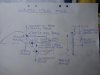
I have some more measurements regarding stylus drag. I think now I understand why there is not really any difference between silent groove and modulated groove if testing platter spin down time.
The reason might be that it´s only a minor increase in friction drag even if playing rather highly modulated grooves. Even if groove angle is 30degr the drag only increases with about 15%, so if friction drag is 0,4gf with a silent groove it will incease to 0,46gf.
I could be wrong but it would seem that other forces are minor and nearly self regulating, like acceleration forces, spring forces and damping forces.
I did a sketch of a very simplified lateral sine, comments about flaws are welcome.
gusten
Attachments
Similar threads


- Replies
- 28
- Views
- 3K

- Replies
- 88
- Views
- 11K


