• The move to the new server is done. There are some software and database maintenance updates in process. This has us passing the hat around to help out. We appreciate any donations. Seriously, even a dollar helps. The payment page may be found here - https://www.audiokarma.org/support.html

Idler wheel "magic"...

DominicL

Active Member
To those of you who contributed in an open minded positive way, I thank you! The rest of you will probably not even notice I took the content down. Probably never read it fully to begin with!!

Good Day!!
 

Attachments

  • DSC01374.jpg
    DSC01374.jpg
    41.9 KB · Views: 270
  • DSC01376.jpg
    DSC01376.jpg
    44.4 KB · Views: 258
  • DSC01383.jpg
    DSC01383.jpg
    48.9 KB · Views: 333
  • DSC01380.jpg
    DSC01380.jpg
    47.7 KB · Views: 347
Last edited:
Register to hide this ad
cool idea! I have thought about doing an external idler drive for a while, have the heavy motor in a separate housing and some sort of spring tension so the idler wheel pushes on the outside of the platter.

I wonder why the idler wheel on a belt drive table would effect the sound?
 
My direct drive Dual 701 [and a few nice Pioneers as well] sounds inferior to any of my idler-drive Dual. The few belt-drive Dual [and other brands, including Rek O Kut] I have owned have been just as disappointing.

I have given up trying to answer this question.
Be forewarned that most vinyl listeners here will laugh at us, but our superior ears don't lie.

Enjoy the Weathers.
 
Much as I like my Thorens, I have to admit my Lab 80 and the Zero-100 especially give it a solid run for it's money. Nothing about the Zero should put it in the same league, particularly given the Pickering V-15 I run on it and the cheesy as cheese can get plastic plinth, but something about that machine is just right. I'm not going to say its the idler drive but even my lower end AT6 variant in the KLH all-in-one sounds better than it seems like it ought to.
 
Plus 1

My direct drive Dual 701 [and a few nice Pioneers as well] sounds inferior to any of my idler-drive Dual. The few belt-drive Dual [and other brands, including Rek O Kut] I have owned have been just as disappointing.

I have given up trying to answer this question.
Be forewarned that most vinyl listeners here will laugh at us, but our superior ears don't lie.

Enjoy the Weathers.

Agree. My belt and direct drives have been a disappointment. My Duals beat them. Have two 1219s,a 1009,a 1015, and a 1229. They are all good. My 1229 sounds the best. It has a Shure M91ED with a JICO stylus-the $35 one.Ran a Shure M55 off the 1219 which was not as good. The second best is my first 1009. Heavy platter with no cue or antiskate. Just put a Radio Shack 1000 cart on it. It was their M91ED. Its a plain jane but it sounds great. That cart came off my Dual 1015. sounds better on the 1009. Rim drives are the best sounding on my systems.

Good luck with the Weathers. Remeber them in the Allied and Lafeyette Catalogs:D: Always wanted one. Enjoy. Off to bed. Always end the day spinning an LP. Got the Dual 1229 there as my daily player. Spun some 45s on the 1009 in the man cave stacked on the tall 45 spindle I got with the 1015.after work today. Beats cutting grass! Best hobby ever.
 
I've done similar comparisons between idler and belt drives and reached the opposite conclusions to yours. My Dual 1214 -- with the heavier alloy platter off a scrapped 1218 -- sounded very good last time I auditioned it, but my Technics and AR belt-drives just sound better. The Dual is currently out on loan to a friend who's doing some 78 dubbing. I may give it another try when it comes home just to be certain of where it belongs in the pecking order. I also have a Garrard Zero 92 that I may take for a spin.
 
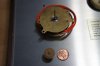
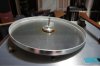
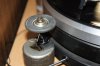
A few weeks ago, I bought a Weathers "the Townsend" turntable off the bay for a fair price. After opening the original box i was little put off by the extremely light weight of the platter (less than 1 pound!) and the miniscule size of the idler and motor. (Pics below). Well after fiddling a bit to get the speed right and the tonearm to track correctly, I found it sounded as good as any of the idler wheel tt's I have. (dual 1019, qrk 12 c, dual 1219, rek o kut l34 etc) It had the idler wheel magic of clearing up the smeared low level music and just more of a sense of realism then my belt drives. It got me thinking that if the idler wheel turntable's forte is speed stability, how come this puny idler wheel matched up to a light weight platter could sound so good. This turntable could not possibly hold its speed as good as the qrk or dual turntables with their heavy platters. A dust brush could slow the Weathers down! It had to be something else, I thought. So with that in mind, I cobbled up the below idler wheel mounted on a dust brush pedestal. Rested it to the platter of my Ariston rd 40 belt drive and bingo! Same sound as from an idler drive! No smearing of the low level music, and the same sense of the musicians being in the room with me! My guess is that the idler dampens the platter in a good way and clears up the low level sounds. Tried it on my Empire and same results. It's easy to a-b test since I can place the idler on and off the platter in a second or two. Has anyone else tried this and had similar results? Or am I imagining this? I think I have a pretty good ear and it sure sounds better to me. I would love for someone else to try this to see if it's as noticeable as I think. I know my turntables are not high end by any means so maybe this would not have as profound an effect on say a Sota Sapphire belt drive? Any other ideas as to why this works? I am going to try this with a direct drive after I figure out how to mount the idler wheel against the platter. Turntables are a tinkerers delight!!

Looking at the pictures, I'm not sure you actually have a standard idler drive setup. Normally, he idler wheel is between the motor capstan and the rim of the platter (Or underneath the platter in the case of the Lenco.) Looking at the picture, it looks like the rubber wheel is attached to the motor and directly driving the rim of the platter. This is not an idler wheel drive but a rim drive (VPI has one of these) it may indeed sound very good because there is little slippage but not the same thing as an idler drive.
 
The best idlers are the heavy platter, heavy motor professional decks in more substantial plinths. Exception is the Lenco heavy platters while lighter weight in some ways do have the motors, platter, and bearings way above average.
 
I have repaired a few CS-5000, and they do indeed sound good. I can only imagine how much better they would sound without all that plastic in the arm and platter bushing support pedestal.
And in the base.
 
I have repaired a few CS-5000, and they do indeed sound good. I can only imagine how much better they would sound without all that plastic in the arm and platter bushing support pedestal.
And in the base.

I intend to find out someday. It's don't think it will be too hard to make a new plinth for it and take care of the pedestal and the base. I'm not so sure about messing with the arm though.
 
oh yeah , my Garrard 401 and russco studio pro b are amazing sounding tables, I cant say enough nice things about Idler drive turntables

but...

I think what the OP has done is take a belt drive turntable and install an external idler wheel( no external motor) just to use the wheel as a dampener. the table is still belt driven, correct?
 
So, what we are talking about here is basically a way of dampening the platter, right? I don´think that external iddler is doing anything else.

I wonder what the result of using a sufficiently large "O Ring" around the platter would be.....:scratch2:
 
I think that you are barking up the wrong tree. I have a talent for damping platters, and damping does little in making a belt or direct-drive turntable sound like an idler-drive.
 
oh yeah , my Garrard 401 and russco studio pro b are amazing sounding tables, I cant say enough nice things about Idler drive turntables

but...

I think what the OP has done is take a belt drive turntable and install an external idler wheel( no external motor) just to use the wheel as a dampener. the table is still belt driven, correct?

Correct...the idler is just rubbing on the outside of the platter doing it's dampening thing.

Also, regarding large o ring, I did try installing an old belt from an empire around the platter to damp it but could not change quick enough to do the a/b testing properly.
 
I think that you are barking up the wrong tree. I have a talent for damping platters, and damping does little in making a belt or direct-drive turntable sound like an idler-drive.


I would try it with an old idler wheel anyway...you may be in for a pleasant surprise. :yes: It might be the moving rubber. What I originally posted is that, after a/b testing, I find it hard to believe that idlers or "rim drives" sense of realism has to do with speed stability. All I know is that my fairly good sounding belt drive turntables sound just that much better with the idler running round the outside of the platter. :music:
 
My direct drive Dual 701 [and a few nice Pioneers as well] sounds inferior to any of my idler-drive Dual. The few belt-drive Dual [and other brands, including Rek O Kut] I have owned have been just as disappointing.

I have given up trying to answer this question.
Be forewarned that most vinyl listeners here will laugh at us, but our superior ears don't lie.

Enjoy the Weathers.

Re:Weathers...Thank you!

Good to see i am not alone! Laugh they can. I don't care. I never was much of an audiophile any way. IMHO, big bux don't "always" = big sonic returns! Sometimes yes, but not always! :nono:
 
SSsssssshhhhhhh! You are coming perilously close to letting slip one of the most closely-guarded secrets among the audio cognoscenti, the true basis of the potential superiority of idler-drive technology.

There are a very few DD turntables that achieve the same end (the Yamaha GT-2000 is the most available and affordable example I have found), but belt drives? Ssssshhhh! If there weren't so many people out there believing in and preferring them, they'd push the prices of our old idler gems-in-the-rough up too much. It has already occurred with 301s, 401s and TD-124s, and is beginning to happen with Lencos. If people REALLY find out what is behind all the sound of these, and how to transfer that potential to other gear to create incredible giant-killers, we'll never be able to find the sleeper bargains again!

:D


The real irony behind ALL of this is that NONE of the manufacturers making any of these TTs --INCLUDING the ones making the idler drives-- ever realized what really was making their systems ultimately better or worse; they only tweaked around the edges, with less-important factors. The idler makers didn't discover how to get the full potential out of their gear, although a few accidentally came close. The belt-drive crowd found ways to overcome most of the weaknesses in their design concept, and made a great marketing virtue of the key element that actually was its most fatal limitation, but the design has always remained --and always will remain-- limited, and thus never the truly best-sounding. The direct drive people had a potentially competitive design, but because they neglected to focus on the right aspects of it, most of them also failed to maximize sonic potential, and made less satisfying machines than they might have. The idler-wheel people had potentially the best design of all, actually far, far superior to belt drives and most ordinary DDs, but never realized why it was so, and thus never managed to bring it anywhere near its potential. They made the ultimate undiscovered gems in the rough!

It's all about physics, and boils down to something fairly simple, which I think manufacturers would have figured out by now, if CDs hadn't taken over... and with the aid of the Internet and some luck, perhaps someone will start manufacturing a TT that truly takes advantage of the simple truths... but let's not make it too easy for them, shall we?

 
Great post Arkay. I would add though, that many of the classic idlers also have great build quality, of a kind that had mostly gone by the time of belt drives. E.g. I'm comparing the TD135 I'm restoring at the moment with my TD125. The giant killer idlers are usually over-engineered. Garrard 301 and 401 in particular.
 
Great post Arkay. I would add though, that many of the classic idlers also have great build quality, of a kind that had mostly gone by the time of belt drives. E.g. I'm comparing the TD135 I'm restoring at the moment with my TD125. The giant killer idlers are usually over-engineered. Garrard 301 and 401 in particular.

True enough about the over-engineering... but the real secret is that "giant killers" can be made from some of the lesser-known models, if you know what to do with them. The over-engineering on the models you mention really helped, but the essence of why they are good, I suspect, probably was an accident that eluded their manufacturers. Garrard continued to make other models that failed to exploit the benefits of the 301/401s. Jean Nantais discovered the potential of other models with the Lencos (which admittedly have real advantages over other models), but there are others with potential, too (albeit not as great). It all boils down to something I call "the big T" or "IT" or "PT" (I won't say more, at this point), and a few other, lesser factors. It's more inherent to idler wheels than most other designs, and even inherently absent from belt-drives. It's the reason, I suspect, why I keep the GT-2000 in my rig. I'm not the first/only person to figure this out, but there is very, very little discussion of it out there, up to now. I'm curious to see, with the Internet at work, how long it takes for this to become "common knowledge". Intelligent application of this allows DIY tables to be cobbled together from other models that are in their own right "giant killers". Most DIYers fail to recognize this.
 
Last edited:
Back
Top Bottom