70W, I test everything I buy on it and it usually goes outWhat wattage is the bulb in your DBT?


You are using an out of date browser. It may not display this or other websites correctly.
You should upgrade or use an alternative browser.
You should upgrade or use an alternative browser.
Kenwood Ka6000
- Thread starter Dart07
- Start date
70W, I test everything I buy on it and it usually goes outWhat wattage is the bulb in your DBT?

Semanon
Super Member
Just to be clear, with the jumper removed, the bulb still remains bright?The bulb still does not go out, jumper "A" and pre out- main in disconnected. What's next?
removed "A" and disconnected "pe out- main in", still bright, diode measurement, the meter on the diode test shows 388mV and O.L. on all similarlyJust to be clear, with the jumper removed, the bulb still remains bright?
Attachments


Last edited:
how to test a transformer so there are no doubts? primary winding measured on the 12ohm plug, secondary winding red +65V to red 0V 2.6ohm, does that say anything, it is burnt ?Is that 4A the main power fuse? That cap is across the power line if it is C305.
If indeed it is C305 disconnect one end and power it up on the Dim Bulb again.
And if you replace it (looks like you should no matter what) be sure to get an AC line rated safety cap for it.
View attachment 3494614
Semanon
Super Member
Im suspecting a shorted power supply cap. These can be tested in circuit for shorts as a preliminary test but should be tested out of circuit for capacitance and shorts. This can mean unsoldering one leg.capacitors checked in the circuit are also conducting,
Next is to test power supply voltages. Keep it on the DBT. Voltages will be lower than noted, but close enough for now.
After that, I’d suspect a short to ground somewhere that will take patient troubleshooting.


Red to Red on the transformer will be an AC voltage. Schematic calls for 65 VAC.removed "A" and disconnected "pe out- main in", still bright, diode measurement, the meter on the diode test shows 388mV and O.L. on all similarly
I think it may be time to shed (isolate) some loads from the power supply to try and pinpoint the problem area.
Lift one end of R301. The big resistor that comes from the + terminal of C301 and Dim Bulb test again.
If the DBT goes dim then the diodes and C301 are OK.
Beware with that resistor disconnected C301 will hold a charge for quite a while.
You may want to quickly ohm check with your meter C307, C303 and C304. They are operated close to their voltage rating.

Semanon
Super Member
Test the output voltage and match against expected voltage.how to test a transformer so there are no doubts?
after disconnecting R301 no change, the bulb does not go out,Red to Red on the transformer will be an AC voltage. Schematic calls for 65 VAC.
I think it may be time to shed (isolate) some loads from the power supply to try and pinpoint the problem area.
Lift one end of R301. The big resistor that comes from the + terminal of C301 and Dim Bulb test again.
If the DBT goes dim then the diodes and C301 are OK.
Beware with that resistor disconnected C301 will hold a charge for quite a while.
You may want to quickly ohm check with your meter C307, C303 and C304. They are operated close to their voltage rating.
View attachment 3497430
Thank you for your support Gentlemen, I will try to fix it with your help.I just had a ka-6000 (and matching tuner) across the bench.
Dart, you are in good hands.
I'll try to follow along. The ka6000/kt7000 pair are nice once you get it sorted out.
That tells us the problem is the filter cap or the diodes. Disconnect one end of the wire coming from the diodes to the plus terminal of C301 and test again.after disconnecting R301 no change, the bulb does not go out,
If bulb still bright you have a bad diode and will have to lift one end of each to test them properly. I'm not sure why you got the odd double diode readings on your tester.
I disconnected the diodes from the cable to c301, the bulb does not light up, does not even flash for a moment, no reaction, but the aux light on the panel is on.That tells us the problem is the filter cap or the diodes. Disconnect one end of the wire coming from the diodes to the plus terminal of C301 and test again.
If bulb still bright you have a bad diode and will have to lift one end of each to test them properly. I'm not sure why you got the odd double diode readings on your tester.
I will buy and replace all diodes with new 1N5408, I will test again and report, re-measurement of diodes after disconnecting from C301
Attachments


Last edited:
That is the expected result. there is no load on the diodes so no big current surge to charge the cap. That tells us you don't have a shorted diode.
Leave the wire form the diodes off and disconnect one end of R301 if you put it back. I don't know if your component tester can check such large caps but try it on C301.
Make sure it is discharged first, check voltage across it with the meter.
Do you by chance have any 100 volt rated caps in the junk drawer? 1000uf or better?
I am an amateur, I have a rlc t4 meter, it should measure it according to the data... I don't have a 1000uF 100V capacitor but I will buy what I need... (4700uF 100V)That is the expected result. there is no load on the diodes so no big current surge to charge the cap. That tells us you don't have a shorted diode.
Leave the wire form the diodes off and disconnect one end of R301 if you put it back. I don't know if your component tester can check such large caps but try it on C301.
Make sure it is discharged first, check voltage across it with the meter.
Do you by chance have any 100 volt rated caps in the junk drawer? 1000uf or better?
should C301 be measured in the circuit or should one leg be disconnected from everything?
Attachments
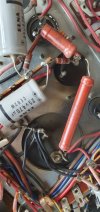
I see the resistor is lifted, I can't see the other things. One of the red wires goes to the diodes it should still be lifted and the other red wire probably goes to that socket which I assume still does not have the plug in it. I can't see everything.I am an amateur, I have a rlc t4 meter, it should measure it according to the data... I don't have a 1000uF 100V capacitor but I will buy what I need... (4700uF 100V)
should C301 be measured in the circuit or should one leg be disconnected from everything?
Basically anything that is connected to the positive terminal of C310 needs to be disconnected on one end, or in the case of the socket the plug should be out.
not very reliable meter..., he saw diode first but next cap... too high esr every timeI am an amateur, I have a rlc t4 meter, it should measure it according to the data... I don't have a 1000uF 100V capacitor but I will buy what I need... (4700uF 100V)
should C301 be measured in the circuit or should one leg be disconnected from everything?
Attachments


Once you get the short figured out and fixed...
i replaced C302-C305 with PW. I was able to fit all under side with only one new lug terminal strip. I also replaced the output caps with 4700uF/63v. You should be able to use 3300/50 too.
I did not try to measure the main filter cap. I've blown up a couple of similar meters trying to measure caps.
Don't forget to center the power supply voltage. Since you are on a dim bulb, just use the voltage at the main filter cap, divide by 2, and measure at each output cap + side.
I need you to confirm that the plug on top of the chassis is not presently installed. And that anything else connected to the + terminal of C301 is not connected.not very reliable meter..., he saw diode first but next cap... too high esr every time
A picture showing the bottom of the chassis with the socket and diodes and the cap all visible would be helpful. Don't be shy using pictures.
The ESR of that cap is pretty high, but that won't make it draw lots of current continuously.