• The move to the new server is done. There are some software and database maintenance updates in process. This has us passing the hat around to help out. We appreciate any donations. Seriously, even a dollar helps. The payment page may be found here - https://www.audiokarma.org/support.html

Klipsch Modifications

Do you have Forte l or ll? There aren’t many mods that can make them better- @Daveintn ’s L-MAHL tweeter is one; you may or may not find improvements by changing the mid driver and if you have Forte ll, adding MUMPS to the mid horn will reduce the beaming effect and improve off-axis dispersion.
Well, here we are again. https://community.klipsch.com/topic...s-for-my-midwoofers-room/#findComment-2887791

Cask05 apparently recommended the K510 to keep my 15" midwoofers from beaming.


Unless you could think of a better horn (s ??), have you personally heard the K510 horn without and with mumps?

If you think the sound quality difference is worth the trouble are there reputable modding services for adding the mumps?
 
Well, here we are again. https://community.klipsch.com/topic...s-for-my-midwoofers-room/#findComment-2887791

Cask05 apparently recommended the K510 to keep my 15" midwoofers from beaming.


Unless you could think of a better horn (s ??), have you personally heard the K510 horn without and with mumps?

If you think the sound quality difference is worth the trouble are there reputable modding services for adding the mumps?
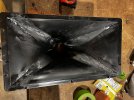
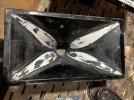
I’ve tried the K510 bare and with plasticine mumps on an alignment that was more or less equivalent to a forte and it was okay. The PRV WH4550 is significantly better. I even made my own mumps:
75549F9D-C0E2-4086-8036-B0CD2D680344.jpegIMG_6103.jpegIMG_6118.jpegIMG_6119.jpegIMG_6122.jpegIMG_6123.jpegIMG_6137.jpegIMG_6153.jpeg
 
Last edited:
Can you elaborate on how this horn presumably outperforms the K510? https://prvaudio.com/products/wg45-...9wYIXNlDJ4PCVsY470oamaFjpApBmO6TVDaVqUDjp-5hk

If only had I such DIY skills. I'm sure my builder does. Hoping he'd agree to add the mumps.

Midrange driver?

Tweeter horn/driver combo?

Any particular reason why you didn't make it a two-way speaker?

I know beryllium drivers are very costly but have you ever heard any of the Radian or 18Sound Be drivers?
Or any of the JBL drivers fitted with Materion Truextent Be diaphragms? If cost were no issue would you have used one with that horn to make a two-way system?

Please share measurements: Directivity spectrograms, spectral decay, 3rd harmonic, IM distortion, frequency response?

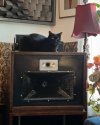
Nice friend you have there on his perch; like mine long ago.
 
Last edited:
Can you elaborate on how this horn presumably outperforms the K510? https://prvaudio.com/products/wg45-...9wYIXNlDJ4PCVsY470oamaFjpApBmO6TVDaVqUDjp-5hk

If only had I such DIY skills. I'm sure my builder does. Hoping he'd agree to add the mumps.

Midrange driver?

Tweeter horn/driver combo?

Any particular reason why you didn't make it a two-way speaker?

I know beryllium drivers are very costly but have you ever heard any of the Radian or 18Sound Be drivers?
Or any of the JBL drivers fitted with Materion Truextent Be diaphragms? If cost were no issue would you have used one with that horn to make a two-way system?

Please share measurements: Directivity spectrograms, spectral decay, 3rd harmonic, IM distortion, frequency response?

Nice friend you have there on his perch; like mine long ago.

Also, 15" woofer? If yes, where do you cross it with the midrange driver/horn?
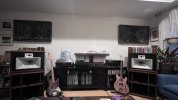
my speakers are a vented 3-way horn system based on the LaScala bass bin, with a rear-mounted 15" passive radiator and constructed from 1” Baltic birch.m. The bass bin is braced, with corner transitions with a JBL 2225H driver and is coupled to the upper horn enclosure, with an interior volume of approximately 8-1/2 square feet, or about 240 liters. mid is the PRV WG4550; I originally used a PRV D2200Ph driver, which is a fantastic value and very popular 2" driver with many DIYers in this forum; I'm currently using a PRV D4500Nd-Ph. Both were crossed at 475Hz, below which the drivers lose directivity; I did not test whether it was a limit of the driver or the waveguide; I assume it's a bit of both. Tweeter is @Daveintn's excellent L-MAHL with a B&C DE10. and crossed from the mids at 4500Hz. I'm using a Thomann T. Racks FIR DSP-408 processor, with 4 Fosi ZA3 mono blocks with Burson V7 op-amps om the tweeters and woofers and a pair or EL-84 differential mono blocks on the mids.

1752233666733.jpeg

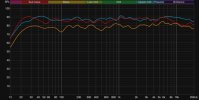
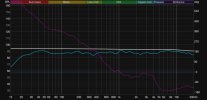
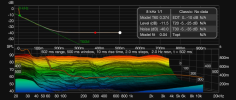
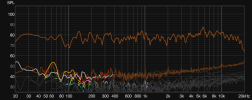
Frequency response in room is +/- 3dB from 20Hz to 20kHz; it simulated to 28Hz, which presumably would be its approximate response in an anechoic room.
1752233756103.jpeg

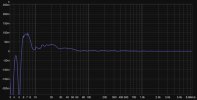
my primary focus was tuning the frequency & phase responses, time alignment and group delay, secondary focus was tuning my room; I have not taken directivity measurements.
SPL + Phase:
1752233944077.jpeg

Group Delay:
1752234041601.jpeg
1752234080584.jpeg
1752234118887.png

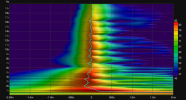
Spectrograph:

1752234168003.png

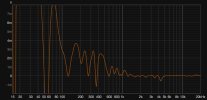
RT60 Decay:
1752234340022.png

Distortion:
1752234402198.png

I have not taken IM distortion readings, that feature was not available in REW when I did my last round of testing a bit over a year ago. There is an overly detailed build thread here on this forum. Quite a few of us have done LaScala and/or Peavey FH-1mods using the PRV WG4550 and the PRV D2200Ph drivers and many have incorporated Dennis Kleitch's DJK Port mods as well; I simply took an extra step, eschewing ports for a passive radiator. I didn't do a 2-way, partly due to cost- a driver capable of 500Hz to 18kHz is exponentially more costly than either of the PRV drivers, partilularly the D2200Ph, which retails around $65 each. Aesthetics were another reason: using the 15" rear passive resulted in a rather large baffle up front, it would have looked odd as a 2-way. That said, at some point, I may redo the upper enclosure and build a mini K402-like horn that fills the baffle space up front and run it either as a 2-way or as a Unity horn. I anticipate either would result in a decrease of frequency response on the low end due to the displacement of the larger mid horn.
 
Last edited:
For the 70th anniversary of my birth, my amazing wife surprised me with a pair of '81 Belle's. A previous owner installed CT-120's and recapped the AA crossover. The squawker is the K55V solder lug. Haven't checked the woofer yet.

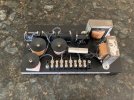
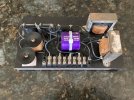
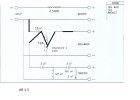
I knew this crossover was not ideal for the drivers, so I bid on and won a pair of AB crossovers. What an odd crossover. No low pass to the woofer and a 1khz(?) high pass to the squawker. Seems like a waste of a wonderful squawker to me.

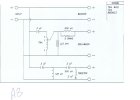
Here's the AB and the schematic.

thumbnail_IMG_0757.jpg

Belle_Type_AB.jpg

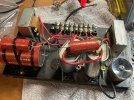
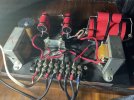
Here's the modded AB and it's schematic. I could have added a 10uf capacitor in parallel with the 5uf to get my desired 15uf, but decided on a new 15uf cap.

thumbnail_IMG_0758.jpg

Belle_Type_AB_Modded.jpg

I decided to reuse as many parts as possible. I moved the parallel 2.5mh inductor from the squawker circuit to a series position on the woofer circuit.

I reused the T2A autoformer in an unusual way to make up for the removed 2.5mh parallel inductor. I moved the "output" of the 15uf capacitor from tap 5 to tap 2 and connected the K55V to tap 1. The inductance between tap 0 and 1 is 2.8mh. Close enough. Using these taps, the K55V will be attenuated by 3db. I wanted to get closer to -4db so I moved the tweeter circuit to tap 2. This should knock down the squawker due to the sharing of the 15uf cap.

I'm still recovering from hernia surgery and am nervous moving heavy objects. When I get brave I'll measure the Belle with the installed AA, the stock AB, and the modded AB.
This seemed like a good place to document my project.


AB 1.5?

Mike
 
I think it’s hilarious that people keep removing and tossing those caps. They may be Mylar, but they’re film and foils. Gary Gillum had those made. I’ve never measured one that wasn’t good.

Some nice wizardry there Mike.
 
For the 70th anniversary of my birth, my amazing wife surprised me with a pair of '81 Belle's. A previous owner installed CT-120's and recapped the AA crossover. The squawker is the K55V solder lug. Haven't checked the woofer yet.

Mike
Congrats! mine was two weeks ago. Got a pair of topping B100 amplifiers. With the 151 dB SN and dynamic range they are perfect with Klipsch. My La Scala II have never had it so good.
 
No sound. The proverbial straight wire with gain. Very tight bass. Only 50 watts into 8 ohms. But with LS II they may never output 5 watts.
The noise floor is so low an APx55B cannot measure it. They put a 40 dB amplifier between output of B100 and input of APx55B. This boosts noise and THD to a measureable level. Then move the decimal point over two places. Or subtract 40dB from measurement.
Was using a Micromega intergrated. It has a resonant mode power supply like an AHB2. It is dead quiet too. But I think not as linear at really low power output. Bass not nearly as tight. Best bass so far from La Scala’s. Turned off sub for a while. Using a Final Sound S220 for the flexibility.
If you look on the Topping B100 material, they sweep THD+N vs output power into 4 and 8 ohms. Still very low at 0.1mW. Never seen this sweep run below 20mW before. That is what hooked me.
Like the SET guys have been saying for 40 years, every note goes through zero. The first watt is what counts. There are a lot of zeros after decimal point and before the numbers at one watt output.
The La Scala’s with DE120’s and WAHL’s are my endgame speakers. The B100’s endgame amplifier.
Getting there at 70.
 
If we could go on a tangent, it seems there's a current of 'film-n-foil is better than metallized' for crossover caps.

Dean (or other local Big Fish) would you care to do any elaboration from the technical side of that? What are your experiences
 
Was asking for more of a Grad School level view of what is seen in-circuit than a Kindergarten overview. I'm sure I wasn't clear.
 
Bob Stout was an industry insider. The following is from my notes.

Bob Stout/capacitors

List: basslist

Subject: RE: Capacitors

From: Bob Stout

Date: 2002-04-09 14:09:11

On Tue, 9 Apr 2002, Clark Judson P wrote:

> What do you mean by "superior" and "better"?

Primarily, lower noise. Capacitor noise is generally caused by flaws in the dielectric or poor terminations. The reason film and foil is "better" than metallized foil is one of metallized films special "features". You will hear vendors speak of metallized foil as self-clearing. All this means is that if there's a pinhole in the film, a temporary arc will vaporize the metal around the pinhole. This is great for long term viability, but bad for noise since each time this happens, it adds noise.

Also, most don't tell you that this only happens when the leakage current through the pinhole is adequate to heat the metallization to the point of vaporization. As noted, this is primarily a factor in polypropylene, since of all the popular high-stability dielectrics, it's the softest and therefore most likely to: a) have pinholes as received from the film vendor, and/or b) develop pinholes during winding.

Another advantage to film and foil is lower ESR since the bulk resistance of the foil is lower than that of the film metallization. I expect this could play a role in any sort of capacitor-induced distortion, since as ESR decreases, the closer the cap approaches a perfect model. Whether the amounts of distortion potentially resulting from this would be audible or not is open to debate. Noise, OTOH, is clearly measurable and therefore, presumably, audible as well.

Finally, in any discussion of passive audio components, one consideration that can't be ignored is the dynamic range of the signals involved. This is why only better quality dielectrics are really suitable since their small signal and large signal characteristics track better than, e.g., NP electrolytics or even Mylar. This difference can also introduce measurable amounts of distortion. This is also significant in noise, since each pinhole may not be cleared by the first spike to come along - until it gets cleared, noise will be added to the signal. This becomes significant when you consider the 10-20 dB dynamic range of typical audio program material. IOW, those 100 Watt peaks may not come often enough to clear the pinholes since the average power is closer to 1 Watt. This is also why non-inductive wirewound resistors are better in crossovers than film or bulk metal types. This does, however, support the contention that metallized film may sound better after "burn-in". For film and foil, the potential advantages to burning them in become debatable.

Finally, I should add the audibility of all these is open to discussion and would only be a potential issue when the rest of the parts used in the design are of sufficient quality. For most purposes, metallized film caps are OK, even in the signal path. This does bring up one last issue, though... Noise and distortion are still noise and distortion even when they're not in series with the signal. Outside the direct signal path is less critical, yes, but their effects are still there in parallel with the drivers and/or other components.
 
Anyway, they don’t sound the same. Some discussion regarding DA, but I’ve really given up trying to figure out why.

As for metallized, the inexpensive variety use recycled pellets for the film and conductive paste for the lead terminations. Expensive types use amorphous pin-hole free film, are double wrapped, and some are fully protected. As a builder, these latter features are important to me.
 
Waaay back in the dark holes of my brain, I think I've read that forum post before. Great to hear it again, thank you for posting.
 
My Klipsch type AA crossovers showed a big improvement when I switched the original spam cans for Jantzen Superior-Z‘s. Much more open with deeper soundstage and better detailed imaging.
 

Attachments

  • IMG_0231.jpeg
    IMG_0231.jpeg
    160.7 KB · Views: 25
  • IMG_0268.jpeg
    IMG_0268.jpeg
    131.6 KB · Views: 25
Back
Top Bottom