• The move to the new server is done. There are some software and database maintenance updates in process. This has us passing the hat around to help out. We appreciate any donations. Seriously, even a dollar helps. The payment page may be found here - https://www.audiokarma.org/support.html

Lets See All Them Axes

You have Epiphone and Gibson,
You have Squier and Fender,
You have
1785255919808.png
and no substitutes...

Well, you have Gretsch guitars made by The Fred Gretsch Company in Brooklyn, then sold to Baldwin in 1967 and made in Arkansas. Then bought out by Fender in 2003. Now you have Gretsch guitars made in Japan, Korea and China...most of what you see in stores today.

I have a '77 Nashville ( Baldwin ) Gretsch.
Better binding and detail work than Brooklyn.
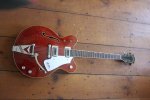
IMG_7559.JPG
 
Last edited:
Well, you have Gretsch guitars made by The Fred Gretsch Company in Brooklyn, then sold to Baldwin in 1967 and made in Arkansas. Then bought out by Fender in 2003. Now you have Gretsch guitars made in Japan, Korea and China...most of what you see in stores today.

I have a '77 Nashville ( Baldwin ) Gretsch.
Better binding and detail work than Brooklyn.

View attachment 3808432
They were also purchased at some point, by St Louis Music and made in Japan, Korea & China. According to internet legend, this 2003-4 Arbor was left over stock after Fender purchased the licensing rights and subsequently rebadged:
1785271026696.jpeg
I've since refinished it and rebadged it anew.
 
I have another one leaving the shop today.

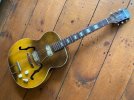
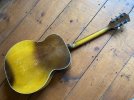
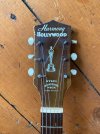
A 1960's Harmony H41 Hollywood. Peter got it for $60. The top and back had come loosed from the sides and somebody had tried to glue it back together with gorilla glue ( always a bad idea ). I managed to slide a fine knife thru and removed most of the gorilla. Then slowly clamp my way around the body using white glue.

Clean and polish, a little fret work, needed a new nut.

Unfortunately they also used gorilla glue to hold the bridge to the top. Not much I can do about that, intonation is close but not perfect.

The tuner posts for both E strings were missing, I managed to find some pieces in my parts inventory and put them back together. All the ferrules are missing, typical.

Both pickups work fine. The gold foil DeArmonds never disappoint. Master volume and master tone. The coolest feature is the blender pot instead of a pickup selector. Really lets you dial in some unique tones.
I'd like to do that to some of my instruments.

No pickguard, no case.


IMG_7466.jpgIMG_7468.jpgIMG_7467.jpgIMG_7469.jpg
 
^^^ Single p/u model just like this one was my first guitar...for about 2 hrs before we brought it back. In hindsight, non adjustable neck was wonky and perhaps like your friend's, some tuning buttons missing (isn't that what pliers are for?) Never let an 8th grader buy a guitar alone with another 8th grade "player" :rolleyes:

Dad got my lawn mowing money back, LOL
 
Interweb claims the guitar is worth $500 to $1,000 depending on condition. I'm sure the money is in the pickups....jazz guys love them.
(I was working for Fender when they bought DeArmond, we were all excited for them to re-issue the p/u but all the tooling was gone and mgt. decided it wasn't worth the investment.)

The Guitar has typical Harmony feel and build quality.
Clunky neck, rough mystery wood fingerboard, painted binding and position markers, narrow fret wire.

Single p/u was the H39, double was the H41.
The model between those, the H40 was completely different....a flat top with mag p/u.
 
img_7466-jpg.3816635

I have another one leaving the shop today.

A 1960's Harmony H41 Hollywood. Peter got it for $60. The top and back had come loosed from the sides and somebody had tried to glue it back together with gorilla glue ( always a bad idea ). I managed to slide a fine knife thru and removed most of the gorilla. Then slowly clamp my way around the body using white glue.

Clean and polish, a little fret work, needed a new nut.
I bet that puppy can do some crazy feedback! I’d love to noodle around with that guitar next to a Champ amp.

Thanks for the photos!

:thumbsup:
 
Good idea. I'll have to bring my Champ next time I visit. I played it thru my Bose S1 just for testing. It sounded real good with a slide, buried in reverb.
Neck pickup has a big cap to make it muddy sounding, like that awful switch on a Gretsch. Bridge is bright, even sharp. Blending the 2 with the pot allows that sweet spot. I'm surprised that feature never caught on.
 
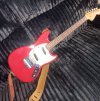
So, I'm looking at guitars in the pawn shop, and I see a vintage Fender on the wall with a price tag on it that was less than you would expect to pay for a used CV Squier. Naturally I ask the guy if I could see it. He says "it's a fake". Well, it looks pretty authentic to me, so I tell him I'm still interested. As he hands it to me, I ask what makes him think it's not legit. Everything he shows me either means nothing, or actually confirms it's authenticity. Serial # can't be confirmed, bridge doesn't look right, F stamped tuners, Fender decal on top of finish. Ok, I'm not going to do his job for him, and he probably only paid $100 for it to someone who didn't know any better. So rather than educate him I brought it home. It's an absolutely authentic and 100% original 65 Mustang. 20260812_073743.jpg20260810_150057.jpg20260810_150254.jpg
 
Good idea. I'll have to bring my Champ next time I visit. I played it thru my Bose S1 just for testing. It sounded real good with a slide, buried in reverb.
Neck pickup has a big cap to make it muddy sounding, like that awful switch on a Gretsch. Bridge is bright, even sharp. Blending the 2 with the pot allows that sweet spot. I'm surprised that feature never caught on.

Nice job on that guitar! Was it typical for them to run the pickup wires on the top of the body like that? Can't say that I've ever seen a guitar wired like that before.

As for pickup blend pots, I seldom see them on electric guitars but they're pretty common on bass guitars nowadays, especially on models with active electronics and onboard EQ. Five of the six electric basses I own have them. Super useful! I really like having the ability to adjust volume without affecting the pickup balance, too.
 
So rather than educate him I brought it home. It's an absolutely authentic and 100% original 65 Mustang.
Nice score. Congrats.
Can you tell us how much you paid ?

Was it typical for them to run the pickup wires on the top of the body like that? Can't say that I've ever seen a guitar wired like that before.

It was originally covered by a large pickguard.
It's a common practice, mostly on surface mount pickups that don't require a cut-out.
I've also see it on some jazz guitars that have the pickup mounted on the pickguard.
 
Nice score. Congrats.
Can you tell us how much you paid ?


It was originally covered by a large pickguard.
It's a common practice, mostly on surface mount pickups that don't require a cut-out.
I've also see it on some jazz guitars that have the pickup mounted on the pickguard.

Interesting! Thanks for that. Now that you mention it, I guess I have seen that on some jazz boxes with floating pickups.
 
Update on my Les Paul Deluxe. I've had it since high school around 1976.

IMG_7563.JPG
I always wondered why it had full size humbuckers instead of the mini's that were in most Deluxe. Never got a good answer, was clearly done at the factory. Even asked some former Gibson mucky mucks about it. Nobody knew.
The other day I found this on Wikipedia:

"Gibson produced 216 Deluxe Gold Top as specially-ordered guitars with full-size humbucker t-tops pickups between 1972 and 1974 (179 in 1973, 28 in 1974 and 9 in 1972), as a Les Paul Standard pickup specification."
 
Are you sure those are OEM 'buckers from the factory? I thought Gisbon didn't offer coverless pups (mini or full-sized) in the 1970s?

Thanks!
 
The guy I bought the guitar from had taken the covers off.
When I asked him about it he said it 'screamed' better without the covers.
At one point I put them back on, realized he was right, and took them off again.

I'm partial to uncovered humbuckers in my own builds, probably because of that.
 
Back
Top Bottom