

You are using an out of date browser. It may not display this or other websites correctly.
You should upgrade or use an alternative browser.
You should upgrade or use an alternative browser.
Magnified LP grooves--pretty cool.
- Thread starter heekma
- Start date
Register to hide this ad


heekma
Well-Known Member
Magnify many things to this level and all sorts of imperfections become apparent, some massively so.
What I find most amazing is even at 500x just how clean the valleys of the grooves--where the stylus resides--have been cut.
It really is amazing to consider the purely mechanical process of record cutting, and the vinyl medium itself can result in grooves this relatively precise. I do wonder if the magnified LP was new and un used, modestly used or mildly abused?
When I see the grooves magnified like this, I can't help but marvel at all the purely mechanical interaction going on--the interaction of the stylus and groove, the tracking of the tonearm, the speed and relative "trueness" of the platter rotation vs. the "trueness" of the record cutting, etc., etc., etc., and yet LPs can still sound magnificent.
When looking at the "bumps" of the CD, I'm reminded the most significant difference in the physical retrieval of information--before DAC--is a laser vs. a stylus--however, the reflected laser is--initially, at least in purely physical terms, before error correction--only as accurate as the surface its' reflected off of.
What I find most amazing is even at 500x just how clean the valleys of the grooves--where the stylus resides--have been cut.
It really is amazing to consider the purely mechanical process of record cutting, and the vinyl medium itself can result in grooves this relatively precise. I do wonder if the magnified LP was new and un used, modestly used or mildly abused?
When I see the grooves magnified like this, I can't help but marvel at all the purely mechanical interaction going on--the interaction of the stylus and groove, the tracking of the tonearm, the speed and relative "trueness" of the platter rotation vs. the "trueness" of the record cutting, etc., etc., etc., and yet LPs can still sound magnificent.
When looking at the "bumps" of the CD, I'm reminded the most significant difference in the physical retrieval of information--before DAC--is a laser vs. a stylus--however, the reflected laser is--initially, at least in purely physical terms, before error correction--only as accurate as the surface its' reflected off of.
Last edited:

Echoes Myron
Active Member
Thanks for the link! These are stunning images.

similost
Rockin and Rollin....
Very cool pictures..
Here's some more for you. There are several pages here. Some show grooves, some show dirt in them, other show wear, and some are of styluses and cantilevers worn and broke..
http://www.micrographia.com/projec/projapps/viny/viny0100.htm
Here's some more for you. There are several pages here. Some show grooves, some show dirt in them, other show wear, and some are of styluses and cantilevers worn and broke..
http://www.micrographia.com/projec/projapps/viny/viny0100.htm

That's a pretty good picture of a CD. I work in the DVD industry and have seen many examples of CD, DVD and Blu-ray pits/grooves. We use high-magnification to look at pit formations to determine if the development time while burning glass/wafer masters is correct. Too much development and the edges start to round, too little and they don't fully form. It's this malformation which causes jitter and asymmetry.

71Challenger
Super Member
Very cool pictures..
Here's some more for you. There are several pages here. Some show grooves, some show dirt in them, other show wear, and some are of styluses and cantilevers worn and broke..
http://www.micrographia.com/projec/projapps/viny/viny0100.htm
That is a great site similost. thanks for the link.

Arkay
Lunatic Member
Excellent pictures! Thanks for sharing them! :thmbsp:
I have three microscopes I use for examining record grooves and stylus tips. Two are purely optical, but the latest --actually the best I've found so far, especially for stylus examination-- is a purely digital (usb link to a computer, with software) one I got from a Taiwanese manufacturer at an industry exhibition. I have mine mounted now on a modified Japanese jeweler's microscope base, with a tonearm end (so that headshells can be mounted without removing the cartridge) where the mirror mount used to be. It's fully micrometer-adjustable (as well as electronic zoom, etc...) with even, shadowless illumination from LEDs encircling the lens.
Unfortunately, I've been having software problems getting the large, manipulable images I should be getting, so right now I'm stuck with 1/4-field images sigh, but if/when that is sorted out with the manufacturer (It's possible the problem lies with my older computer's limitations...), I'll post about it (with pics) on AK. If enough people are interested to meet the manufacturer's minimum order requirements, we can do a bulk-buy.
I have three microscopes I use for examining record grooves and stylus tips. Two are purely optical, but the latest --actually the best I've found so far, especially for stylus examination-- is a purely digital (usb link to a computer, with software) one I got from a Taiwanese manufacturer at an industry exhibition. I have mine mounted now on a modified Japanese jeweler's microscope base, with a tonearm end (so that headshells can be mounted without removing the cartridge) where the mirror mount used to be. It's fully micrometer-adjustable (as well as electronic zoom, etc...) with even, shadowless illumination from LEDs encircling the lens.
Unfortunately, I've been having software problems getting the large, manipulable images I should be getting, so right now I'm stuck with 1/4-field images
sigh, but if/when that is sorted out with the manufacturer (It's possible the problem lies with my older computer's limitations...), I'll post about it (with pics) on AK. If enough people are interested to meet the manufacturer's minimum order requirements, we can do a bulk-buy.
spartanmanor
Lunatic Member
It is pretty amazing what sweet sounds can come from those grooves. Great photos, thanks for the link.


Doug G.
Lunatic Member
Here is my Shure stylus after cleaning with ME.
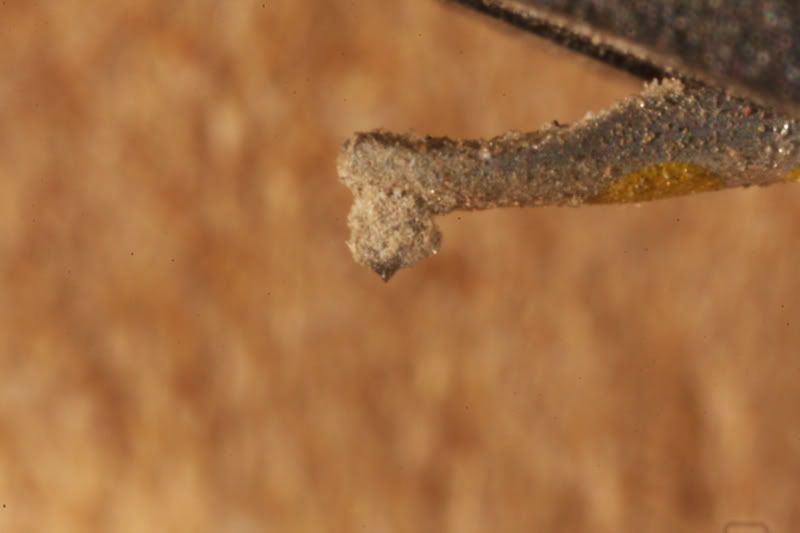
You definitely have a problem with your records not being clean or going too long between stylus cleanings.
Doug

Similar threads

- Replies
- 17
- Views
- 2K


- Replies
- 20
- Views
- 1K
