• The move to the new server is done. There are some software and database maintenance updates in process. This has us passing the hat around to help out. We appreciate any donations. Seriously, even a dollar helps. The payment page may be found here - https://www.audiokarma.org/support.html

Magnified LP grooves--pretty cool.

At Iowa State University in the late 70's I took a physics class "Physics of Stereo Reproduction." No kidding, actually got credit for taking this class.

They showed a magnified movie of a record groove similar to those pix. As the record turned you could see the "dust" striking the stylus and actually "shattering" chunks of vinyl, just like minature explosions. Another project had us figure the psi on a record groove from a conical stylus tracking at 1.5 grams. As I remember, since the surface contact area is so limited, it was well over 1000 lbs/sq inch.

I've never, ever, failed to clean records ever since seeing that video and doing those calculations.
 
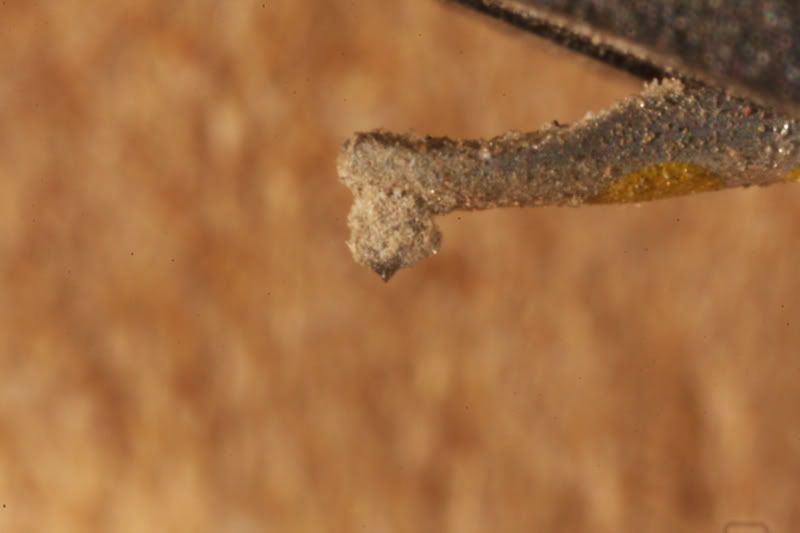
Here is my Shure stylus after cleaning with ME.

IMG_0001A.jpg

That's pretty fuzzy. I use the ME myself, but maybe the ME doesn't work so well? It would be interesting to see pics with different cleaning methods.
 
Quite revealing.

If one were standing on a record's surface between the grooves, what would it sound like, and what would the Richter Scale readings be as the diamond stylus thundered through the valleys...?
 
Thanks for the great post. The educational experience continues. Stuff like this keeps you reaching for that record brush before each play...
 
He needs a better LP cleaning regimen. There seems to be mold on the high spots and those boulders in the grooves!

Great pictures, thanks.
 
the 'cd' shot is a very nice indicator of how much musical 'information' isn't there on a cd. and the smearing and rough cuts on the vinyl give extra 'info' to the analog recording-although the vinyl might tend to smooth out under the pressure of the stylus.
 
Last edited:
tincat,

I agree they are very different--one is purely, almost at least--physical/mechanical, while the other is based on reflected light. I don't know if you can realistically compare the two that way. Kind of like comparing a snowmobile track to a snow tire--they both have similar jobs, but go about it in very different ways.

Either way, I find it fascinating that LPs operate the way they do and sound so great.

I don't mean this as an insult to LP enthusiasts--but in a way, tubes are similar. It's almost a "Rube Goldberg" kind of contraption, that even though it would seem it has too many physical obstructions to work well, work well it does--heck even better than "well," let's say "great!"

Best,

John
 
That's pretty fuzzy. I use the ME myself, but maybe the ME doesn't work so well? It would be interesting to see pics with different cleaning methods.

This particular stylus was given to me this way.
I cleaned it up with a zepher fingerprint brush and some lens cleaner.
This is the before ME.
IMG_0003A.jpg


This is after cleaning.
IMG_0014.jpg
 
Great stuff. I love that video. I work in a lab and get to use a SEM, scanning electron microscope everyday. We have two of them and they are amazing.
 
You can't actually assess stylus wear by looking at it from the side (profile)even under magnification, unless you look at it straight on from the top at 80X - 200X with the correct side lighting, what you're looking for are the shiny wear polish area's.

The photo's shown can only confirm that the diamond isn't cracked or chipped nothing more.

Even if you have the correct microscope and lighting, you need some experience examining the [particular stylus profile being examined, the best way to do this is to start examining your stylus
from the beginning of it's service life, then periodically from then on, while keeping track of the hours
it's been run.

In general what you're looking for a good stylus are symmetrical and distinct approx. equal polish areas, when the polish areas become asymmetrical with indistinct borders the stylus is usually shot
by this point it's likely damaging your vinyl :-(

The most practical way of keeping track is to use a Golf stroke counter

http://www.basspro.com/webapp/wcs/s..._60799_800015000_800000000_800015000_800-15-0

keep it by your table, punch it every time you change sides, tally it periodically and you'll know how much time that stylus has racked up, no guess work
Your basic cheap generic conical replacement stylus is good for between 200 to 300 hours
with decent record and stylus hygiene a quality elliptical can last 700 to 800 under the same conditions, a good quality Micro ridge or fine line, Shibata etc. can last between 1000 to 1400 hr's
a #1 profile VDH or Fritz Geiger can last as long as 3000 hr's under the same conditions
Once one of those is shot it becomes a nasty little vinyl lathe :-(
 
Back
Top Bottom