• The move to the new server is done. There are some software and database maintenance updates in process. This has us passing the hat around to help out. We appreciate any donations. Seriously, even a dollar helps. The payment page may be found here - https://www.audiokarma.org/support.html

My first tube amp - Scott LK-72-B

arossphoto

Active Member
Hi everyone,

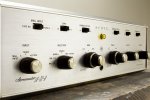
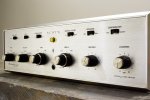
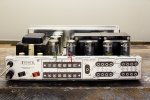
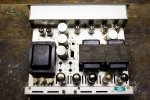
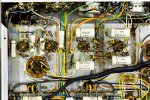
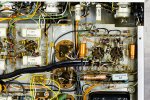
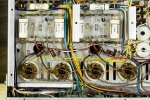
Thought I'd share some pics of a Scott LK-72-B I picked up recently. It's in very nice condition and looks original to me. I've been listening to it for a few weeks and it sounds really nice too. Only thing I've done is get the tubes tested. They all tested good except one 6U8, which oddly showed a short on one tester, but not on another. So to be safe I replaced them both with a pair of vintage RCAs.

I know I should consider replacing many other parts, and I have been doing a lot of reading on these forums and about what should be done, but if anyone has any suggestions on where to start I would really appreciate it.

One question I do have is about the bridge rectifier. I've read it should be replaced with a silicone rectifier, but I would really appreciate a recommendation for a specific product. Most of the discussions I've found about this are older and reference items that don't seem to be available any more.

Thanks and here's a few photos.
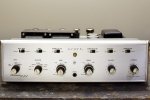
Scott-LK-72-B-1.jpgScott-LK-72-B-2.jpgScott-LK-72-B-3.jpgScott-LK-72-B-4.jpgScott-LK-72-B-5.jpgScott-LK-72-B-6.jpgScott-LK-72-B-7.jpgScott-LK-72-B-8.jpgScott-LK-72-B-9.jpgScott-LK-72-B-10.jpg
 
Last edited:
Register to hide this ad
A quick check of the bridge, I am not sure if it is still a Siemens Selenium, is to measure the voltage to the filaments of the 12AX7 tubes. If it is what it should be, the rectifier is doing its job. Or, the output from the bridge should be around -56 volts DC. If it is close, you should be OK for now.
 
BTW, that amplifier was constructed by someone who was proud of his/her work. Very neatly done from what can see in the pictures. One thing for you to know (if you don't already) is that the brass knob caps will often pop off easily. They are held on by some kind of brown glue and it often releases (after over 60 years!). Just a heads up. There is a guy on eBay who sells very nice reproduction caps for $5 each. The only difference is that they are a little darker and would look better if used in a set.
 
That's lovely. Mine is very similar and like yours and was built by someone with definite skills.
I replaced all the Ceracaps in mine out of an abundance of caution but every one of them still measured spot on.
Have you downloaded the manuals for it yet?
 
Wow, you'd be lucky to find one that pristine (and well-built) even back in 1970! Congrats! Only thing I see is that one of the 7591s appears to have been overheated.

Jack
 
Thanks all the replies. It's good to know the assembly was well done. It looked good to me, but I have a never owned a piece of equipment with point-to-point wiring, so don't have enough experience to really judge these things.

I have downloaded the "Full Color Instruction Book" and printed the schematic on 11x17 paper. I have some electronics experience and a few years ago I replaced all the capacitors on a vintage Sansui AU-11. But the printed circuit boards on that amp were labeled, so it was easy to find components on the schematic. I haven't spent much time looking at the Scott yet, but I so far I have found it kind of confusing and hard to identify components on the schematic within the actual amplifier.

I was reading a bit more about the rectifier and found this post that says "Also, look carefully at the bias bridge. If it is the square, Siemens Selenium Bridge, it is suspect. But the 299D (possible equivalent of the LK-72B) often had silicon rectifiers instead of the bias bridge, and it was mounted up front on the inside of the control mount. If silicon, I would start elsewhere."

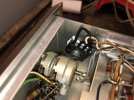
Is the item in the attached picture the bridge rectifier? Can anyone tell if it selenium or silcon?

IMG_0419.JPG
 
Thanks all the replies. It's good to know the assembly was well done. It looked good to me, but I have a never owned a piece of equipment with point-to-point wiring, so don't have enough experience to really judge these things.

I have downloaded the "Full Color Instruction Book" and printed the schematic on 11x17 paper. I have some electronics experience and a few years ago I replaced all the capacitors on a vintage Sansui AU-11. But the printed circuit boards on that amp were labeled, so it was easy to find components on the schematic. I haven't spent much time looking at the Scott yet, but I so far I have found it kind of confusing and hard to identify components on the schematic within the actual amplifier.

I was reading a bit more about the rectifier and found this post that says "Also, look carefully at the bias bridge. If it is the square, Siemens Selenium Bridge, it is suspect. But the 299D (possible equivalent of the LK-72B) often had silicon rectifiers instead of the bias bridge, and it was mounted up front on the inside of the control mount. If silicon, I would start elsewhere."

Is the item in the attached picture the bridge rectifier? Can anyone tell if it selenium or silcon?

View attachment 3329218
That is indeed a modern silicon bridge rectifier.
 
Only thing I see is that one of the 7591s appears to have been overheated.

Jack
I noticed that tube last week as welI, but I had them tested and they were all good. Should I still consider replacing that one, or could the overheating be an indication of another problem?
 
It could be the result of a leaking coupling cap. All those original caps need to be replaced before using the unit. This issue can also damage the output transformers. As for whether the tube is still good, you will need to measure cathode current and compare it to the others.

Jack
 
I had a quad of Mullard EL84's that had one with brown getter flash on top.
It tested good and tested around the same as the others. But over time the flash went white. The tube lost vacume. It took a couple years, but it finely died. So it could be slowly loosing vacume, or the getter is used up. Either way I would replace it.
 
Some detail on the "Ceracaps".

I'm pretty sure they might be "Tin" which are a sought after type of capacitor (For sound).

I've replaced hundreds of them.

But if your adamant about "Stock" sound they should all have one end disconnected and tested for leakage.

Ideally rated voltage should be applied and tested for "HiPot".

We have always replaced them with either Mylar Metal Film or Aluminum with great results.

This is perhaps one of the Finest full fledged, Full function/designed integrated amplifiers.

High quality phono preamp, DC filament supplies, Fixed bias power amplifier all in a compact 5 lbs of stuff in a 2 lb box~!

About the brown 7591, The color indicates activation of the "Getter" by absorption of stray contaminants.

This can be caused by long term excessive DC current draw.

The deal with (Original) 7591's is they can have a completely brown or clear getter and still test 85/90%, They age Very well.

Hope that helps.

Buck
 
Last edited:
All those original caps need to be replaced before using the unit...
I've been doing quite a bit of reading and there seems to be mixed opinions about replacing the Ceracaps. Here's a few examples of what I've reading with links to the original discussions.

"By all means check these (ceracaps), particularly the coupling caps, but don't necessarily do a shotgun replacement of all of them. Leave those in the tone sections."

"My 5c: I think it was a mistake to replace the ceracaps in the tone section of my Scott 222C. I think it took away a little of the magic and was not necessary."

"I replaced all of the Ceracaps in my LK-72 except those in the tone controls and volume pot. I tested all of them at 400V with an EICO 666 and they were all good on value and did not have any leakage. Next time I would just replace the electrolytics and let them be."

"I will test the remaining ceracap caps but will leave them in place as I do not want to change the tone of the amp from where it is now. I have read various things regarding the ceracaps but also noticed a change in tone on an LK-72 that I restored where I replaced all of the ceracaps."

So it sounds like a conservative approach to capacitor replacement might be a good idea. In the last post quoted above that person only replaced the large can capacitors on top, as well as the electrolytics circled in the top right of the image below, and the six Ceracaps circled in lower left (are those the "coupling capacitors"?)

Any thoughts on this approach? I'm considering Sprague Atoms for the small electrolytics and Hayseed-Hamfest for the can capacitors. If I do replace the six Ceracaps, I was thinking either Sprague Orange Drops or these Cornell Dubilier MPW Caps as replacements. Seems to me like the axial Cornel Dubilier are a better physical match and would fit better than the radial Orange Drops.

Thanks and I'm definitely open to any other suggestions.


Scott-LK-72-B-1.jpg
 
Last edited:
Seek facts not opinions.
AK is great, but those quoted messages are opinions relating to different amplifiers.
You need to establish, on a factual basis, weather or not your coupling caps pass DC to your power tube grids (which should be negative) if they do, they will need to be replaced. If they do not, then you have the option to replace or not replace according to opinion.
First start with the facts.
Do the caps in your amplifier leak?
 
The output stage coupling caps need to be replaced. It doesn't matter if they test good. At this age, they can fail at any time, and they can take the output tubes and transformers with them. It's fine to leave the others in place, but bear in mind that caps made with polypropylene or teflon will be more transparent. They exhibit much less dielectric absorption than other types, including mylar. You won't lose a thing by replacing every coupling cap in the unit with one of these superior dielectrics.

Jack
 
I was just going to add the above. Why trust components that test good, but are known to fail due to there age? Tubes and transformers can get expensive to replace. I wouldn't trust old electrolytic caps either.
If it's a piece of equipment I'm going to keep and use I don't want to have to keep watching for tubes to redplate or watch for smoke coming out of the equipment. It's just peace of mind and a good practice to replace parts that can fail at any moment.
I bring old equipment up on a variac, or use a dim bulb tester first. It everything goes well and the piece of equipment works, great. But I'm not going to keep using it until old electrolytic caps are replaced along with any other known to fail parts are replaced along with any that are out of spec.
An example is an old console amp I had. It passed the variac test and made music. But I noticed the choke was getting hot. Looking closer someone has been messing around in the power supply. Who knows how long it had been used like that with the choke cooking long enough the varnish and wax was oozing out.
 
I have had a lot of experience with American Radionic Ceracaps because many Scott 222/299/LK-48/LK-72 amplifiers have crossed my bench, not to mention the 340B etc. By the time your amplifier was produced, the Ceracaps were most likely Mylar/foil. They usually do not leak as paper in oil usually does. If you want to be more comfortable, you might replace the four coupling capacitors to the 7591 grids. Bad capacitors there will cause the most collateral damage. They could ruin the output tubes or even the output transformers.

I have had a few Ceracaps that tested OK for leakage (meaning no leakage at the rated WVDC). But a few of them just looked funky on the capacitor checker. When testing for value, the eye shadow was not crisp. It had fuzzy edges. I'm not an engineer but posed that question on the Antique Radio Forum and was informed that it was degradation of the Mylar, or possibly causing dissipation problems. I have a whole box of Ceracaps which will eventually find their way to the auction site.

Also, if your electrolytic capacitors are not getting warm, they probably have reformed properly. Mind you, Scott used very good components back in the 60s. But let's face it, that was 60 years ago.

I have a 222D which is all original except for the bias bridge. The voltage was low and I replaced it with a silicon bridge. Kinda broke my heart since it has a Mullard GZ34 and Telefunken tubes throughout. But It's a daily driver and in similar cosmetic condition.

As they say, "Your mileage may vary!" You have quite a masterpiece there and it's the last of the line with the 7591 and huge output transformers. Enjoy!
 
Back
Top Bottom