I suggest buying a step-down transformer that's compatible with 50Hz when you get there. One less thing to ship. The Scott itself is specified for 50Hz and 60Hz line voltage.

Jack
Jack



Are you referring to the plug adaptor? All the phone chargers I've seen work automatically on 120/240V and 50/60Hz.Good info on the ac. I used an adapter for my phone in Ireland this year. It also has a standard AC outlet on it next to it's USB phone outlet(s).
Right, but it takes more than that with electronics equipment that isn't rated for 50Hz. The OP is lucky the Scott has this rating. Many domestic (US) products don't. He can get a plug adapter either here or after he moves. They're very common everywhere.Yes. Bought it before flying from Northern California to Dublin. No problems.


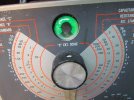
I have to agree with Dave in my experience. I have also seen them rather high in ESR. My capacitor checker will show fuzzy edges on the eye tube instead of crisp clean edges.The common failure mode I see of Ceracaps is that they go intermittent. I’ve never seen one leak, but plenty go intermittent, making for some real head scratching when troubleshooting depending on where they’re located in the circuit.
Dave


Hi Dave, That's really interesting. I have an HH Scott 272 integrated amp from 1960 that is absolutely chock full of Ceracaps. The amp is quiet and stable so far, but I want it to be reliable. I tested most of the caps for leakage by unsoldering one side and using my extremely sensitive DIY cap tester from Mr. Carlson's Lab (with a 2 GOhm equivalent Rleak detection in "Poly" setting, and a 20 GOhm sensitivity in "Forecast" setting). I found a leaky cap and dissected it (picture), and determined that it is metallized mylar rather than paper. I replaced all of the output stage coupling caps, since those have a very hard life under sustained DC voltage and of course a catastrophic effect if they leak. I didn't think of checking ESR, since I usually think that only matters in bypass caps and other large electrolytic applications. Would my Peak ESR tester work on such small caps (usually 10's of nF to 100nF))? How do you check ESR?The common failure mode I see of Ceracaps is that they go intermittent. I’ve never seen one leak, but plenty go intermittent, making for some real head scratching when troubleshooting depending on where they’re located in the circuit.
Dave