• The move to the new server is done. There are some software and database maintenance updates in process. This has us passing the hat around to help out. We appreciate any donations. Seriously, even a dollar helps. The payment page may be found here - https://www.audiokarma.org/support.html

Nobsound E6 Preamp Uses Directly Heated Tubes

I was going to ask about this but wasn't ready to go deep, so to speak. :) This thing only needs 5 Volts DC and above 350mA, if I remember without looking at it. I plugged the usb into a 2.4A max powerstrip plug. It's working fine. I used the cable provided, but there was no wall wart, so I figured since it said connect to a PC or.... that the power strip would be fine.
That should be fine, I'm sure these draw very little current.

The current rating of a PS just means that it can supply up to that amount of current, assuming the rating is accurate.

The device that's being supplied draws a certain amount of current. It doesn't draw any more current just because you run it off a PS that is capable of supplying more than it draws.

That's not to say that a different PS, that just happens to be rated for higher current, isn't a better supply. It might be quieter or have less ripple but it's not going to supply any more current than the device draws.

A higher current rating might, or might not, be indicative of better quality. But the increased current capability itself is not the reason why one PS might be better than another if they are both capable of supplying whatever current the device requires.

A higher current rating might result in the PS itself running cooler which may increase its long term reliability. Any PS will be under more stress if it's being asked to supply current that's close to its maximum rating. But this has no effect on the device that's being powered by the supply.

I would not suggest that you use a higher voltage supply. Some parts, and probably the tube's filaments, might not be able to handle more voltage than the stock PS provides.
 
Last edited:
I was going to ask about this but wasn't ready to go deep, so to speak. :) This thing only needs 5 Volts DC and above 350mA, if I remember without looking at it. I plugged the usb into a 2.4A max powerstrip plug. It's working fine. I used the cable provided, but there was no wall wart, so I figured since it said connect to a PC or.... that the power strip would be fine. So far I haven't burned the house down and there is no noise in the line. It has been left on for days now. But some guidance on this would be fine...

I'm sure it's fine.
 
On the tube sockets, might it be possible to unsolder the pins and extend them enough to allow the tube to accommodate? On these mini pres, I'm always concerned with overheating the smd components. Bet they're a challenge to replace.
 
On the tube sockets, might it be possible to unsolder the pins and extend them enough to allow the tube to accommodate? On these mini pres, I'm always concerned with overheating the smd components. Bet they're a challenge to replace.
Preamp tubes in general don't run all that hot, nothing anywhere close to an output tube or a rectifier tube for example. And the low voltage / current filaments used in these particular tubes don't get warm at all. You can touch the tube and you'll feel barely any warmth.

Even with a tube that gets considerably warmer, the components should be able to handle the heat just fine. And since heat rises, the board underneath probably doesn't get too hot as long as the parts they used were chosen correctly.

If you see heat damage on a circuit board, which is much more likely on an amplifier, it's usually because they should have used a higher wattage bias or load resistor but they decided to cheap out and save a few pennies.
 
Had the day to get the last of presents wrapped but afterwards I messed around with this new amp for a bit.

I took it out and replaced it with the FX Audio Tube03 4 or 5 times with the Little Bear first in the chain from the PC signal. Messed around with the tone and volume controls on the 03 after listening with them zeroed and the volume from 11-3 (o'clock). I couldn't match what I was hearing with the Nobsound with the Russian tubes, tho.

I don't think there is a way to do better than the Nobsound and the Little Bear using the receiver tone controls. The receiver is a Fisher 170. Low watts but really warm and clear with all types of music - very tube-ish already.

What I like more about the receiver with the Nobsound E6 is the overall clarity remains fantastic and added slightly punchy naturalness of the bass and mids. I find the Nobsound lacking just a little on highs. I had to bump the treble about a notch on the receiver.

I even tried putting a Schitt Loki in the chain and putting the receiver tone controls at neutral. The Loki has a defeat switch on it, so I could go back and forth between the receiver and the Loki. The Loki gives a little more gain and even tho I did get some more highs out of it, it was fatiguing. I finally understand what that term means. It wasn't harsh, it was crisp, but became a little too much after a few songs.

I've always preferred the loudness setting on the receiver on, bass at 1-2 (o'clock), and treble at 2:30-3. I bumped the treble to 4 with excellent results. So I think I'm done futzing with it for a while. Listening to some Johnny Cash. No background noise at all. No hiss or ringing of any kind. Really easy to listen to and no edge in the highs with these settings. Just super clear and rich. Johnny's deep voice is great and you can hear all the inflection and words clearly.

Success.
 
Thank you all for your posts about this unit, especially FlaCharlie! I googled “Nobsound E6 review” and it brought me to this thread. I stumbled upon this unit on Amazon curious about adding a cheap tube preamp between my single ended DAC and my solid-state class AB headphone amp. You all convinced me to give the E6 a try, and I am very glad I did! I have never used tubes before, so I didn’t know what to expect. Initially, I was very impressed with the sound, but I noticed the lower-mid-to-bass roll-off that 45rpmspinner pointed out. I just adjusted with PEQ; I always listen with DSP and PEQ, so that was not a big deal to me. I was immediately impressed with the spatial qualities the E6 added to the sound as well as, what seemed like, more treble detail. The DAC I’m using has always sounded clinically, detailed to me. With the E6, the sound is more airy and natural sounding while enhancing resolution. I have not turned the E6 off at all for a week now and have been listening through it everyday. The first day listening, in addition to hearing less bass, I started to get fatigued after a while. Now, it seems the sound has mellowed out a bit, and I think the bass roll-off has reduced too. Maybe it is just my brain adjusting, but I like the sound even more now. I already ordered some of the Soviet tubes (both the 2Ж27Л and the 2P29L). Truthfully, I am pretty content with the Chinese tubes already, but everyone seems to think the Soviet ones are better. I am especially curious about the 2P29L; I have been using a 2100mA phone charger to power the E6, but I am going to start using a 4000mA raspberry pi psu. Thanks, again, everyone. Happy New Year!
 
Last edited:
Got the E6. Horrible microphonics.

Got Russian tubes. I know they won't fit.

But what about this ? I think it will work.


https://www.tubedepot.com/products/8-pin-octal-socket-with-long-pins
I've noticed some microphonics, mostly when tapping the volume knob, but not in normal use. But I've only used it with two different amps, a little SE 6BQ5 tube amp and an Aiyima A07 Class D.

What amp are you using with it? Assuming it has a volume control, you might get better results if you turn the volume control on the amp down a lot and use the control on the E6. Or vice versa.

As described earlier, in its original form the tube is enclosed in an aluminum shell. The diameter of the shell is larger than the hole in the top of the chassis so you need to remove the shell. It's very simple with the right tool, also shown earlier.

Also, I don't think that enlarging the hole, which was considered earlier, would work. That's because the locator pin is fairly long and there is very little space between the bottom of the socket and the board so the pins probably wouldn't seat properly. Also, because these low filament voltage tubes don't glow much, they mounted LEDs on the board right in the middle of the socket, which reduces the available space even more.

So just cut off the shell. It takes less than a minute per tube.

These tubes are not octals, they're loctals, so they won't fit in an octal socket. They both have 8 pins but they are totally different sizes and lengths.
 
Does that influence the microphonics? I want to be wrong about the outer metal shell being there to limit interference. Really, it's probably there because it's easier to pull out.
In my earlier post #25 on page 2 you can see that there are cardboard rings that dampen the tube inside the shell. So they likely are at least a bit less microphonic with the shell in place.

Again, what amp are you using it with? Some amps have very sensitive inputs and that might make the microphonics more noticeable. Do you hear issues with music playing or only when tapping on it or the tubes themselves?
 
In my earlier post #25 on page 2 you can see that there are cardboard rings that dampen the tube inside the shell. So they likely are at least a bit less microphonic with the shell in place.

Again, what amp are you using it with? Some amps have very sensitive inputs and that might make the microphonics more noticeable. Do you hear issues with music playing or only when tapping on it or the tubes themselves?
Topping D50s DAC into the preamp. Then to either a Class T power amp, or a push pull EL84 tube amp, then to speakers.

Yes. I'll use the DAC to control volume. So as to avoid the minutes long bell sound from even touching the unit.

But there is a persistent hiss, buzz that never goes away.

I'll try your mods. But honestly I think I simply got conned here.
 
These are repurposed military surplus tubes, a clever use for otherwise useless and presumably plentiful stock, Keeping expectations reasonable for what they are and what they cost make sense.
 
Topping D50s DAC into the preamp. Then to either a Class T power amp, or a push pull EL84 tube amp, then to speakers.

Yes. I'll use the DAC to control volume. So as to avoid the minutes long bell sound from even touching the unit.

But there is a persistent hiss, buzz that never goes away.

I'll try your mods. But honestly I think I simply got conned here.
I've had nothing like a "minutes long bell sound from even touching the unit" with the amps I'm using. I only get a short and faint ringing if I tap the tube or the volume knob. No reports of this from others, either.

I suspect a combination of factors. First, it seems like the individual tubes in your unit are particularly microphonic. Years ago, I had a similar experience with a preamp I built that used 12B4A tubes. Some of them were much more microphonic than others. Try the Russian tubes, maybe the Chinese ones in your E6 are just particularly crappy.

In addition, it's possible that your amps are very sensitive and that you're also sending it a particularly strong signal from the source. Again, try different combinations of volume control settings.

As I posted earlier, with the Aiyima A-07 I had the volume pot of the Aiyima set at 8:00 and the E6 set between 12:00 and 1:00. I don't know how sensitive the A07 is but I suspect it's not much different from other similar Class D amps.

I do know that the modded SE Voice of Music 6BQ5 amp that I use with this is not very sensitive at all because, unlike most amps, it doesn't have an input tube. It's just a pair of 6BQ5s. It originally had a separate preamp chassis connected with an umbilical but the preamp section was missing so I modded the amp so that it could be used with whatever separate preamp I might want to use. Here's a thread about that project:

https://www.audiokarma.org/forums/index.php?threads/voice-of-music-se-6bq5-w-local-nfb-build.926391/

Surprisingly, I discovered that it works pretty well with just a line level signal from an Apple Airport Express because 6BQ5s are very easy to drive. But, unlike a typical amp that has input tubes, it does need an external preamp in order to make full power.

If your PP EL84 amp (the Packard Bell you've posted about?) doesn't have a volume pot on the input you could add one (or a simple voltage divider using fixed resistors) in order to reduce the input sensitivity. But hopefully some combination of settings on your DAC and the E6 will work.

Out of curiosity, I just swapped the little SE 6BQ5 amp for a little Magnavox SE that I modded to use 12BH7s as output tubes. It does have a preamp tube and a volume control. Even with the volume controls turned all the way up on both the amp and the E6 I still only get a faint ring when I tap the tubes.
 
First, it seems like the individual tubes in your unit are particularly microphonic. Years ago, I had a similar experience with a preamp I built that used 12B4A tubes. Some of them were much more microphonic than others. Try the Russian tubes, maybe the Chinese ones in your E6 are just particularly crappy.

This has to be it. I've tried other little chinese tube buffer preamps and didn't have this problem. Once i cut around the metal and put the russian tubes in i'll report back. If i ignore the ringing, it does have that nice fat tube sound.
 
This has to be it. I've tried other little chinese tube buffer preamps and didn't have this problem. Once i cut around the metal and put the russian tubes in i'll report back. If i ignore the ringing, it does have that nice fat tube sound.
I agree with FlaCharlie. I think your E6 came with some bad tubes. I’m still using the stock Chinese tubes and have never experienced any microphonic ringing. I always run the E6 at max volume too. I even purposely tapped on the E6 and the tubes themselves and still no ringing. I was worried about it though because there were others here that reported ringing with their units too. FlaCharlie recommended to always power-on the E6 before you power-on the amp it is feeding into, so I have always used that method. I have noticed that the sound of the Chinese tubes have changed (tonal response) for the better after the E6 had been powered-on for a week. By the way, I am feeding the E6 with, roughly 2.5Vrms from my E1DA 9038D dongle DAC into my Schiit Jotunheim. To power the E6, I am currently using a 4000mA raspberry pi power supply. I have had good results with this psu and a 2100mA phone charger.
 
Last edited:
I had a ringing when I inadvertently nudged the unit off the edge of a mini mousepad I had it sitting on when I was first setting up the unit. Turned everything off in the chain, and then refired everything starting the farthest from the receiver. No more ringing since. I've had it powered on continuously for the month I've had the E6. I changed out the stock tubes to Russians and really like everything about it. I am probably going to invest in a couple dampers for each tube, but I haven't found the correct sized gasket anywhere yet.

Mine is set at 2 o'clock, stays on all the time. It runs in the line from my PC Sabre DAC, to a LittleBear T7 to increase the gain (with tubes), the E6, to receiver. No ringing or noise at all in the line. I turn the receiver on and off, but everything else stays powered on unless I'm going out of town.
 
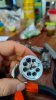
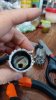
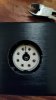
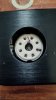
Cut the top off the metal. Tubes popped out easily. I marked on the Russian tube where pin one is, it's the only different shape. I assume that's pin one. Pin count seems to go clockwise. So that pin 1 and 8 would be next to each other and fit the socket. Chinese tubes had markings on the tube with a sharpie.

Also marked with a line on the socket where it goes.

Russian tubes aren't working.

I want to hope I just need to experiment with pin locations.
 

Attachments

  • IMG_20230116_153523.jpg
    IMG_20230116_153523.jpg
    61.3 KB · Views: 57
  • IMG_20230116_153527.jpg
    IMG_20230116_153527.jpg
    66.4 KB · Views: 55
  • IMG_20230116_153536.jpg
    IMG_20230116_153536.jpg
    52.8 KB · Views: 57
  • IMG_20230116_153913.jpg
    IMG_20230116_153913.jpg
    62.5 KB · Views: 57
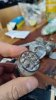
To answer my own question. Here is the actual pin location for the Russian tubes. It's the second marking at 4pm.


Also tone is far better and the microphonics are far less troublesome. I have to tap it hard to get microphonics.
 

Attachments

  • IMG_20230116_160154.jpg
    IMG_20230116_160154.jpg
    61.9 KB · Views: 39
Cut the top off the metal. Tubes popped out easily. I marked on the Russian tube where pin one is, it's the only different shape. I assume that's pin one. Pin count seems to go clockwise. So that pin 1 and 8 would be next to each other and fit the socket. Chinese tubes had markings on the tube with a sharpie.

Also marked with a line on the socket where it goes.

Russian tubes aren't working.

I want to hope I just need to experiment with pin locations.
To answer my own question. Here is the actual pin location for the Russian tubes. It's the second marking at 4pm.


Also tone is far better and the microphonics are far less troublesome. I have to tap it hard to get microphonics.
Not sure how you have them marked but if they're working you've got them installed correctly as there is only one orientation that will work.

Don't just try random positions, though! Installing them incorrectly could cause damage, depending on how they are installed. Looks like you got lucky if you had them in wrong earlier.

Pin numbers found on tube data sheets are always counted clockwise when viewed from the bottom of the tube / bottom of socket.

As I explained earlier, there are two ways to identify the orientation. When the tube is in the shell the pins on either side of the locator pin are Pins 1 and 8, which are the heater pins. You can see on the socket where the locator pin would fit if clearance allowed you to use it with the shell. So Pins 1 and 8 align on either side of the locator slot.

The other way to identify the two heater pins is with a meter that's set to continuity. In this setting you'll hear a beep when the two probes are touched together or when there is continuity between two points. The heater pins are the only pins that will show continuity with each other.

The Russian tubes will typically have a data sheet stuffed inside the box. It's in cyrillic, of course, but it's still helpful.

Glad to hear that the Russian tubes solved your problems!
 
Where are you guys buying these Russian tubes? I just bought an E6 yesterday, supposed to be here Friday. Maybe if i order some tubes they'll be here by then.
 
Back
Top Bottom