• The move to the new server is done. There are some software and database maintenance updates in process. This has us passing the hat around to help out. We appreciate any donations. Seriously, even a dollar helps. The payment page may be found here - https://www.audiokarma.org/support.html

Open Baffle Epiphany!

^^

Go back to pg 36 of this thread starting at post #533 and you might find an answer.

Thank you for reminding me about this previous discussion. Not sure I understood how important it is when I first read this entire thread some weeks ago (plus, I must be getting old and forgot it was there ;) ).

What I am taking from this is that I will have to stand on the shoulders of those who actually understand how all of these things really interact and use their designs as my guide.
 
Baffle width seems to be more critical than height. Can I lengthen the MV Model 3P baffle adding 16 inches between drivers? That would put the Fostex at seated ear height. Would this alter the crossover design function?

That would be a completely different OB design, driver placement and the crossover would probably need to be reworked to get a smooth response.
 
Baffle width seems to be more critical than height. Can I lengthen the MV Model 3P baffle adding 16 inches between drivers? That would put the Fostex at seated ear height. Would this alter the crossover design function?


Can you lengthen and change driver position? Yes, you can, but it would take reworking the X-over. If not mistaken, separation between woofers, drivers, tweeters, etc. do make a difference and may alter a design. Best way to find out is to run simulatiions.


Sent from my iPhone using Tapatalk
 
That would be a completely different OB design, driver placement and the crossover would probably need to be reworked to get a smooth response.

Just for purposes of discussion.....

How much trouble am I buying myself if I took, for example, the JE Labs 'Stereo Sound' OB based on the Wharfedale SFB/3 and added enough height to run two Eminence Alpha 15's and the Tang Band? I will use an active crossover and can touch up the frequency domain with a SAE Parametric.

Same question with MJKing's Eminence Alpha 15A Experimental Open Baffle Design.

From what I am reading, it appears that the main issues are designing the passive crossover, which I am not going to use, and mitigating the various 'humps' in response so the drivers will blend at the crossover point(s) which I can (hopefully) smooth out with the parametric (if needed).

My first entry into the OB addiction is University 6201's in the JE Labs 'Stereo Sound' OB based on the Wharfedale SFB/3. I really like this sound, hence my continued questions around that type of OB.

Does this mean that I will be delegated to the 'Wide OB Cult'.....? ;) :)

As always, your tolerance of my lack of experience with OB's and willingness to help me work through this in my mind is appreciated.
 
wide baffles are usually an effort to maximize LF. JE labs style is typically used w/ single-driver set-ups. given that you are planning on adding woofers to assist the LF the width is no longer needed for that objective.

when you take that issue off the table you are left with concerns re how much the back wave (reflecting off wall behind your speakers) will affect the front wave, and similar concerns. given the martin has done all the modeling, it is safer to use his project #9 -- rather than inventing a new wheel.
 
Okay, understood, and keeping the crossover passive, for me, is a big deal.

That would be a completely different OB design, driver placement and the crossover would probably need to be reworked to get a smooth response.
 
How much trouble am I buying myself if I took, for example, the JE Labs 'Stereo Sound' OB based on the Wharfedale SFB/3 and added enough height to run two Eminence Alpha 15's and the Tang Band?

Tne Eminence Alpha 15A has an fs of about 40 Hz. Once your baffle is about 20" wide you are probably getting 90% of the bass an OB can potentially produce with this driver. Adding more width is not adding much additonal bass output, you are limited to 40 Hz and each addiitonal inch adds less and less additional bass.

Again, an OB design juggles driver properties, baffle size, and crossover design (active or passive) so if you change one of those you need to adjust the other two to achieve an optimum result. Your choice is to start and follow an existing design or roll your own. If you roll your own and get a great result you deserve all the credit, if it sucks you have nobody to fault but yourself. I cannot do the design work for other people, I can barely keep up with my own e-mails, so you have to do the work yourself if you roll your own OB design.
 
Tne Eminence Alpha 15A has an fs of about 40 Hz. Once your baffle is about 20" wide you are probably getting 90% of the bass an OB can potentially produce with this driver. Adding more width is not adding much additonal bass output, you are limited to 40 Hz and each addiitonal inch adds less and less additional bass.

Again, an OB design juggles driver properties, baffle size, and crossover design (active or passive) so if you change one of those you need to adjust the other two to achieve an optimum result. Your choice is to start and follow an existing design or roll your own. If you roll your own and get a great result you deserve all the credit, if it sucks you have nobody to fault but yourself. I cannot do the design work for other people, I can barely keep up with my own e-mails, so you have to do the work yourself if you roll your own OB design.

Absolutely understand and was not asking for you to do the design work.

My apologies if that is how it looked.

I appreciate the time that you have taken to answer my questions.
 
Okay, understood, and keeping the crossover passive, for me, is a big deal.

I have the same issue, but, though a science, X-Over design is also an art. I'm going to blame PG for the extra $180.00 spent! PG highly recommended using an active x-over, and once I have the speakers dialed in to build a passive x-over based on the parameters set on the active x-over. It was an extra expense, but a very good recommendation to follow, which I did. BTW, I spent an extra $180.00, not only because of the $80.00 for the active x-over, but since you have to bi-amp, I built an 80WPC @ 8 Ohms DIY amp using a Sure PCB, that was approx. an extra $100.00 for amp board, power supply, wiring, accessories and pre-fabricated enclosure. (very well spent as that Class D amp sounds very good for $100.00).
 
Last edited:
Amazing how this stuff just takes off. I did use information from PG and bought a Dayton Audio APA150. Nice little versatile amp.

I have the same issue, but, though a science, X-Over design is also an art. I'm going to blame PG for the extra $180.00 spent! PG highly recommended using an active x-over, and once I have the speakers dialed in to build a passive x-over based on the parameters set on the active x-over. It was an extra expense, but a very good recommendation to follow, which I did. BTW, I spent an extra $180.00, not only because of the $80.00 for the active x-over, but since you have to bi-amp, I built an 80WPC @ 8 Ohms DIY amp using a Sure PCB, that was approx. an extra $100.00 for amp board, power supply, wiring, accessories and pre-fabricated enclosure. (very well spent as that Class D amp sounds very good for $100.00).
 
With all the OB's I've listened to over the past few years I'm still haunted by these.

greenvalve-no-baffle-speakers.png
 
Do you know roughly what range the oval mid bands units covered? I'm assuming they're assigned the same region as that appears to be a MTM arrangement.
 
Those look to me like a way to terrorize the wife....

:banana: :nono: :smoke:

As be fun to see the look on unsuspecting friends as you drag them in for a listen! :music:

EV3
 
There are some hard and fast rules.....

1) The boundary layer behind the speakers should not be absorptive. Reflective is preferred and diffuse is better. 1D quadratic diffusion is optimum.

2) A minimum of three feet spacing should be established from the back of the driver to the boundary layer behind it to establish the proper delay in arrival time (to the listener) between content dispersed directly from the front of the driver and reflected content fired from the rear of the driver.

3) Because the radiation pattern of a dipole is in a figure-of-eight pattern, or having two identical lobes with one firing to the front and one to the rear (out of phase with one another), there is cancellation directly perpendicular (to the sides) of the baffle. This reduces interaction with the boundary layers to the sides and therefore reduces the detrimental effects of early reflections that are generated from those locations.

And there has been much research conducted wrt dipoles. SL and MJK are great sources for some of this research, but they certainly haven't been the only "players". It's not really as much of a "black science" as you are suggesting.

I am very intrigued. My speakers are dipole. As such I thought that I shouldn't have anything behind the speakers.

If I understand what you have written here "1D quadratic diffusion" is beneficial behind dipole speakers?

My speakers are rather close to the side walls (re-organized my listening room). I experimented with absorption panels that I made per your recommendations a long time ago and I am using them on the first reflection point with good results.

I have a fireplace between my speakers so if I were to build quadratic diffusion panels they would go on the walls on either side of the fireplace - is this feasible or are the panels meant to go in the middle between the speakers.

I rather like the look of the quadradic diffusion panels. How would those compare to the 1d panels?

Back on topic....
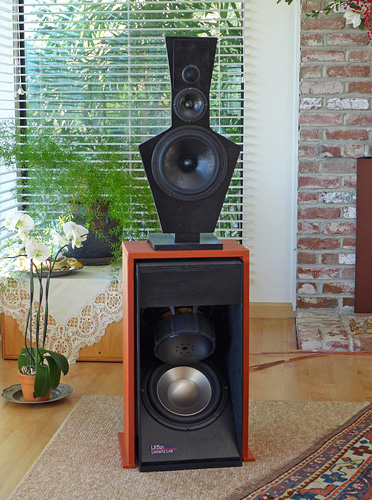
Linkwitz and these awesome looking speakers. Has anyone heard them?
8-10 amps required?
LX521_front500.jpg
 
Back
Top Bottom