

You are using an out of date browser. It may not display this or other websites correctly.
You should upgrade or use an alternative browser.
You should upgrade or use an alternative browser.
Open Baffle Epiphany!
- Thread starter cptnCanada
- Start date

tomlinmgt
Lunatic Member
I am very intrigued. My speakers are dipole. As such I thought that I shouldn't have anything behind the speakers.
If I understand what you have written here "1D quadratic diffusion" is beneficial behind dipole speakers?
My speakers are rather close to the side walls (re-organized my listening room). I experimented with absorption panels that I made per your recommendations a long time ago and I am using them on the first reflection point with good results.
I have a fireplace between my speakers so if I were to build quadratic diffusion panels they would go on the walls on either side of the fireplace - is this feasible or are the panels meant to go in the middle between the speakers.
I rather like the look of the quadradic diffusion panels. How would those compare to the 1d panels?
First I should clarify for you that QRD diffusers can be 1D or 2D. The stepped fractal diffuser array pictured below behind my Acoustats is an example of a 1D design...meaning the diffusion is occurring in one plane only (when mounted on walls it's typically the horizontal plane so sonic energy is diffused horizontally...and that's how mine are installed). The "well" type diffusers that are so common are also 1D QRD designs and in the second picture you can see I have a two unit array I'm experimenting with at side wall first reflection. An example of a 2D QRD diffuser would be the "skyline" style which is the design that looks like a bunch of square buildings of varying height all clustered together. 2D is typically used most effectively on the ceiling. Actually, the only real rule with the location of diffusion devices is that you don't sit too close to them or locate them where they could generate an early reflection. I've only tried diffusion directly behind the speakers or almost entirely covering the front wall, so I can't comment on what you might experience by locating diffusion devices in between the speakers (on front wall). The idea is to prevent the reflected wave of sonic content from coming directly back into the room which will create the shortest arrival time to the listening position. By diffusing it the arrival time is effectively lengthened, thereby creating a similar effect as one might get if the speakers were located further from the front wall than they actually are (increased sound stage dimensionality...especially depth).
Last edited:

GTIanz
Active Member
Very interesting. I really enjoy seeing your listening space and how it has progressed Tom.
I might have to build a couple of those panels and give it a shot. You haven't steered me wrong yet.
Wish my listening space was as large as yours. Im dealing with a 12'x32' area. Orientated lengthwise.
I need to browse more of your history and read up on your distributed base setup as well.
I might have to build a couple of those panels and give it a shot. You haven't steered me wrong yet.
Wish my listening space was as large as yours. Im dealing with a 12'x32' area. Orientated lengthwise.
I need to browse more of your history and read up on your distributed base setup as well.
Mister Pig
Pigamus Maximus
I spent some time changing cabling out in my system yesterday, and also went through some speaker location adjustments. Ended up with the speakers 48" off the front wall, with a 2" amount of toe in. All of the drivers in the Hawthorne Trio have a rear wave, and I found that if i got closer than 48" I experienced some peakiness in the upper midrange area. Once I got to the 48" range though everything locked in, and not only did the soundstage improve in terms of being solid, but the tonal balance evened out. Seems to me that with open baffle speakers you are going to have to pay a lot of attention to how the rear wave interacts with the listening room.
Regards
Mister Pig
Regards
Mister Pig
tomlinmgt
Lunatic Member
Seems to me that with open baffle speakers you are going to have to pay a lot of attention to how the rear wave interacts with the listening room.
Regards
Mister Pig
It should be first priority with any dipole design....otherwise you're neglecting the whole reason for having a dipole. I mean, what's the point in having the rear wave if you aren't optimizing its sonic contribution? And now you've heard what some of the consequences of neglecting dipole placement can be. I'm going through it with my Acoustats right now. I first set them up 3.5' from the tallest diffuser well and experienced some upper mid range beaming. I was afraid moving them forward any more would enhance that beaming since it would bring the origination point of the front wave closer to the listening position, but the exact opposite happened and even the center image came forward in the sound stage with greater presence. You simply have to ignore assumptions and experiment, experiment, and then experiment some more. Probably not the best speaker design choice for the lethargic audiophile!
Last edited:
Mister Pig
Pigamus Maximus
It should be first priority with any dipole design....otherwise you're neglecting the whole reason for having a dipole. I mean, what's the point in having the rear wave if you aren't maximizing it's sonic contribution?
Yup. But i notice that on a lot of these posts of people experimenting with their OB build that the speakers are located pretty close to the front wall. I was just trying to be polite in bringing the point up.
In my case, i have moved the speakers around a lot looking for that balance between the front wall reflections and amount of toe in needed to get a focused sound stage and the best tonal balance at the listening position. I have experimented with some materials on the front wall in terms of diffusion and absorption. Looking to consider building panels. But so far, I find that diffusion seems to make the most sense, and that absorption panels tend to creat tonal imbalances more than they help. Not sure what i am going to put on that front wall yet....although I know I have to get it refinished/painted before I put anything there permanently.
Regards
Mister Pig.

Seppo
Super Member
Regardless of positioning, my RS-II's with the dipole mids and highs sound much better compared to more traditional RS-IIIa's (when played/compared in the same compromised position, e.g. even in the corner). I do believe that meticulous positioning would affect and improve the reflection of the rear waves even further.
But it looks to me that simply having a dipole setup is an improvement in itself...particularly with classical music where e.g. individual instruments (Yo-Yo Ma for example) really sound much like they are in the room when played through a dipole system.
My physics interpretation of the above is that in a sense a dipole radiator mimics the single instrument better in that spot (a point source), so that the realistic/correct back scattering of that point source instrument from the back wall fools ones's hearing/brain to further think that there indeed is an instrument in that position..

TubeHiFiNut
Super Member
<snip> You simply have to ignore assumptions and experiment, experiment, and then experiment some more. Probably not the best speaker design choice for the lethargic audiophile!
+1..... :thmbsp:
tomlinmgt
Lunatic Member
Yup. But i notice that on a lot of these posts of people experimenting with their OB build that the speakers are located pretty close to the front wall. I was just trying to be polite in bringing the point up.
In my case, i have moved the speakers around a lot looking for that balance between the front wall reflections and amount of toe in needed to get a focused sound stage and the best tonal balance at the listening position. I have experimented with some materials on the front wall in terms of diffusion and absorption. Looking to consider building panels. But so far, I find that diffusion seems to make the most sense, and that absorption panels tend to creat tonal imbalances more than they help. Not sure what i am going to put on that front wall yet....although I know I have to get it refinished/painted before I put anything there permanently.
Regards
Mister Pig.
One thing I often see from many owners of dipoles is once they become aware of the design's characteristic of having less acoustic interaction with the room than a bipolar design (which is true) they assume this gets them off the hook wrt needing to address the usual speaker/room interaction issues that typically exist in the standard living space/listening area. The most frequent issue that I see getting overlooked is the early reflection from the rear wall (behind the listener). Because dipoles have to be pulled out from the front wall as far as they do for proper rear wave interaction, it's not uncommon for the listening position to be moved back and closer to rear wall as the listener attempts to maintain sufficient distance between the listening position and the speakers so a "near field" scenario is avoided. If the distance between the speakers and listening position is 8-12' and the distance from the listening position to the rear wall is 6-8' or less and the wall is reflective then a strong, detrimental early reflection from that location is generated. This can diminish or negate the spatial effects and enhanced sound stage dimensionality that is unique to dipole designs, smear imaging and create tonal imbalance. It gets even worse if one is trying to squeeze a dipole into a small room and places the speakers close to the front wall and the listening position close to the rear wall...in which case the fundamental benefits of a dipole design are impossible to realize.
I'd say getting the dipole adequately spaced from the front wall is first priority and if one doesn't have the room to get them four feet from the front wall (one might be able to get away with three, but you and I both experienced tonality issues at that distance, Mr P...so it's not a best case scenario) and avoid a near field arrangement between the speakers and listening position then one should be prepared to accept sonic compromises that prevent the realization of optimum or near optimum performance from the design. You've managed to find a more favorable speaker to front wall distance so that's certainly a move in the right direction. I think if I were you I'd look at the rear wall next if your listening position is around 8' or less from it and the wall is currently reflective. Any sonic effects that might be created by treatments applied to the front wall (such as diffusion) will likely be masked by the early reflection from the rear wall if you don't attenuate those reflections appropriately (with absorption panels).
GTIanz
Active Member
the Hawthorne Trio
Speaking of Hawthorne speakers.
This whole open baffle thing is new to me (even though I own open baffle speakers) and I just started reading this thread yesterday.
Spotted these beautiful things on the CL this morning - way out of my price range @ $6000. Mind blown! I'd love to hear a system like this.


GTIanz
Active Member
An active crossover can make your DIY OB's so easy to bi-amp without the worry and expense of building passive crossovers and the sound will be better. You can still use your nice RCA cables with 1/4 inch adaptor jacks ( I found 8 on ebay for $5 ).
The active takes the left and right signal from the preamp, divides the frequency between the highs and lows sending the appropriate signal to the HF amp and the LF amp. With an active you can even use an old AVR to power the bass woofers.
With a passive crossover the signal is altered at the speakers but with an active the signal is altered before it is amplified ( upstream of the amp ). It may look complicated but it's really not.
In addition to dividing the frequency between two amps most of the 2 way active crossovers have an extra connection for a sub which means it's more like a 3 way.
Actives don't have to be pricey. The Behringer CX2310 for 2 ways cost around $90 and 3 ways can be had for under $150. Good used ones on ebay can go for even less.

This deserves a repost.

Poultrygeist
Lunatic Member
I'm constantly moving my OB's around and each time things sound different.
My next build may have castors but I haven't figured out how to do them without resonance.
My next build may have castors but I haven't figured out how to do them without resonance.
GTIanz
Active Member
With the regards to the questions on the miniDSP...forgive me if it's been posted in the thread previously...but here is a series of articles regarding using the miniDSP with OB. What could be more appropriate?
http://www.hifizine.com/2010/12/prototyping-4-way-open-baffle-speaker-with-the-minidsp-2x4/
Here is my thread in the DIY forum about my OB's and MiniDSP.
http://www.audiokarma.org/forums/showthread.php?t=569977
In a nutshell. The MiniDSP can make your speakers do whatever you want. Almost too easy to get a flat response or to boost the top or low end to your liking.
The sound quality is quite good. I am sold while using a digital source. When playing vinyl I may be noticing the analogue aura "someone breathing on the back of your neck" feel may disappear. I haven't had enough experience using it yet to positively identify this.
build the OB's, get a MiniDSP, and if you want you can later build passive XO's or analogue active. But the MiniDSP is an invaluable tool in getting them set up correctly.
The high dollar Bryston electronic crossover.
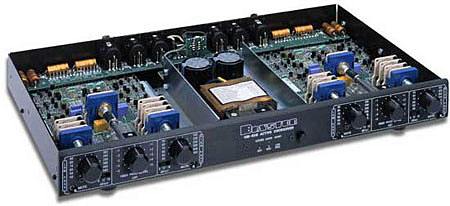
One of the finest analog units - the Marchand tube crossover.

thought these deserved to be re-referenced as well.
Last edited:
Poultrygeist
Lunatic Member
Can't post a picture of the Hestia- forte as they're featured on another forum but here's a link. My friend built the standard Hestia and likes them a lot. When he gets around to inviting me over I'll post some impressions.
http://www.audiocircle.com/index.php?topic=121548.60
http://www.audiocircle.com/index.php?topic=121548.60
Poultrygeist
Lunatic Member
Speaking of active crossovers If I buy another one it may be a Pass B5.
Mr Pass knows OB's
http://www.lowther-america.com/First_Watt_Amplifiers/
http://www.firstwatt.com/pdf/prod_b5_man.pdf
Mr Pass knows OB's
http://www.lowther-america.com/First_Watt_Amplifiers/
http://www.firstwatt.com/pdf/prod_b5_man.pdf
The First Watt B-5 is spot on of course for this. I got one about 2 months ago but haven't had time to play with it much. It's very adjustable but you do have to lift the lid and play with a number of dip switches.
A lot easier is the Bryston 10B sub version. You just dial what you want. But it, nor most others has that baffle step comp of the B-5.
The DCX9624 used to be the hot digital but it's complexity is the fact it needs to be balanced and runs best with more level than the home minus 10 levels.
The other really nice one for OB is the active Dahlquest model from a number of years ago. Those work nicely.
EV3

Bonkers60
Super Member
Will a single capacitor work properly as part of a passive crossover? I am using Fostex FE126En drivers supported by 15" Eiminence Alpha's. I have thought about minidsp and active crossovers, but I'm curious if I can use a simple high pass crossover. I am using a receiver for the full range speakers, and a Yung SD-200 for the Eminence Alphas. I am happy with how the speakers sound, but I curious of the improvement the crossover would make. Thanks.

^^^ I think Poultrygeist did something similar.