
Semanon
Super Member
This is what I would like to add. Sequencing power on and off would be great for my vintage stuff.One functional advantage for me has been the trigger and switched/unswitched outlets.


This is what I would like to add. Sequencing power on and off would be great for my vintage stuff.One functional advantage for me has been the trigger and switched/unswitched outlets.


I don`t know what model (it was very tall, large and heavy) Monster power protector my childhood friend bought back in early 2000s or so to protect his big $8k at the time very large Pioneer plasma HD TV.One functional advantage for me has been the trigger and switched/unswitched outlets. The HTS-3500 mkii trigger input can handle from 3 to 30 volts and controls the power state of the unswitched outlets. I had a lot of equipment in my home theater system and the Monster unit allowed me to control what was on only when the AV preamp was on, and which devices were on all the time, and which outlets (power amp) were delayed switched with the "timed" outlets. Each outlet type (video, cd, power amp, etc.) is labeled to imply it has it's own filtering specific to each device type (no idea if there are significant differences between the outlets).
There are pass-through filters for coax and phone jacks (!)-- the coax filter did help with a cable issue a long time ago (too long ago for me to remember, I don't think I am using the filter currently).
Back in the day when these were popular, I remember people saying that Panamax had better performance than Monster. The Monster units look a lot better than Panamax to my eye, and are very well built. I really don't know if either one is better or worse, but Panamax used to be talked up as better back then.
This is what the back of the HTS-3500 mkii looks like: switched/unswitched/timed outlets -- on the right coax filters, trigger, and phone jack filters

This top view shows the text discussing the implied difference in filtering and switching for the various outlet types:

I don`t know what model (it was very large and heavy) Monster power protector he bought back in early 2000s or so to protect his big $8k at the time very large Pioneer plasma HD TV.
But he finally wore out the Pioneer just last yr. and replaced it with a very large LCD one, and that Monster Power AVR/protector is still surge/spike protecting and regulating the AC to his HT system as I type.

And the outlet that their plugged into AC`s ground integrity/reversed outlet`s wiring and device`s current protection condition monitoring status LEDs absence !There is fine line on marketing with these devices. Surge protectors and surge suppressors. The suppressors are usually dressed up devices that look like a surge protector but don't have proper trip out devices in them. Like a breaker.


In my opinion cheap, generic wallwarts are the bane of good audio.Thanks to this thread I made some positive changes to my rig yesterday. I have mostly 12 volt ambient lighting in my listening room and the wallwarts that I had been using were causing issues with dropouts with my digital music. So the noisy wallwarts got removed and I had been using a couple of 100 amp 12 volt lithium batteries to power the lighting. Problem solved and no more dropouts.
Yes; I agree. Clean power is one of many essentials to great audio. Another issue I found today is my $100 lithium smart charger is far worse than the cheapo wallwarts for adding noise to the lines. The struggle for clean power is real.In my opinion cheap, generic wallwarts are the bane of good audio.
My solution is old-school isolation transformers and Hospital-Grade power supplies. The IT people at work got me into Meanwell Hospital (Medical) grade PSUs.Yes; I agree. Clean power is one of many essentials to great audio. Another issue I found today is my $100 lithium smart charger is far worse than the cheapo wallwarts for adding noise to the lines. The struggle for clean power is real.

I have a similar kind of thing hooked up in my system, might even be the same model, I don't know. I bought it as I was using a plain old power strip, but ran out of outlets and this thing had more of them as well as protection and conditioning features. I also have a PS Audio power conditioner, one of the smaller, low end models. It was given to me by a friend who'd got a really great audio system and said that he felt that the thing was worthless... that it didn't make any improvement. I lent it to the guitar playing of my band (I'm the drummer) who had issues with a noisy amp and claimed that the PS Audio power conditioner improved things. I'm skeptical that it's doing much, but since he had his amp worked on, it's not as noisy and I'm tempted to get the thing back from him to try on my stereo. The only problem is that it doesn't have enough outlets, but I wonder if it would be worth plugging the Monster power bank thing into it? I figure that it can't hurt to try, right?Does anyone swear by these? I needed a power strip with a lot of outlets and saw this cheap at goodwill. Needed to replace some capacitors to get an inop voltage display working again. There’s a lot of “stuff” going on in there! Wether all that stuff is doing anything is another story. I haven’t really noticed any difference in sound quality but all my gear is tube so there’s always some noise.
Anyone notice a difference using these?View attachment 3153940

There is a company (Stromtank) that produces "audio grade" battery power supplies. Their TOTL model S5000 is $31K. It's suitable for even higher power, power amplifiers.If you really want to be serious you get a computer grade battery eliminator. That way you are never directly connected to the AC electrical grid. You charge up the batteries of the eliminator and then an invertor creates pure sign wave 120 VAC from the batteries. That way no out side noise gets into your system. You dont have to worry about your house wiring or circuit breaker wiring or the wiring from the Step down transformer on the electrical pole or the noise getting on the 10,000 volt line at the top of your power poles.
Or I guess you could get a Genrac or Cumins back up power generator that works off of diesel, Propane or natural gas that can feed your system all the time and your house with a switch over box when the electrical serice from your local electric company fails. I had Onan's, which was Cummins, in my Motor homes and they provided great noise free power to the coach when boon docking or at rallys. First coach had a 8K genset and the second coach a 12k genset. The newer ones are much quieter than they were when I bought mine in the early 2000's. I assume all of them have water proof noise cancelling hush boxes now days to keep the neighbors happy. . You just push a button to start the genset motor driving the alternator when you need it and give the unit a minute or two to stabilize and you are ready to go.
I guess you could do the same thing with solar panels now days and that way you wouldn't need to worry about noise. But you have to have enough battery capacity to allow night time operation while the sun is down. A Tesla Power Wall for instance.


If it was me I'd be checking the emi to satisfy my own curiosity. I checked my portable inverter gen a while back and the emi was about 2,000 which is very high.I wonder how clean my house`s power is right now as 10 minutes ago the grid unexpectedly (no thunder storm(s) went down and I`m currently on my whole house genset backup !
So its just my inhouse created dirty power, since my 2 drop transformer sharing neighbor`s dirty power connections are disconnected from my house`s electrical system, via my genset`s 200 amp transfer switch !
All 4 operating stereos, DAC. and the distributed WAV. ripped music player resumed playing after my 25 yr. old Generac genset auto cranked up and switched over.
It`s 84` outside, and the HVAC is currently engaged and blowing 76 ` temp air upon me, and I can`t help to smile about the situation from my personal POV.

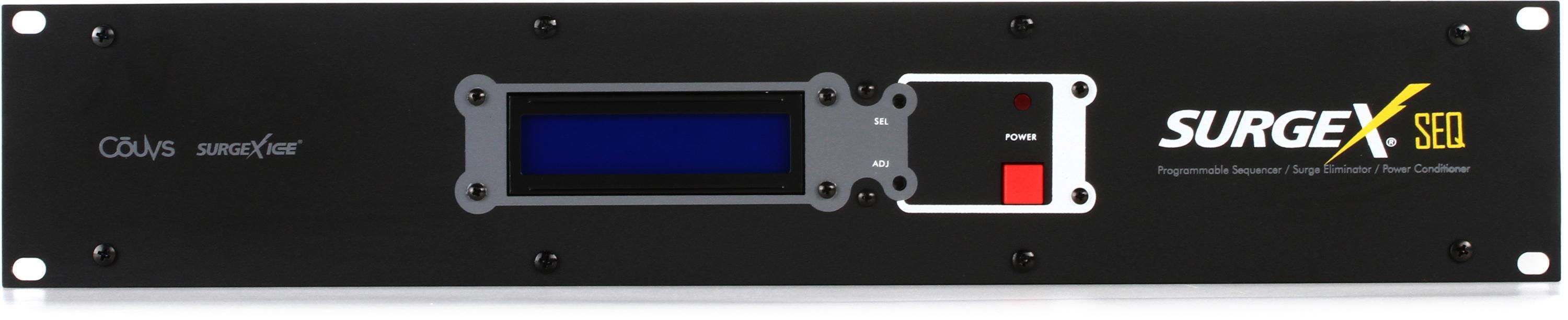
 www.sweetwater.com

Well, with a small scale portable genset, I would possibly consider checking for EMI dirt on my house`s distributed AC circuits, but I probably wouldn`t be running the 4 room`s background music playing stereos because of conserving my lessor available watts available.If it was me I'd be checking the emi to satisfy my own curiosity. I checked my portable inverter gen a while back and the emi was about 2,000 which is very high.
Today I decided to try running a pair of line conditioners in series. I was able to get an emi reading of 10 coming out of the 2nd conditioner which is by far the lowest I've ever seen it. Research tells me it isn't a good idea to do that with equipment plugged in so I won't be doing that. But my curiosity is now happy; 2 pc's in series does lower emi a lot
And, may I inquire the brand/model of your low confidence in your RM "Power Conditioner", if I may, gadget73?My "power conditioner" is a rack mount thing that has almost nothing inside beyond a cap and a toroid. I don't really think its providing much useful filtering or surge protection. It has a voltmeter that works and an ammeter that only seems to work with purely resistive loads, so basically it never reads. What I use it for is a master power switch a power strip.
The other item is a big isolation transformer. That one probably does provide some filtering, and it certainly pulls DC out of the line but I'd be lying if I could tell you I heard any difference. The rack mount unit plugs into the iso transformer.