• The move to the new server is done. There are some software and database maintenance updates in process. This has us passing the hat around to help out. We appreciate any donations. Seriously, even a dollar helps. The payment page may be found here - https://www.audiokarma.org/support.html

Power conditioners Snake oil?

IME computer back up power supplies tend to produce lots of noise on the AC output. While they will allow safe shutdown when AC is lost, I'd use them only with appropriate caution. Attach a scope probe to the AC out of an APC and observe the noise for yourself. :)

FWIW: I use a Tripp Lite Isobar on a dedicated 20A line for my small signal sources. My power amplifiers are on their own dedicated 20A lines (2).
For what it's worth, here is a consideration:
I have noted that some prefer using Power Conditioners/Surge Suppressors for their audio equipment. It would be less expensive and beneficial to have a SPD installed at the main panel to protect the whole house (including dedicated circuits). The latest electrical Code (NFPA 70 - NEC - 2023) now has 4 types of Surge Protection Devices (Type 2 - protection at the Service entrance as being the least expensive to retrofit).
Ballpark cost - $80 for a good SPD and breaker pair and $150 for an electrician to install it.
For an audio-visual on what it takes to install an SPD and what are the different types of SPDs, see

Note: Although the video only explains Types 1 through 3, Type 4 is what is installed intrinsic to and integral with equipment.
I am in no way affiliated with any electrical contractor or manufacturer/dealer/distributor/reseller of SPDs.
Sincerely,
John Graham.
 
I have a Monster HTS-3500 MKII in my theater system. I don't know if it makes any difference in performance (I didn't really pay attention to "before and after' performance because I didn't expect any difference). I think it offers some degree of safety. These units also offer cable (coax) filtering and Ethernet filtering. I do remember that routing the cable coax through the Monster did clean up some cable issue a long time ago.

I also bought one of those Monster HTS-2000 "power-strip style" conditioners off of the popular auction site, and it hummed very loudly when I plugged it in. The seller said to "keep it" rather than return it since it was toast. I didn't want to try to fix it, but disassembled it and kept some internals.

Everything about the Monster units seems very high quality. The full-size ones seem to last an eternity, the power-strip sized ones seem to have more problems for whatever reason.

Monster HTS-3500 MKii
2064770-95b1c2b8-monster-power-conditioner-hts-3500-mk2-obo.jpg
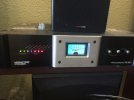
Monster Power Power centers do a creditable job of "power conditioning" but from the numerous reports I have read, the majority of their HTS 3500 (MKI/II) usually fail fairly quickly and have long term reliability issues. I have been fortunate in that my early HTS 3500 MKII (I have 2 of them) have withstood the test of time. (at least 10 years) They are a moot point since I have a SPD (Surge protection Device) at my main panel, but I use them now only as a cool feature (their blue light and meter (which looks much like a VU Meter)) to my home audio system.
The problem is that one of them has the blue LED (Clean Power LED) has started dimming (losing it's brilliance) during the last week. the other one is fine (See comparison photos attached). Have had no power surges/power failures/lightning strikes in my local distribution grid in the last few months. With Monster Power no longer supporting these types of units (they have migrated to the "Power Strip" line), I'm hoping someone could point me to a schematic so I can troubleshoot the LED issue.
Sincerely,
John Graham.
PS: The "blue light" in the volt meter is really an ordinary incandescent lamp that is coated with a blue film.

Edit:
Never mind - from an intense search on the internet, I find an old quote from Monster Customer Support "The blue “Clean Power” LED is purely aesthetic and tends to burn out faster than the other LEDs on your surge protector. If you are getting power to the outlets, the unit is still functioning properly. "
All I need to do is replace the blue LED.
Hope this helps someone with the same problem
 

Attachments

  • Monster Power HTS3500MKII-L_800x600.JPG
    Monster Power HTS3500MKII-L_800x600.JPG
    63.9 KB · Views: 4
  • Monster Power HTS3500MKII-R_800x600.JPG
    Monster Power HTS3500MKII-R_800x600.JPG
    86.6 KB · Views: 4
Last edited:
Checking in as safe from losing any electronics plugged straight into the outlet since... forever, and all over the country.

Have always plugged directly into outlets, Midwest, southeast, PNW, east coast and west coast. Have never lost any electronics because they were plugged into the outlet, and a couple of these houses still had knob and tube.

That said I have been known to unplug when the lightening was crazy.

Here's to living my scarey life on the edge :rolleyes:
:beerchug:
 
Last edited:
Mostly snake oil. At least IR to the advertiser claims for some of the products in audio.

Any equipment that has its own power supply with transformer, chokes, rectifiers, filtering caps should do the filtering just fine. DC in the supply can make some transformers hum though.

If it has surge suppression it might be useful to protect downstream components. If it actually does a good job of it. So, as most things the answer is; it depends. :)

I haven't noticed any sound degradation in the transition from incandescent light bulbs to LED, smart sockets w. wifi, SMPS LEDs and PC's, installation of huge solar farms and wind turbines during the last 15 years. So I guess the AC in my house does still resemble a sine somewhat..;)
 
I have Furman surge suppressors on my audio equipment. After a wide power outage on the island, when power was restored, a large surge occurred. My protected gear was fine -- but my refrigerator was not! The fridge was toast. Cost me 2K!

At the appliance store I met a lady who also had her fridge fried, she showed me photos of her fridge in flames!!

My new refrigerator is now also on a Furman. I want a whole house suppressor.
 
Mostly snake oil IMO, if you aren't living in a third world country the power should be just fine without one.

That being said, I do run a few around the house (2 x Powervar 12, 1 x Powervar 6), but they were free; I wouldn't actually pay money for one of these beasts. The 12 has to weigh about 50 pounds lol, used to run with an echocardiogram machine.

View attachment 3154296
I tend to agree that there is an element of snake oil involved, but what no one addresses when speaking about these things is the difference in the ambient noise on the line between rural areas with moderate climates and seashore areas where high humidity and salt accumulate on all the insulators in the local power grid...there simply MUST be some leakage due to salt and humidity contributing to noise on the line...but even at that, high frequency noise would be filtered out in the sound equipment's power supply. Consider that all high current linear power supplies used in audio gear have built in low pass filters that would clean up the hash from very dirty noisy power coming in. Maybe it doesn't all get filtered out, but it should be well below audibility.
 
Well that maybe so, but the last failure of a electronic device, was recently on a perfectly clear day, and it was the OEM provided SMPS of a 13 yr. old 24/7/365 operating VGA to ethernet cable distribution headend unit after my power utility Co. unexpectedly did a load switch and power blipped the grid which always generates a very powerful stressful, or damaging power grid surge/spike rich situation, in which they do on occasion !

I have encountered this many times since moving here in 1989 after a cold snap and the temperature starts warming back up
and the load on the grid becomes reduced, and the power Company desires to adjust the power capacity level back down to keep the grid`s voltage from rising too high with the lessor public demands.

It ain`t only lightning based destructive power blips that cause me to provide the high quality level of power based surge/spike protection that I choose to engage in !

My chosen protection for my high 10`s of thousands of dollars worth of replacement costs of my house`s A/V are not "Snake Oil" !

I`m totally unconcerned what anybody believes in or not about the power protection/conditioning coddling of their house`s electronic/electrical equipment, as my methods have been working quite well for me since starting in 1992 !
Have you considered using uninterruptible power supplies to do this or is that what you use. I have found them effective at protecting equipment but I have no clue if they have any impact one way or the other on sound quality.
 
For what it's worth, here is a consideration:
I have noted that some prefer using Power Conditioners/Surge Suppressors for their audio equipment. It would be less expensive and beneficial to have a SPD installed at the main panel to protect the whole house (including dedicated circuits). The latest electrical Code (NFPA 70 - NEC - 2023) now has 4 types of Surge Protection Devices (Type 2 - protection at the Service entrance as being the least expensive to retrofit).
Ballpark cost - $80 for a good SPD and breaker pair and $150 for an electrician to install it.
For an audio-visual on what it takes to install an SPD and what are the different types of SPDs, see

Note: Although the video only explains Types 1 through 3, Type 4 is what is installed intrinsic to and integral with equipment.
I am in no way affiliated with any electrical contractor or manufacturer/dealer/distributor/reseller of SPDs.
Sincerely,
John Graham.
That load center type, plus the purchased from my power provider service entrance meter can type has been successfully protecting my whole house electrical/electronic 240/120v equipment for quite some time.

The purchased by me and installation of the Leviton brand load center type SPD was performed by me, as I`m comfortable with load center work, using 2 L1/L2 connected 20 amp dedicated circuit breakers as instructed by the SPD`s installation manual.

Those 2 whole house type SPDs in partnership take care of the bulk of the initial outside fed powerline sourced surge/spikes, plus any nearby strikes to trees with the resultant high energy EMP that energizes all the wiring in my attic, that makes it easier for the endpoint equipment`s surge/spike protectors to take care of any residuals, especially the very nearby intense lightning strikes to the grid, a common warm weather event here in NE.FL.
 
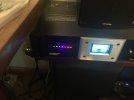
Monster Power Power centers do a creditable job of "power conditioning" but from the numerous reports I have read, the majority of their HTS 3500 (MKI/II) usually fail fairly quickly and have long term reliability issues. I have been fortunate in that my early HTS 3500 MKII (I have 2 of them) have withstood the test of time. (at least 10 years) They are a moot point since I have a SPD (Surge protection Device) at my main panel, but I use them now only as a cool feature (their blue light and meter (which looks much like a VU Meter)) to my home audio system.
The problem is that one of them has the blue LED (Clean Power LED) has started dimming (losing it's brilliance) during the last week. the other one is fine (See comparison photos attached). Have had no power surges/power failures/lightning strikes in my local distribution grid in the last few months. With Monster Power no longer supporting these types of units (they have migrated to the "Power Strip" line), I'm hoping someone could point me to a schematic so I can troubleshoot the LED issue.
Sincerely,
John Graham.
PS: The "blue light" in the volt meter is really an ordinary incandescent lamp that is coated with a blue film.

Edit:
Never mind - from an intense search on the internet, I find an old quote from Monster Customer Support "The blue “Clean Power” LED is purely aesthetic and tends to burn out faster than the other LEDs on your surge protector. If you are getting power to the outlets, the unit is still functioning properly. "
All I need to do is replace the blue LED.
Hope this helps someone with the same problem
When you replace the blue clean power LED, maybe track down its voltage dropping resistor and replace it with a mildly higher ohmic value for longer LED life.
 
My impression or power conditioners is that they do work, but you don't need what they do most of the time. Any competent equipment should take care of that internally.
 
Have you considered using uninterruptible power supplies to do this or is that what you use. I have found them effective at protecting equipment but I have no clue if they have any impact one way or the other on sound quality.
I have and use quite a few UPS scattered around the house for various electronic devices, to carry the equipment for the minute or so until my whole house auto switchover genset kicks in so as to not have to wait for the reboot of internet gateway, unmanaged ethernet switch, wifi distribution equipment, hard wired 8 camera security system, WAV. ripped music player (OPPO), the 6 room active analog distribution of same. etc.
All those UPSs are plugged into surge/spike protection to help preserve their life, doing so must be working very well, as several of the APC AVR type UPS` are over 12 yrs. old and have only needed their batteries replaced twice since installation.
 
My impression or power conditioners is that they do work, but you don't need what they do most of the time. Any competent equipment should take care of that internally.
There is the thought of older (vintage) audio equipment wasn`t subjected to the proliferation of SMPS that didn`t exist, that now highly back feed noise polluting ones own house`s circuits in these modern times, and those audio equipment might have single ~ .01 or so value cap connected internally across the mains feeding the device.

I`m quite comfortable with the investment with high quality surge/spike filtering/AVR coddling my A/V electronics just on the principle, knowing that the powerline dirt exists in my house`s circuits (plus my 2 neighbors strapped across our split phase serving shared output power drop transformer) from all the LED bulbs, cheap ass OEM provided SMPS wall wart scattered about in their and around my house.
 
There is the thought of older (vintage) audio equipment wasn`t subjected to the proliferation of SMPS that didn`t exist, that now highly back feed noise polluting ones own house`s circuits in these modern times, and those audio equipment might have single ~ .01 or so value cap connected internally across the mains feeding the device.

I`m quite comfortable with the investment with high quality surge/spike filtering/AVR coddling my A/V electronics just on the principle, knowing that the powerline dirt exists in my house`s circuits (plus my 2 neighbors strapped across our split phase serving shared output power drop transformer) from all the LED bulbs, cheap ass OEM provided SMPS wall wart scattered about in their and around my house.
Surge protection make sense to me, and I have it on my setup. Fancy filtering of the AC power, no.
 
Surge protection make sense to me, and I have it on my setup. Fancy filtering of the AC power, no.
I use Tripp-Lite brand surge/spike/AC filtering, and some of their AVRs, and there is nothing fancy about any of them, and they don`t audiophile label market any of the products that I`ve ever purchased since my first Tripp-Lite purchase in 1992 of a 20 amp rated RM AVR with powerline surge/spike/filtering, all in use, at least here, are utilitarian, non fancy audiophile marketed conveyed based products.
I starting noticing well over 20 yrs. ago that wherever I might look somewhere around wherever when there was a computer work station at a business that more often than not a Tripp-Lite surge/spike ISOBAR type model protection device was in use .
If these units filter the AC line along with protection, whom am I to discourage the inclusion of it, as if properly ampacity chosen for the expected + current draw task at hand, there should not be any real noticed negative sonic effects to the audio systems using it.
 
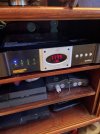
Op here. I was originally just going to throw this one out, I got it in a bundle of stuff I bought. Tried to give it away a few times with no takers. Then I started rebuilding my surround sound. Adding a preamp/ main amp instead of a receiver. A few more streaming boxes ect. And I figured well I need more outlets might as well give this thing a shot. It worked out great and not so much for the power flittering but for the switchable outlets. Now I can turn on my receiver and everything comes on. There’s a delay option so things come on slowly instead of overloading the outlet. For that propose alone it’s worth holding on to. I don’t think I’d spend much money on it though. So now I’ve got the smaller one on my stereo and this one on my surround sound. IMG_4990.jpeg
 
I use Tripp-Lite brand surge/spike/AC filtering, and some of their AVRs, and there is nothing fancy about any of them, and they don`t audiophile label market any of the products that I`ve ever purchased since my first Tripp-Lite purchase in 1992 of a 20 amp rated RM AVR with powerline surge/spike/filtering, all in use, at least here, are utilitarian, non fancy audiophile marketed conveyed based products.
I starting noticing well over 20 yrs. ago that wherever I might look somewhere around wherever when there was a computer work station at a business that more often than not a Tripp-Lite surge/spike ISOBAR type model protection device was in use .
If these units filter the AC line along with protection, whom am I to discourage the inclusion of it, as if properly ampacity chosen for the expected + current draw task at hand, there should not be any real noticed negative sonic effects to the audio systems using it.
The AC filtering does no harm, but the filter does insert an impedance between the AC and the device connected to it. Only time I could see a problem is it the filter is used with a high power amplifier, where AC voltage sag might be an issue. Voltage at the filter's output may not be as stiff as the voltage at the input of the filter.
 
My impression or power conditioners is that they do work, but you don't need what they do most of the time. Any competent equipment should take care of that internally.
My problem is when people add power conditioning equipment to a very expensive amp or whatever component. It implies that the designer of said component cannot design a power supply that creates clean DC.
 
Back
Top Bottom