

You are using an out of date browser. It may not display this or other websites correctly.
You should upgrade or use an alternative browser.
You should upgrade or use an alternative browser.
Presence, Realism, Palpable sound amplifiers
- Thread starter tucky
- Start date


Destructor
Super Member
I like my Ultravalve or my AES 300B amps, though I'm sure others may think they are garbage.

Bicyclist
Super Member
In my opinion, and it's only an opinion, one of the bigger differences between tube and transistor is damping factor. Tube amps have way less and with some speakers that will sound better, with some it will sound worse. For my stuff tube and early solid state is really nice.OK. Thanks, guys, for the responses.
So, "in general" would it be reasonable to assume a tube amp sounds bigger than a SS amp?
I’m using a tubed McIntosh MC275 MKVI (current model) with my horn speakers. Love it! Got it used, in mint condition, for $3,900.00 from Audio Classics. Much prefer it across all frequencies to all of the SS McIntosh amps I’ve had and/or auditioned. I also recommend Cary.

knotscott
Super Member
What is the amplifier that sounds most realistic, has correct timbre, and projects palpable image you have ever heard?
My current amp, Willsenton R300 Plus with Jupiter capacitor mod, sounds almost up to there, really close! But its centric tonal balance and the little far from real timbre, especially piano and double bass, get me down. That is perhaps due to my speaker(Tekton Lore Reference), but I also really like them and found that they are very sensitive to any small changes I do to the system. Hence I hope the amp can fill the last tiny bit of gap.
Yes, this is a kind of budget friendly system in the tube amplifier kingdom, then the maximum would be up to US$3500, totally squeezed out. I do not have any preference between integrated or separated system.mps
Any suggestions will be appreciated!
My modified Dynaco/VTA monoblocks sound really good to me these days...they get a lot of things right. Even Ken Stevens was mildly impressed when he heard them...but I gotta say the amps that really stand out in my mind as the most transparent and emotionally moving amplifiers I've heard have consistently been the Convergent amps. I've heard several systems with them, and they always take me to another level of ultra performance that no other amps ever have. They're not remotely in my price range, but they do give me something to aim for when I tweak my amps.
Last edited:

tubelectron
Super Member
What is the amplifier that sounds most realistic, has correct timbre, and projects palpable image you have ever heard?
If we stay Tubes and put aside any DIY release, I'll mention this set...
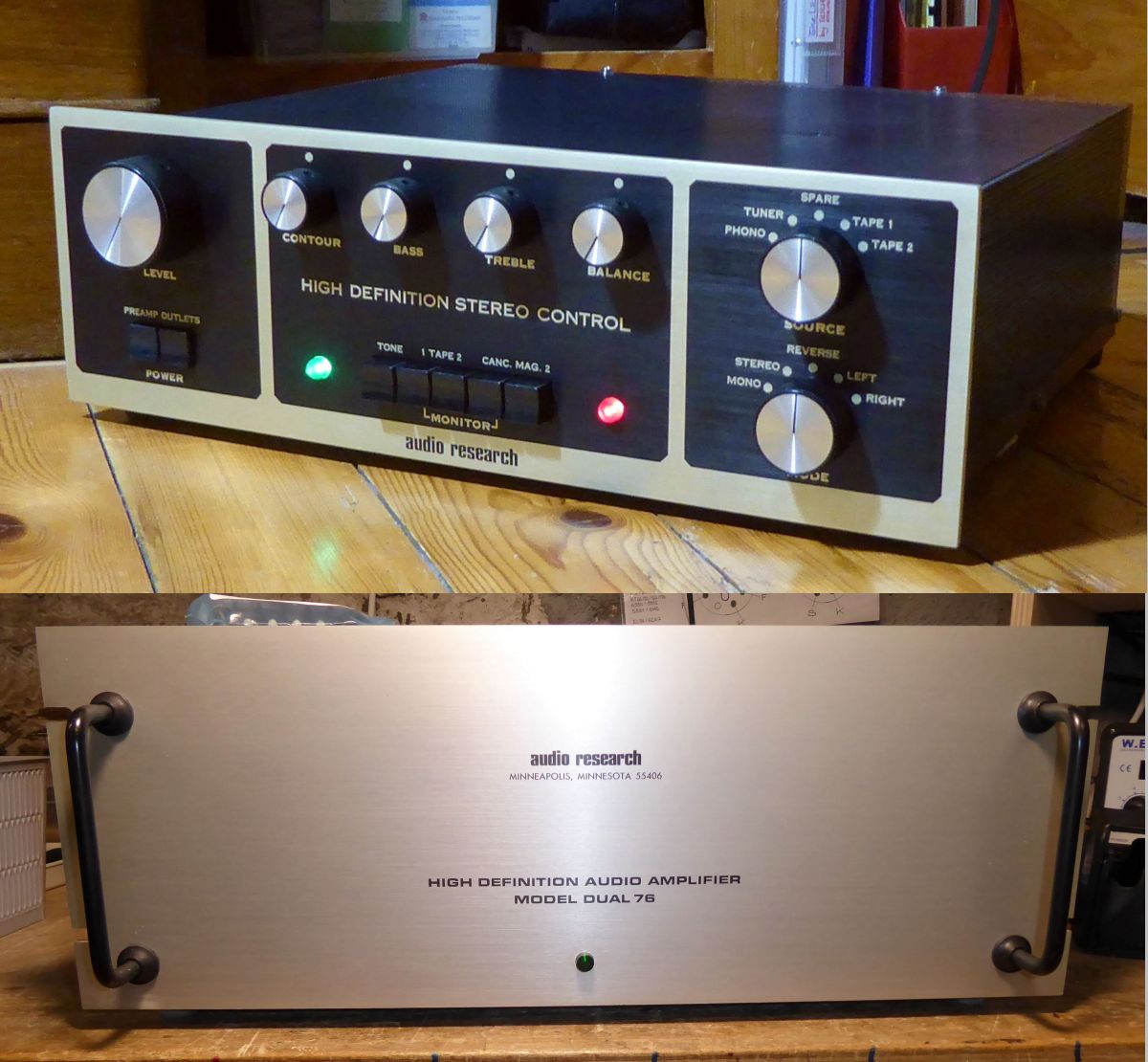
... Once serviced and a bit updated to meet today's requirements.
But it's me, OK ?


T

This thread being the most "current" (pun intended, I think?) to respond-to, I pose this stupid question...so, last year, while my Manley Snapper was in the shop, I purchased a Schitt Vidar to fill the void 'til my Snapper returned. The Snapper has some serious grunt, the Vidar, not so much. Both amps are rated at 100 watts. How come is it?
Synergy between the speakers and amplifier has been mentioned, between the amp and preamp is also important but likely it is the speakers’ needs here.
Some amplifiers have a better output design, whether it is NFB, the output transformer design, or even power supply design and capacity it sounds like your earlier amp might be more influenced by the current requirements or need for headroom than the latter one, possibly impedance swings. Very possibly the crossover design also. So the short answer is yes, 100W is just a number and it might be all you get and at 8 Ohms / 1,000lHz, no headroom or seriously degraded output at 40Hz or at the crossover point or at a 4 Ohm dip.
Perhaps I could restate my question. Can, do, tube amps sound bigger than SS amps?
So, "in general" would it be reasonable to assume a tube amp sounds bigger than a SS amp?
“Bigger” is a great measurement in audio, because it can mean many things whether it’s headroom, max. SPLs, or even-order distortion (or other distortion elements introduced into the music by the system). One of the things that people like about tube amplifiers and simple output designs is what they add to the music by way of ringing, distortion, soft-clipping, other things that might make for a “wider soundstage” type of effect.
What you like to hear is completely up to your taste in your room with your components, and no tube-amplifier will publish the ability of their amplifier to distort the music in pleasant ways, it’s just part of what they do and people call it many positive-sounding things like “warmer”, “bigger”, “larger soundstage” etc. that essentially means that the music is altered by the amplifier/speaker/preamp/etc. to give it a presentation that does not exist in the actual program material, but enhances the listening experience. This might sound like I’m down on tube amplifiers, I’m not. My mantra is that music is art, the system is science, and just like how light might highlight a piece of art or obscure its flaws to enhance its beauty the system can do the same to your music listening experience, … that’s what you’re laying your hard-earned money down to create.
This is also why it is so important to be able to listen to a system, in-home demo or whatever, to decide whether it is the listening experience that you enjoy most. No wrong answers on what amplifier is “best”.


Interesting thread...
The largest soundstage winner definitely goes to tube amps, with low to no feedback, imho.
I have an obsession with 3D playback. A "wide soundstage" is not enough. A "wall of sound" is not enough. I believe the speakers are the "front of the stage," so there should be significant, depth of image behind the speakers. If there is a forward presence, there should be a larger, rear soundstage...
The deepest, widest, tallest sound I ever get, seems to always need a no feedback, push-pull triode amp. The most accurate, "reach in and touch" soundstage needs an interstage transformer to split the phase, driving my 2A3s, 245s, 6A3s or VT-52s.
I do not underestimate SE 300B type amps. I simply achieve my desired "enormous soundstage" via pp triodes w/no feedback.
When I use low feedback, triode amps, like the Peerless A100 topology, with only R-C coupling, the soundstage is not as huge. However, the bass can sometimes be considered tighter.
Now, let us talk about concert going, please...When have you ever heard an acoustical instrument orchestra with tight bass ? Tight drums, maybe...
Accurate reproduction of the live, theater performance recordings, is my goal. I worked as a sound engineer, within a performing arts complex, for nearly a decade, from the mid 1970s to the mid-1980s. That live, theater sound (from live theater recordings), is still my goal...
BTW, my ref speakers are 16 Ohm, Altec Valencias.
Lastly, for this post, may I reccomend the RCA LP, "Bang, Baroom & Harp" as a fantastic, demo LP, to encourage the feelings of palpable, reach in and touch, presence ?
Keep on spinning the vinyl...
The largest soundstage winner definitely goes to tube amps, with low to no feedback, imho.
I have an obsession with 3D playback. A "wide soundstage" is not enough. A "wall of sound" is not enough. I believe the speakers are the "front of the stage," so there should be significant, depth of image behind the speakers. If there is a forward presence, there should be a larger, rear soundstage...
The deepest, widest, tallest sound I ever get, seems to always need a no feedback, push-pull triode amp. The most accurate, "reach in and touch" soundstage needs an interstage transformer to split the phase, driving my 2A3s, 245s, 6A3s or VT-52s.
I do not underestimate SE 300B type amps. I simply achieve my desired "enormous soundstage" via pp triodes w/no feedback.
When I use low feedback, triode amps, like the Peerless A100 topology, with only R-C coupling, the soundstage is not as huge. However, the bass can sometimes be considered tighter.
Now, let us talk about concert going, please...When have you ever heard an acoustical instrument orchestra with tight bass ? Tight drums, maybe...
Accurate reproduction of the live, theater performance recordings, is my goal. I worked as a sound engineer, within a performing arts complex, for nearly a decade, from the mid 1970s to the mid-1980s. That live, theater sound (from live theater recordings), is still my goal...
BTW, my ref speakers are 16 Ohm, Altec Valencias.
Lastly, for this post, may I reccomend the RCA LP, "Bang, Baroom & Harp" as a fantastic, demo LP, to encourage the feelings of palpable, reach in and touch, presence ?
Keep on spinning the vinyl...
Last edited:
<<snip>> Now, let us talk about concert going, please...When have you ever heard an acoustical instrument orchestra with tight bass ?
Accurate reproduction of the live, theater performance is my goal. I worked as a sound engineer, within a performing arts complex, for nearly a decade, from the mid 1970s to the mid-1980s. That live, theater sound is still my goal... <<snip>>
For some the goal is re-creating the live, theater performance that exists in the recording, accurately and without any additional artifacts.
For others, the goal is creating a live, theater performance effect from all recordings, whether it is in the recording or not.
For the former it takes a carefully curated system and environment for listening to music. It can all be measured and predicted.
The latter can involve all sorts of cross-talk, reverb, ringing, second-arrival sound, other vehicles of artistic creation on the playback side. This takes a lot more (IMO) experimentation and experience to create, you’re essentially becoming your own Sound Engineer / Mixing Engineer.
I can say from experience that going from the latter to the former, … it can sound quite boring and flat until you get used to it.
In my experience, I’ve definitely heard deep, tight bass in percussion instruments at live orchestral concerts. Tympani are tight and clear and sometimes felt in the chest. Certainly—not amplified to 127 dB—it’s nothing compared to the amplified bass drums at a rock concert. But it’s no slouch.