"She loves you..CLICK..yeah, yeah. Yeah, don't miss it at all.Growing up with 8 track, I must have missed the fun factor part. Curious to see what that is.


You are using an out of date browser. It may not display this or other websites correctly.
You should upgrade or use an alternative browser.
You should upgrade or use an alternative browser.
Question about 8track audio quality
- Thread starter Yeeterkeeter
- Start date
-
- Tags
- question

Yup-I doubt I would pay more than a Lincoln for one. Most of what I have, have been given to me or I paid less than a buck each.Would I buy more of them? Well, that depends, if they’re for cheap, sure. Otherwise, nope

1tumbleweed
Kozmik Kowboy
I fail to see how a move from rubber to plastic rollers would affect sound quality. Speed, perhaps, but not sound. I was initially distrustful of them, but they have proven to do the business.
That said, it's only the earliest rubber rollers that dissolved into goo in my experience. Splices and foam pressure pads are another story.
As always, just my opinion, YMMV.
That said, it's only the earliest rubber rollers that dissolved into goo in my experience. Splices and foam pressure pads are another story.
As always, just my opinion, YMMV.


turnitup
No, the stereo won’t break the crystal...Oh CRAP!
I have a nice quality Akai 8 track deck, and about 50 tapes. I NEVER play them but have them in my collection for historical purposes. They are a great conversation/display piece. I have always felt they were an inferior format, and went the cassette route in my youth, when most of my friends went with the 8 track. I found that they generally worked best as long as you had a book of matches on hand to jam underneath the tape to correct for the misaligned tape/tape head. Drank a lot of beers listening to 8 tracks though back in the day - good memories of low fidelity!

Yeeterkeeter
Kermit the Frog
After listening and “experiencing” the 8track for awhile, I can see why they went out of fashion quick. The way that you skip songs is somewhat mind boggling, and the channel system is mildly annoying at best. That said, the quality is far better than what I expected, and I do get the “fun” factor out of them lol.

maxhifi
Addicted Member
I fail to see how a move from rubber to plastic rollers would affect sound quality. Speed, perhaps, but not sound. I was initially distrustful of them, but they have proven to do the business.
Seem to be more prone to letting the tape slip, but I don't have enough 8 track experience to act as an expert on the matter, and there could have been other factors influencing things when I made that judgement.

orsen
Jukebox Hero
Growing up with 8 track, I must have missed the fun factor part. Curious to see what that is.
that was when the player "ate" the tape and you got to pull half a mile of it out of the machine,work out the wrinkles and creases, and then getting it to all wind up again with a quick flic of the wrist


DJDDay
Active Member
Just had to chime in to this thread since I was a kid in the 70's when I had my experience with 8-tracks. There was absolutely something satisfying about that mechanical "CHUNK" when you slid them in to play, but even as a kid I was infuriated by the whole "program" setup and lack of FF/RW in most consumer decks. That said, the tapes that were mostly on repeat in the house were the soundtrack to "Grease" as well as "Star Wars".  I was glad when I got my first compact cassette deck and never looked back. Always forward.
I was glad when I got my first compact cassette deck and never looked back. Always forward.
The whole concept of 4-track or 8-track cartridge tape feeding is interesting.
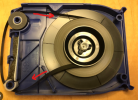
- Consider this... you are feeding the tape from the center of the pack where the diameter is small.
- When it pulls out, the reel rotates to wind the tape to the outside of the pack. But the diameter of the outer pack is much larger than the center.
- The tape is being pulled at a linear rate (3-3/4 ips) which causes the pack to rotate at an angular rotation rate.
- The linear rate of the outer take-up diameter is much larger and much more than the feed rate.
- This only works if the tape is able to easily slip while wound in the pack.
- As you pull from the center, it pulls the tape from the rest of the pack tighter around the center hub.
- From what I remember, this is accomplished by using a tape that has a very slick back-coating (graphite) that made it easy to slide.
1tumbleweed
Kozmik Kowboy
Finally, a post that explains (and pretty well, I might add) the technology of the endless loop - without being snarky. Yes, it was primitive to our 21st Century eyes, but it was advanced technology in 1964 (and based on a patent from the early '50s!)
Try to evaluate the 8 track not by what it looks like compared to cassettes or CDs or streaming, but compared to AM radio (which is the audience it was aimed at!)
Perhaps it's time to repeat something I wrote almost ten years ago on another forum:
2014 marks the fifty year anniversary of the creation of the 8-track tape cartridge system, although it was the tail end of 1965 before it became generally available to the public at large. Development work on the players and tapes under the direction of Bill Lear at Lear Aircraft in Wichita, KS was completed during 1964. After gaining commitments from RCA Victor to license its music catalogue, and Ford Motor Co. to offer 8-track players as factory options in the following year, Lear had set the stage for a revolution in music listening that some late-comers to the world of the 8-track may not fully comprehend.
Stop and think for a moment, and try to understand what a very different place the world was in 1964. John F. Kennedy had been assassinated only the year before, and people were still trying to figure out what really happened. Lyndon Johnson was stuck with this annoying little war somewhere (we weren’t really quite sure where), although it was of much more concern if you were of draft age or – even worse – were actually IN Vietnam. Organized large-scale protest of the war was at least three years away. The album that would bring four Liverpudlians to the attention of US teenagers, “Meet The Beatles”would be released in 1964. The Rolling Stones would begin to emerge, too, in 1964 from the endless waves of British bands preparing forThe British Invasion of 1965. A noisy band from London called The High Numbers would revert back to their original name, The Who, during 1964. The Byrds came together as a band in the summer of ’64. Bob Dylan was a scruffy East Village folksinger that people were starting to hear about.
So, what were people listening to in 1964? Well, RCA’s initial release in the 8-track format, in early 1965, included such “top stars”as Floyd Cramer, Peter Nero, Arthur Fiedler, Jim Reeves, and Arthur Rubinstein. Clearly, no one involved in 8 track’s beginnings had a clue how their invention would help change the culture of America.
The oldest of the baby-boomers were growing up into their late teens in 1964. Society was just starting to grasp how their interests – and numbers - would change the world. Suddenly this explosion of consumers had discretionary money, an interest in music well beyond previous generations, and were on the cusp of an electronics revolution. What were the options for music listening in 1964? Well,you had the family “phonograph”, radio, if you were lucky maybe a real “stereo” - or perhaps you knew someone who had one of those weird reel-to-reel tape recorders. In the car you had a radio; AM only, of course, since FM was this “other” system that required an adapter to plug into your “real” radio. Then, just at the moment that millions of kids were starting to drive (and “park” –what a quaint notion), the electronics industry gave them a gift –the ability to select and play their own music, whenever they wanted. And that, kiddies, is the true significance of 8-track’s place in history. Now, go ask somebody at Philips if they can tell you a story like that about the cassette – which started life in a dictating machine!
Try to evaluate the 8 track not by what it looks like compared to cassettes or CDs or streaming, but compared to AM radio (which is the audience it was aimed at!)
Perhaps it's time to repeat something I wrote almost ten years ago on another forum:
2014 marks the fifty year anniversary of the creation of the 8-track tape cartridge system, although it was the tail end of 1965 before it became generally available to the public at large. Development work on the players and tapes under the direction of Bill Lear at Lear Aircraft in Wichita, KS was completed during 1964. After gaining commitments from RCA Victor to license its music catalogue, and Ford Motor Co. to offer 8-track players as factory options in the following year, Lear had set the stage for a revolution in music listening that some late-comers to the world of the 8-track may not fully comprehend.
Stop and think for a moment, and try to understand what a very different place the world was in 1964. John F. Kennedy had been assassinated only the year before, and people were still trying to figure out what really happened. Lyndon Johnson was stuck with this annoying little war somewhere (we weren’t really quite sure where), although it was of much more concern if you were of draft age or – even worse – were actually IN Vietnam. Organized large-scale protest of the war was at least three years away. The album that would bring four Liverpudlians to the attention of US teenagers, “Meet The Beatles”would be released in 1964. The Rolling Stones would begin to emerge, too, in 1964 from the endless waves of British bands preparing forThe British Invasion of 1965. A noisy band from London called The High Numbers would revert back to their original name, The Who, during 1964. The Byrds came together as a band in the summer of ’64. Bob Dylan was a scruffy East Village folksinger that people were starting to hear about.
So, what were people listening to in 1964? Well, RCA’s initial release in the 8-track format, in early 1965, included such “top stars”as Floyd Cramer, Peter Nero, Arthur Fiedler, Jim Reeves, and Arthur Rubinstein. Clearly, no one involved in 8 track’s beginnings had a clue how their invention would help change the culture of America.
The oldest of the baby-boomers were growing up into their late teens in 1964. Society was just starting to grasp how their interests – and numbers - would change the world. Suddenly this explosion of consumers had discretionary money, an interest in music well beyond previous generations, and were on the cusp of an electronics revolution. What were the options for music listening in 1964? Well,you had the family “phonograph”, radio, if you were lucky maybe a real “stereo” - or perhaps you knew someone who had one of those weird reel-to-reel tape recorders. In the car you had a radio; AM only, of course, since FM was this “other” system that required an adapter to plug into your “real” radio. Then, just at the moment that millions of kids were starting to drive (and “park” –what a quaint notion), the electronics industry gave them a gift –the ability to select and play their own music, whenever they wanted. And that, kiddies, is the true significance of 8-track’s place in history. Now, go ask somebody at Philips if they can tell you a story like that about the cassette – which started life in a dictating machine!
Last edited:
I was around when the predecessor to the 8-track, the 4-track tape was "invented". At the time, I worked in Van Nuys, CA about a half mile from the "Madman Muntz" main headquarters. (Remember the "Muntz Mobile?) The physical characteristics of the 4-track were slightly different and there was a big hole in the bottom of the cartridge for the pinch roller to pop-up into. It was only 4-track so it only had a choice of two stereo programs. We used to make custom tapes by unwinding the tape from the pack, recording on a reel-to-reel recorder (only on one program channel since the other would play backwards), then rewinding it back onto the spool and splicing it back together. Fun times.
Late Boomer
Super Member
Philips had two competing projects for a then new cassette: one with a single hub similar to 8-track, another was a miniaturized RCA cartridge. Philips made the right choice. Later Philips tried to apply the idea of a flippable cassette to video, and this was a resounding flop.
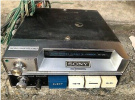
My first car in high school was a 1965 Ford Mustang 289 (bought used in the '70s). Back then the standard car radio was ONLY AM. I didn't like 4-track or 8-track because I could not record my own "mix" tapes, so I waited until a decent cassette player arrived... My first car cassette player was a Sony TC-20. It was a nice, rugged deck, but lacking in features.
Then I decided to upgrade to the legendary Pioneer KP-500 AM/FM/Cassette deck... the ultimate hi-fi stereo at the time. It had it all... separate bass and treble controls, switchable loudness, FM stereo (with muting). It was a great car deck. Hmmm... I think I still have it installed in the Mustang. It was a great sounding deck. You could crank up the volume and PLAY IT LOUD... listening to Pink Floyd, Genesis, Beatles, Moody Blues... I understand that these are quite collectable now.

Then I decided to upgrade to the legendary Pioneer KP-500 AM/FM/Cassette deck... the ultimate hi-fi stereo at the time. It had it all... separate bass and treble controls, switchable loudness, FM stereo (with muting). It was a great car deck. Hmmm... I think I still have it installed in the Mustang. It was a great sounding deck. You could crank up the volume and PLAY IT LOUD... listening to Pink Floyd, Genesis, Beatles, Moody Blues... I understand that these are quite collectable now.


I had one of those in my 76 Camaro.My first car in high school was a 1965 Ford Mustang 289 (bought used in the '70s). Back then the standard car radio was ONLY AM. I didn't like 4-track or 8-track because I could not record my own "mix" tapes, so I waited until a decent cassette player arrived... My first car cassette player was a Sony TC-20. It was a nice, rugged deck, but lacking in features.
View attachment 2980420
Then I decided to upgrade to the legendary Pioneer KP-500 AM/FM/Cassette deck... the ultimate hi-fi stereo at the time. It had it all... separate bass and treble controls, switchable loudness, FM stereo (with muting). It was a great car deck. Hmmm... I think I still have it installed in the Mustang. It was a great sounding deck. You could crank up the volume and PLAY IT LOUD... listening to Pink Floyd, Genesis, Beatles, Moody Blues... I understand that these are quite collectable now.
View attachment 2980421
I think it was labeled the super tuner ?
lots of good times with that deck.
Yeeterkeeter
Kermit the Frog
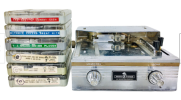
My general understanding of 8tracks in cars is that it is an easy way to have your 8track gobbled up and never to be seen again, but I might be wrong.Another interesting find. Apparently, there were some players that would play either 4 track or 8 track cartridges. Check out the heavy-duty, chromed case.
View attachment 2983003
I think part of the problem is that the user (teenager or young adult ) never cleaned the heads or pinch roller. The tapes were tossed in the car glove box or on the floor and left in the heat of a summer day. I think if we treated our reel-to-reel tapes like that, we would have issues with our home hi-fi decks as well....it is an easy way to have your 8track gobbled up and never to be seen again...


