
• The move to the new server is done. There are some software and database maintenance updates in process. This has us passing the hat around to help out. We appreciate any donations. Seriously, even a dollar helps. The payment page may be found here - https://www.audiokarma.org/support.html

Question for Realisitic Nova Experts

JamVal

Addicted Member
Picked up a set of Nova 7B at a thrift a few days ago just because they looked in great shape and they share a remarkable similarity in appearance to my Pioneer CS-99/99A.
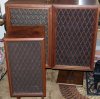
IMGP5926.jpg
Nova 7B sitting in front of CS99A/99. Nova 7B lattice grills are plastic, CS-99/99a are wood lattice grills.

All I can find on these is that they appeared in the Radio Shack catalogs from 1975 - 1979. I assume mine are the 1979 version with the 'Realistic' Plastic Logo Pin off center to the lower right. The 1975-78 catalogs show an 'RS' logo pin center bottom. The '79 catalog shows 30-20,000 hz, 70 watts, 8 ohm, but there is a gold inspection sticker on the back of my cabs that show 45 watts max program power. Previous catalogs show 20-20,000Hz and the '78 catalog shows program power 55 watts.

Questions:
Other than the logo pin, is there any known differences between the 1979 Nova 7B version and the previous versions (1975-78)?
Anyone know the efficiency rating? I'm guessing 90dB or less.
Anyone know who made them for Radio Shack? The backs of mine show "Custom Manufactured in Japan for Radio Shack a Division of Tandy"

They sound pretty good, better bass than I imagined when I first bought them. Woofer surrounds show no deterioration; not sure what they are made of, don't look like foam or rubber.
 
Register to hide this ad
Questions:
Other than the logo pin, is there any known differences between the 1979 Nova 7B version and the previous versions (1975-78)?

Not that I'm aware of.

Anyone know the efficiency rating? I'm guessing 90dB or less.

I've never seen published specs, but I would guess they're in the upper 80's (~87-88)

Anyone know who made them for Radio Shack? The backs of mine show "Custom Manufactured in Japan for Radio Shack a Division of Tandy"

No, but a lot of people have guessed that Fostex made a lot of RS gear. They certainly made a number of drivers used by RS.

They sound pretty good, better bass than I imagined when I first bought them. Woofer surrounds show no deterioration; not sure what they are made of, don't look like foam or rubber.

Yes, they do have very good low end response and have those 'never rot' surrounds -- that's not a marketing term, just something a lot of folks have noted over the years. I've had several Nova and Optimus models from that era and none have ever needed new surrounds.

By the way, the crossover has a single capacitor that is easy to change out, so yours may benefit from that. Yours look to be in very good condition, so it's well worth the effort here.
 
Last edited:
Gnesen, thanks much for the info. I searched and see the threads referencing a 15uF.

I'm thinking of moving these on. I'm not sure what's wrong with me. When I'm at home and look at the accumulation of gear, I tell myself, ENOUGH - Get rid of some of this stuff. But when I'm out and see something that looks good it seems to follow me home.
 
A very nice sounding solidly built speaker. I've owned 2 or 3 pairs of the Nova 7 and several pairs of the Nova 8b. Well worth the effort. As was mentioned underrated.
 
I've got two pair in my collection. They are pretty good, but the design is old. It has two paralleled 16 ohm tweeters which result in 8 ohms to the amplifier.The cross-over frequency is pretty low on these. (Don't remember exactly, but it is somewhere at or near 1200hz. A lot of these are found with blown tweeters. I would suggest a recap. There was a lady doing a modified crossover for the Nova 8B that had shown interest in doing the 7B, but disappeared from the community before she could design it for the 7B. These would be sweet if someone could design a fresh cross-over with maybe a second order filter or such. One item I've been pondering is whether the two tweeters would have an interference pattern between them that might reduce the quality of the sound. Just day dreaming and wondering......

These are worth hanging on to and fixing. the cabinets are beautiful walnut veneer on all the ones I've run across (possibly all of them are the same).
 
Thanks for the replies. Today I've been listening to some Classic Guitar music through this path:
Spotify ---> FiiO E17K DAC ---> Technics SA-505 ---> Nova 7B.
The Nova 7B's are growing on me. I have to sub them in to my main system and do some A/B listening against some Pioneer CS-99A's.

I played some test tones through these 7B's to make sure all the drivers are working and both sets of tweeters are good on mine.
From what I understand the full range is sent to the woofers.
 
Gnesen, I have very little understanding of crossover design.
While listening to test tones I believe I'm hearing a considerable audible overlap between the woofers and the midrange/tweeters. Although it's not that easy for my old ears I believe I'm hearing the mid/tweeters with the woofer down to about 1,000hz. And I believe I'm hearing the woofer with the high range drivers at least up to about 3500hz, maybe higher.

So, as a hypothetical example, when a 2 way speaker specification shows a crossover frequency of 2000hz, does it mean at or below 2,000hz only the woofer is audible, and above that 2,000hz only the tweeter is audible? Or is there some overlap?

I read the thread started some years ago by videolady201 on the Nova 8B crossover modification, and I think you did one also, so a good question for you; do you think the Nova 7B would benefit from a 2nd order modification?

I think the stock Nova 7B is considered a 1st order. I went to : http://www.v-cap.com/speaker-crossover-calculator.php
and also http://www.diyaudioandvideo.com/Calculator/SpeakerCrossover/
On the 1st order calculator I plugged in 8 ohm for both high and low pass impedance. Then tinkered with the cross over frequency until I got as close to the stock 15uF Cap and a 1.0mH inductor as I could. That came out to be 1325Hz which gave a 15uF Cap and a .96mH Inductor.

Then I looked at the 2nd order calculator. 8 ohm for the high and low pass impedance. For frequency I thought I would start with the 1325Hz that I came up with in the 1st order calculator. Then there are choices of Linkwitz-Riley, Butterworth, Bessel, and Chebychev Q=1. The Chebychev Q=1 gave the same Cap and Inductor values as the 1st order - 15uF, .96mH, but of course in the 2nd order cross over there is C1, C2, L1, L2 (15.02uF, 15.02uF, .96mH, .96mH respectively).
I started pricing out all the options for the 4 different 2nd order cross overs and decided a trial and error approach might get expensive.

Again, not knowing anything about crossovers, does it make sense to use the same frequency for a 2nd order design (1325Hz)?
I would be looking for a flat response, so which of the 4 (Linkwitz-Riley, Butterworth, etc) designs would be better.

Has anyone come up with any suggested 2nd order mods for the Nova 7B?

Probably the safe route for me is to just replace the existing 15uF caps and stay with the original design.
 
Gnesen, I have very little understanding of crossover design.
While listening to test tones I believe I'm hearing a considerable audible overlap between the woofers and the midrange/tweeters. Although it's not that easy for my old ears I believe I'm hearing the mid/tweeters with the woofer down to about 1,000hz. And I believe I'm hearing the woofer with the high range drivers at least up to about 3500hz, maybe higher.

So, as a hypothetical example, when a 2 way speaker specification shows a crossover frequency of 2000hz, does it mean at or below 2,000hz only the woofer is audible, and above that 2,000hz only the tweeter is audible? Or is there some overlap?

I read the thread started some years ago by videolady201 on the Nova 8B crossover modification, and I think you did one also, so a good question for you; do you think the Nova 7B would benefit from a 2nd order modification?

I think the stock Nova 7B is considered a 1st order. I went to : http://www.v-cap.com/speaker-crossover-calculator.php
and also http://www.diyaudioandvideo.com/Calculator/SpeakerCrossover/
On the 1st order calculator I plugged in 8 ohm for both high and low pass impedance. Then tinkered with the cross over frequency until I got as close to the stock 15uF Cap and a 1.0mH inductor as I could. That came out to be 1325Hz which gave a 15uF Cap and a .96mH Inductor.

Then I looked at the 2nd order calculator. 8 ohm for the high and low pass impedance. For frequency I thought I would start with the 1325Hz that I came up with in the 1st order calculator. Then there are choices of Linkwitz-Riley, Butterworth, Bessel, and Chebychev Q=1. The Chebychev Q=1 gave the same Cap and Inductor values as the 1st order - 15uF, .96mH, but of course in the 2nd order cross over there is C1, C2, L1, L2 (15.02uF, 15.02uF, .96mH, .96mH respectively).
I started pricing out all the options for the 4 different 2nd order cross overs and decided a trial and error approach might get expensive.

Again, not knowing anything about crossovers, does it make sense to use the same frequency for a 2nd order design (1325Hz)?
I would be looking for a flat response, so which of the 4 (Linkwitz-Riley, Butterworth, etc) designs would be better.

Has anyone come up with any suggested 2nd order mods for the Nova 7B?

Probably the safe route for me is to just replace the existing 15uF caps and stay with the original design.

Not sure if anyone has posted anything about an improved crossover design, but years ago on AK a poster named "videolady201" did an improved design for the Nova 8B which is highly regarded. She had talked about doing the 7B, but fell off the radar before that happened. The consensus was that she had some health issues that took her away from the forum. I personally would love to see someone design and test 2nd order Linkwitz-Riley filters for the 7B on both the tweeter and woofer. I'm thinking that the cross-over frequency should probably be significantly higher than the 1200 or 1325HZ that's being discussed with the stock x-over, but I have neither the experience, time or ability to design it. I have two sets of 7B's and I would be happy to use one as a control and the other as the test subject. Having said that, real testing would be involved and again I'm not sure I'm suited to the task. When I say all this, it doesn't mean that I don't understand basic filters - it is just that I have been reading and that doing it right is a lot more than just plugging in numbers. There are interactions with the design of the box and the drivers being used that are more complicated than using filter tables.

Gosh I hope that someone does an upgraded 7B x-over.
 
I'm pretty sure there's a choke that leads to the woofer -- I don't think it runs full range.

I just read a brief thread on diyaudio - a member reported that there is indeed a 1.0mH inductor on the crossover, but not connected to the woofer. Someone replied that RadioShack used second order on the high range and nothing on the woofer. I don't know if that has any effect on my assumption of a 1,325Hz crossover point.

One of the 2nd order designs, the Chebychev Q=1, called for C1 and CS to be 15uF, with L1 and L2 to be .96mH. I'm guessing the original designers wanted more of the highs going to the woofer though, or were they just cutting cost. If I do anything at all with these, it will be just replacing the 15uF caps, sealing up the RCA connection on the backs of the cabinets, and if the tweeters have the cups on the back; seal them up also.
 
I just read a brief thread on diyaudio - a member reported that there is indeed a 1.0mH inductor on the crossover, but not connected to the woofer. Someone replied that RadioShack used second order on the high range and nothing on the woofer. I don't know if that has any effect on my assumption of a 1,325Hz crossover point.

One of the 2nd order designs, the Chebychev Q=1, called for C1 and CS to be 15uF, with L1 and L2 to be .96mH. I'm guessing the original designers wanted more of the highs going to the woofer though, or were they just cutting cost. If I do anything at all with these, it will be just replacing the 15uF caps, sealing up the RCA connection on the backs of the cabinets, and if the tweeters have the cups on the back; seal them up also.

Yes, consensus is that RS was letting the woofer run free to cut costs. That in itself means that the woofer and tweeters have serious overlap up to the woofers cutoff frequency. With the phase shift of the x-over and the dual tweeters too, I am guessing that there was a whole lot of interference patterns going on around and in between the boxes. Again, I'm no expert.
 
Ok. I found a diagram. (Reference from AK member "Stuart Pedaso" on ,Sep 11, 2015 in thread http://audiokarma.org/forums/index.php?threads/realistic-nova-7b-any-crossover-mods.677937/)7B-xover.JPG ). This is a good place to start.

In looking at the diagram, indeed the stock x-over is a 2nd order model. Haven't tried to determine which kind yet. I am intrigued by the opportunity to also put a 2nd order low pass filter on the woofer as well and to potentially raise the cross-over frequency some. That would help protect the tweeters which seem to have a higher than expected mortality rate. Here are some questions and potential issues that I suggest could be explored regarding the stock 7B x-over.

1. I think the x-over frequency for the high pass filter might be too low at 1200-1400Hz. Maybe it should be higher at 1500-2000Hz. I don't have data to validate this though.
2. The woofer runs free and it probably shouldn't. By designing the speaker with no x-over on the woofer it has the both drivers running above the x-over frequency up to the point that the woofer drops off naturally. I would think that there would be an interference pattern between the woofer and tweeter in this band, but again I don't have data to validate that.
3. With two tweeters in the cabinet I would think they too would have an interference pattern between them for their full range. That can't be good, but again I don't have any data to validate this. [Geeze. That would mean (based on my item 2, that all 3 drivers could be having complex interference patterns? I'm no expert on speakers. I'm just applying what I learned in basic physics for any kind of waves with two (or more) point sources.)

Just some thoughts.... Maybe someone can take this and run with it?

Gosh, I wish that videolady201 was still around......
 
Tim, thanks for posting the stock schematic, I was wondering if one was available.
I'm not sure if I'm correct, but the 6 and 2 ohm resistors are in the High pass circuit to attenuate the tweeter?
And, if I'm reading it right those resistors are bypassed when switched to the high position. Which makes sense, no attenuation.
In the normal position only the 2 ohm resistor is in.
In the low position, both are in series yielding 8 ohms. Which again makes sense, most attenuation of the tweeter.

When I switch the attenuators on mine, I don't hear any difference from low to normal to high. I probably need to open them up and clean the switches and check the resistors. Based on your comment on the high mortality rate of the tweeters, I think I should look into this area. Maybe replace the caps while I'm in there.
 
Tim, thanks for posting the stock schematic, I was wondering if one was available.
I'm not sure if I'm correct, but the 6 and 2 ohm resistors are in the High pass circuit to attenuate the tweeter?
And, if I'm reading it right those resistors are bypassed when switched to the high position. Which makes sense, no attenuation.
In the normal position only the 2 ohm resistor is in.
In the low position, both are in series yielding 8 ohms. Which again makes sense, most attenuation of the tweeter.

When I switch the attenuators on mine, I don't hear any difference from low to normal to high. I probably need to open them up and clean the switches and check the resistors. Based on your comment on the high mortality rate of the tweeters, I think I should look into this area. Maybe replace the caps while I'm in there.

Hi JamVal,

Yes, those resistors and the switch are to attenuate the tweeters. I leave mine in the highest output setting all the time and control the high end from my amp/receiver. Maybe others will chime in with their feelings on this topic.

Listen to the individual tweeters to see if you are getting output from each of them. Most htk them to make sure you are checking only the speakers resistance and not the rest of the cross-over and other drivers (particularly when measuring the tweeters because they are wired in parallel). Make sure they aren't infinite/open/blown. Can't remember for sure, but the tweeters should be 12-16 ohm for each and the woofer should be 6-8 ohm. If the tweeters are infinite then they are probably blown, but we've seen/heard that the leads can come off where it passes through the cone. The tweeters come up on flea-bay occasionally, so don't despair. You definitely want to replace the 15uF capacitor. Go with something that is audio quality. You don't need to get crazy expensive, but I would recommend against replacing it with a generic capacitor type/brand. Along the way you can use the ohm meter on the switch to check it out. Some "Deoxit" or tuner/switch cleaner would be a good idea.
 
Last edited:
Looking around on the internet it looks like the stock x-over really does have a crossover frequency in the neighborhood of 1325. It would be interesting to put in 2nd order filters on both the tweeters and the woofer, but I wonder if that would mess with the sound levels above the cutover frequency? I.e. Would we lose enough energy/volume above 1325 to make it sound bad because the woofer would no longer be contributing? (Just thinking out loud.) Also, I wonder if some of the other RS speakers might be able to donate a single 8 ohm tweeter that could replace the two 16 ohm tweeters in the 7B? Would the efficiency be good enough?
 
Initially, I was thinking along the same lines. It would be relatively easy to just add a low pass filter with an inductor and cap having the same values as the high pass filter (1.0mH, 15uF). In fact that's one of the options an online calculator gave me, its called Chebychev Q=1. The Radio Shack catalogs refer to the 2 tweeters as midrange/tweeters. This could be tested on 1 speaker with no investment. Take the cap and inductor from the high pass filter on one speaker and use it for the low pass filter on the other speaker.

I'm trying to find the frequency range of the 2510Aa online short of pulling the leads and running some tones on it. I found a thread that referenced the same Nova 7b woofers and tweeters being in the Optimus 1B. http://audiokarma.org/forums/index.php?threads/rs-nova-15-and-optimus-1b-new-scores.447950/page-3
The Optimus 1B is in the same year catalogs as the Nova 7B and were a little cheaper with a fabric grill and a slightly smaller cabinet. I thought I was on to something when I found this thread, but the gist of the conversation was in finding replacement tweeters for the 2 that were fried on the author's Optimus 1B's.

Not finding any mods for the Nova 7B I did a google 'Optimus 1B Crossover Modifications'
http://the-radioshack-forum.1496864...-Crossover-And-Driver-Upgrades-td6450816.html
Not much here, other than someone replaced the 15uF caps and got an improvement.

The thread says that the woofer range is 25-300 Hz, but that must be a typo, he probably meant 25-3,000Hz. Further down on page 3 of this thread it mentions the crossover to be around 1300Hz, and also mentions it being a Chebychev Q=1 crossover. So if these values are correct the overlap between the woofer and tweeters would be 1300 to 3000. When running test tones I believe I'm hearing a larger overlap on both ends.

On this thread: http://audiokarma.org/forums/index.php?threads/realistic-nova-7b-crossover.515971/ I read that these tweeters 0705Ae will go down to 350Hz. Would my hearing a broader overlap be an indication that my caps are bad and need replacement? I'm 100% sure that all my tweeters are working because I hear them clearly at 15,000Hz. (the more I read about these tweeters the more lucky I feel at finding a set with all the drivers working)

I have the same concern - if we put a low pass filter in at the same values, we cut the woofer back to around 1300Hz, and I suspect that the two mid/tweeters aren't going to make up for that loss. Going higher, up towards 2000Hz, on both high and low pass would give some protection to those vulnerable tweeters. Videolady mentioned that the 12" Nova 8b woofers showed very good performance up to 1600Hz, so what does that say for the 10" woofers in the Nova 7B? So maybe shoot for somewhere between 1600-2000Hz.

Based on the online calculators there's more than one way to get there: Butterworth, Bessel, Linkwitz-Riley, Chebychev Q=1. Which way to go? Having no knowledge of how the cabinet and driver parameters, driver spacing (those 2 tweeters), 'lobbing' effect (lobbing? what's that), etc play into the design it would just be trial and error for me, and that could get expensive and still not hit an optimum.
 
Back
Top Bottom