• The move to the new server is done. There are some software and database maintenance updates in process. This has us passing the hat around to help out. We appreciate any donations. Seriously, even a dollar helps. The payment page may be found here - https://www.audiokarma.org/support.html

Question for Realisitic Nova Experts

So I ordered a UMM-6 calibrated USB microphone. It should be here today. I'll start with Holmimpulse and run some basic frequency response tests. I might need to start a thread somewhere to ask questions. Another site has an active community for measuring speakers and using Holmimpulse. We're on our way!
 
So I ordered a UMM-6 calibrated USB microphone. It should be here today. I'll start with Holmimpulse and run some basic frequency response tests. I might need to start a thread somewhere to ask questions. Another site has an active community for measuring speakers and using Holmimpulse. We're on our way!
Excellent!
 
So I ordered a UMM-6 calibrated USB microphone. It should be here today. I'll start with Holmimpulse and run some basic frequency response tests. I might need to start a thread somewhere to ask questions. Another site has an active community for measuring speakers and using Holmimpulse. We're on our way!

Anxiously waiting to see what your findings are.
 
Gentlemen, hats off to you for the efforts. I've subscribed and will be following along as I have a pair of 7B's as well, interested in your journey! :beerchug:
 
Wow. A lot to learn with Holmimpulse. The microphone is mostly plug-and-play, but you need to download the calibration file and load it in. I ran some tests with one of my 7B's and got some inconsistent results. I'm still studying those results. Note too that there is some calibration mentioned for the sound card as well that I haven't done (called loopback?). Here are some challenges I'm experiencing.

- It's a complex program. A lot to learn and a lot of settings. There is a wealth of info out in the internet - maybe too much.
- I'm finding that the results I'm getting are inconsistent. Each time I run a measurement I get different results (the plot is vastly different). It might be reflections as I'm just doing some basic tests inside the house right now, but I would have thought I'd get the same reflections/results each time. I have not set any gating and I'm certain that is something I still need to do. Still studying.
- I'm not able to drive the measurement with only the sound card on my laptop. The application complains that the output is too low. I've temporarily driven my laptop through a NAD receiver I have on hand. I'm concerned about non-linearity added by the receiver.
- There is information that I'm supposed to do a loopback calibration to calibrate the program for the non-linearity of the sound card. I believe I need to get a cable to do that.

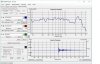
I've opened up the 7B's and disconnected the tweeters so that only the woofer is being driven directly while in the cabinet. Here is a first diagram. DON'T BELIEVE THIS IS REAL DATA. THIS IS JUST A TEST RUN WHILE I LEARN HOW TO USE THIS APPLICATION. I still have a lot to learn before I start showing real results. There is a lot wrong with this plot, but we're close to getting real measurements!

Woofer.jpg
 
I'm not familiar with the 6B, but looking online it seems that it is an 8 inch 2-way with only a single tweeter. A simpler speaker than the 7B with dual tweeters. The midrange might be better, but I bet it doesn't have the low end that the 7B (a 10 inch 2-way) would have.

On the OP subject of Realistic Nova "experts", I have 3 pairs of Nova 6, catalog number 40-4019A and love them. They are very nicely balanced with extended bass when used on bookshelves as intended. On a long wall in my basement I have 2 pair connected in L-R-L-R configuration with about 6 feet between them. The original set was purchased new by a friend for $29 each when Radio Shack used to offer half price speaker sales. With a normal retail of $79 each, the salesman had made a $20 mistake making them an exceptional bargain.

When I found a pair of Nova-7 at a thrift store for $15 I was excited to hear them. I don't recall which version they were but they had two tweeters. In the couple of weeks of listening to them that followed I could not get past what I perceived as harsh, peaky treble. I considered using only 1 tweeter and perhaps an upgrade to a dome or planar device but also noted IM distortion from the woofer unit at any significant volume. Modifications seemed pointless so I gave them to a friend. I don't wish to dissuade anyone from seeking improvements but wanted to share my experience and opinion.
 
Last edited:
When I found a pair of Nova-7 at a thrift store for $15 I was excited to hear them. I don't recall which version they were but they had two tweeters. In the couple of weeks of listening to them that followed I could not get past what I perceived as harsh, peaky treble. I considered using only 1 tweeter and perhaps an upgrade to a dome or planar device but also noted IM distortion from the woofer unit at any significant volume. Modifications seemed pointless so I gave them to a friend. I don't wish to dissuade anyone from seeking improvements but wanted to share my experience and opinion.

Were they the Nova 7 or 7B ? I believe there may be a difference.
 
Were they the Nova 7 or 7B ? I believe there may be a difference.
I'm not sure which version and understand that would make a difference. I know the two tweeters were identical and the woofer had a stone like area immediately surrounding the dust cap. I'll try to get the version number from the friend that has them now.

For what it's worth, the ADC 303AX I may have directly compared them to have a laid back presentation. The woofer in that speaker has good clarity and an especially good low end extension. Sometimes you quickly know what characteristics you can live with and those that you can't.
 
Last edited:
With a friends help we've been measuring the 7B drivers separately and without the crossovers in the cabinet. I'm going to post the frequency response measurements in the next several posts. First, here is my setup for measuring them.

- Using an ASUS laptop with Windows 10 64-bit running Holmimpulse with the UMM-6 microphone. This microphone is USB driven and as a result it avoids the need for a microphone preamp.
- I had downloaded the calibration file for the microphone and loaded it into Holumimpulse.
- I found that the laptop didn't have sufficient power to drive the RS Nova 7B directly, so I fed the laptop through the CD inputs on a NAD 7000 receiver I had on hand. I made several measurements to adjust the NAD and laptop volumes. At first I received some pop-up messages from Holminpulse indicating that digital clipping was occuring. After turning down the laptop volume and adjusting the NAD volume I could see somewhat consistent results from each run. (I wasn't sure how to calibrate the setup for any non-linearity introduced by the NAD, so I didn't calibrate for this.) (There is an ability to calibrate the sound card when using a non-USB microphone by jumping the input to the output on the computers sound card. I did not do this either because I was using a USB microphone.) So, the following measurements were taken without calibrating for the sound card and NAD receiver/amp non-linearlities. I believe though that the measurements taken were decent and useful without this calibration.
- I had this setup in my kitchen with the microphone about 1 meter from the speaker and the setup was about 4 feet off the floor. While sonically this probably isn't the best setup due to the hard surfaces all around, the Holmimpulse has a feature (called gating) that digitally removes any of the late received bounces.

In preparation, on one of the 7B's, I bypassed the cross-over and disconnected the drivers I wasn't testing at the moment. In order to bypass the cross-over I used a jumper around the capacitor so that the tweeters were directly driven by the NAD. I had to cut one leg on the inductor as the inductor was in direct parallel with the tweeters. I also set the tweeter switch on the back of the cabinet to "high" to take all of the resistors out of the circuit. The cabinet was ready to measure any of the drivers directly driven - without the affects of the cross-over.

Next post will be a measurement of the speakers.
 
Last edited:
Here is a measurement of the tweeters. I ran these mostly full range. The power was moderate and I don't believe that I ran too much risk of damage on the tweeters. I left the tweeters in parallel and I disconnected the woofer. Those tweeters were being directly driven by my NAD 7000 receiver.

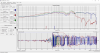
Here is the frequency response of those speakers. Blue is tweeters, red is woofer and green is the digital addition of the response of both together. (The addition would be in a perfect world with all drivers running in parallel without any cross-over.

RS Nova 7B.png

Next post is a detailed look at the response of the woofer.
 
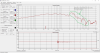
So here is the response of the woofer by itself. Notice the area encircled in green. I believe this is woofer breakup and while I've only circled the area starting at about 2KHz, you can see a dip just ahead of 2KHz which is likely part of that breakup. This is likely a problem with the original 7B design in letting the woofer run free. This breakup mode (particularly between 2-3KHz) would be adding distortion in a very important area of mid-range frequencies. This chart would indicate that a cross-over frequency well below 2KHz would be a good idea.


Woofer_Breakup.png

Next post is a detailed look at the response of the two tweeters together.
 
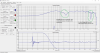
So, here is a response to the two parallel tweeters alone. Again, the cross-over had been bypassed and the tweeters were being driven directly by the NAD receiver. (Two 16 ohm tweets in parallel for an approximate 8 ohm impedance). Here is the pic of those measurements. There are two dips in the response. I don't know what is the cause of the first dip, but the second dip could be a cancellation frequency caused by interference between the two tweeters. We ran a separate test with only one tweeter running and this dip went away.

Tweeter.png
 
Last edited:
Here is the response for a single tweeter. Notice that there is no dip at (or near) 13KHz. That's why I think it was cancellation between the two tweeters.

Single Tweeter.png
 
Phew. Those previous 5 posts were kind of a big deal to put together. Sorry it took so long. I am hoping that some experts will chime in and tell me where I'm wrong with my assumptions and give pointers in the areas that I am deficient. (Calibration of the sound card and amp, assumptions as to the causes of various behaviors, etc.)

Those dips in the woofer and the also the tweeters around 1.5KHz are bothering me. I'm not sure how to deal with that. It rather leaves a hole in the response at that frequency no matter where it crosses over.
 
Here is a measurement of the complete and stock speaker. Notice the bump around 2.5KHz where the woofer (which is running free) had a bump in its' output due to the breakup.

Stock Crossover.png
 
Tim, I want personally applaud your efforts:bigok::thumbsup:. Great work, that is much appreciated by more people than you would think.

I currently own 3 iterations of these loudspeakers, so I have a personal vested interest in your findings:hug:

Now, get back to work before I throw you a beat'in...:p!
(alcohol induced channeling of jerky boys above)
 
Last edited:
Tim, I also want to thank you for your efforts. All of this is already way over my head, and I would have no idea of what to do with the results once you're satisfied with the analysis - in other words how to use the results to design a better cross over.

Just a thought here - but at this point the question of interpreting the results is more general than the lead title of this thread "Question for Realistic Nova Experts"
Maybe starting a new thread with your posts #50 - #56 will get more of the speaker gurus involved in the discussion. I know double posts are frowned upon, but I'm thinking the analysis you're running is relevant to use of the software and microphone on any speaker, not just the Nova's.

Maybe a thread titled "Driver Analysis - Holmimpulse, UMM-6 Mic ?" will get more attention.

I took a simplistic look at the results (along the same lines as what you said in post #52) - we see that dip for both the woofer and tweeter(s) at around 1300Hz (? I can't see the scale very well, but the dip looks to be centered between 1K and 2K, but that scale is not linear (yes/no?). So I'm guessing those dips are around 1300Hz, which I had calculated, coincidentally, as the crossover point for the tweeters in the stock design.

So, did the original designers leave the woofer to run free as a cost savings measure, or for a sonic reason? They used electrolytic caps back then, couldn't have been much of a savings, maybe the inductors? Labor to install one additional inductor and a cap in Japan in the 1970's?

Does the software have modeling capability to calculate a response curve with different crossover designs once you have an accurate response curve for the drivers by themselves? If what you have so far is accurate, my guess is that moving the crossover up to about 2.0KHz on both the tweeters and woofer might flatten those blips out at 2.5KHz and add some protection to the tweeters. (another guess is that the original designers knew a hell-of-a-lot more about this than I do.)

 
Hey JamVal,

I thought about posting in another thread, but we were trying to improve the 7B's here. I just left it here as I think it is an appropriate location IMHO.

I was looking at the location of the dip too. You are right the scale is non-linear. I'll work on getting a good bead on that low point, but there may be more to picking the x-over frequency then just knowing that low point. I think we need to be cognizant of that breakup on the woofer that is happening just to the right - we don't want to cross-over to close to that.

In terms of why the woofer is running free... I'm guessing it was a cost cutting decision, however, it seems that RS put a 2nd order filter on the tweeter which was a good thing to do. They might just as well saved more by going with a 1st order filter (just a capacitor), but we should be glad they did as much as they did.

The Holmimpulse doesn't seem to have the ability to model the cross-over components. I think it is just a measurement package. I can start looking for packages that do that, but I'm wondering if those packages will require data that I don't have. I'll start the research and let the group know what I find.

In terms of moving the cross-over frequency toward 2KHz, we'll see. I think though that because the cross-overs don't have sharp drop-offs (for first or second order) that we may have to stay farther away from the woofers troubles at 2.5KHz. In terms of tweeter protection, I'll see if we can include something for that in the final design. Those tweeters are a bit special (16 ohm) and it might be worth it to put in that protection. If we end up moving the cross-over frequency upward, that can add a level of protection too.
 
Last edited:
Sorry that I've been away. I was trying to setup a measurement of the impedance mostly to satisfy my curiosity about how the impedance curve would look with the woofer running free. In any case I ended up buying the DATS package and measured the 7B and yep. The impedance goes low (5ohm) above about 1.5KHz. I don't know if that is a problem, but I'd think that you'd want the amp to see a reasonably flat curve if at all possible. In any case, I think I'm ready to start experimenting with changes. I'm going to look at putting a 2nd order filter on the woofer first to see how that behaves.
 
Back
Top Bottom