

You are using an out of date browser. It may not display this or other websites correctly.
You should upgrade or use an alternative browser.
You should upgrade or use an alternative browser.
Random Thoughts or Whatever
- Thread starter whoaru99
- Start date

Mystic
We're all born mad

Earth Day, celebrated annually on April 22, marks a global commitment to environmental protection and sustainability. The first Earth Day took place in 1970, ignited by U.S. Senator Gaylord Nelson of Wisconsin, who aimed to raise awareness about environmental issues and mobilize action to address them. Since then, Earth Day has evolved into a worldwide movement, engaging millions of people across the globe in activities such as tree planting, clean-up campaigns and advocacy for environmental policies. Its organizer is EARTHDAY.ORG, a non-profit organization dedicated to promoting environmental conservation and mobilizing communities to take action for a healthier planet.
The theme of this year’s Earth Day is “Planet vs. Plastics” – a theme chosen to raise awareness of the damage done by plastic to humans, animals and the planet and to promote policies aiming to reduce global plastic production by 60 percent by 2040.
As our chart shows, global plastics use has increased rapidly over the past few decades, growing 250 percent since 1990 to reach 460 million tonnes in 2019, according to the OECD’s Global Plastics Outlook, which projects another 67-percent increase in global plastics use by 2040 and for the world’s annual plastic use to exceed one billion tonnes by 2052. As our chart shows, packaging is the largest driver of global plastics use, which is why a rapid phasing out of all single use plastics by 2030 is one of the policy measures proposed under EARTHDAY.ORG’s 60X40 framework.
Other major applications of plastics include building and construction, transportation as well as textiles, with the fast fashion industry particularly guilty of adding to the world’s plastic footprint. “The fast fashion industry annually produces over 100 billion garments,” the Earth Day organizers write. “Overproduction and over-consumption have transformed the industry, leading to the disposibility of fashion. People now buy 60 percent more clothing than 15 years ago, but each item is kept for only half as long.” Most importantly, the organization points out that 85 percent of disposed garments end up in landfills or incinerators, while just 1 percent are being recycled.


nailer
audionerd
Wondering what constitutes an investment account and how this percentage has been trending over time.Percentage of U.S. teens who have investment accounts: 23
(Harper's Index, May 2024)

davidhun
Well-Known Member
I bet a lot of them are 529s.Wondering what constitutes an investment account and how this percentage has been trending over time.
nailer
audionerd
Now wondering percentage of these and the other teen investment accounts are parental unit funded.I bet a lot of them are 529s.
Mystic
We're all born mad

While UNESCO's General Conference probably thought of ink on paper when it first celebrated the event "Happy World Book Day" in 1995, some 21st century book lovers have moved onto enjoying the pastime in the electronic form. In the following chart, we compare just how popular e-books are versus those in print.
According to data from Statista’s Market Insights: Media & Advertising, e-book penetration still trails that of printed books in the vast majority of countries around the world. In the United States for example, 20 percent of the population are estimated to have purchased an e-book last year, compared to 30 percent who bought a printed book. China is the only country of those studied that saw the opposite trend, with only 24 percent of people having bought a printed book in the 12 months prior to the survey, while around 27 percent of people bought an e-book in that time frame.
Looking at forecasts for the book market on a worldwide scale, Statista analysts predict that while e-books have grown in popularity, they will not be the final nail in the coffin of printed books but rather a complementary product that should ultimately benefit the publishing industry.
Happy World Book Day -- 2024!
Mystic
We're all born mad
I still handle/read, exclusively, paper-based books --- paperback and hardcover. In fact, I am staring @ this moment @ a stack of three hard-bound books I'm reading: Shadows On The Grass (Dinesen), Radiant: Life And Line of Keith Haring (Gooch), and Cocktails With George And Martha (Gefter).We and China placed 4th in percent of population that purchased books. Haven't bought one in five years or so. Been a library fan since grade school.
Mystic
We're all born mad

As part of a larger national security and foreign aid package, President Joe Biden on Wednesday signed into law legislation that forces TikTok parent ByteDance to divest the U.S. arm of its popular social media platform within 270 days or be banned from operating in the United States. The “Protecting Americans from Foreign Adversary Controlled Applications Act” seeks to cut any ties between TikTok, its current parent company and the Chinese government, which allegedly abuses the platform to “surveil and influence the American public” in a way that poses a threat to national security.
Compared to an earlier standalone bill that had passed the House in March but then failed to gain traction in the Senate, the newly passed bill extends the time given to ByteDance from 180 to 270 days, with the possibility of a 90-day extension if the president finds that significant progress towards a “qualified divesture” has been made. This means that TikTok’s Chinese owner now has until after the U.S. presidential election to find a suitable buyer, turning the question of whether or not TikTok should be divested or banned into a potential election issue. Sure enough, former president Donald Trump told young voters to remember that “crooked Joe Biden is responsible for banning TikTok,” when they vote in November, omitting the fact that he tried to ban TikTok himself during his time in office.
And while Trump was right in his view that young Americans would be more likely to oppose legislation against TikTok, he ignored the fact that the vast majority of Republican voters is in favor of a potential ban. According to a recent YouGov/The Economist survey, two thirds of Republicans strongly or somewhat approve the forced divesture/potential ban of TikTok versus just 20 percent who oppose such legislation. Democratic voters are almost evenly split on the issue, with 40 percent of respondents in favor of legislative action against TikTok and its parent company. Looking at different age groups, the trend is clear: the younger the respondents the more likely they are to oppose a potential TikTok ban, which is easily explained by the fact that young people are much more likely to be TikTok users.
So what happens next? If ByteDance fails to find a suitable buyer within the given timeframe, it would be unlawful for app stores and web hosting companies to distribute the app in the United States. Finding a buyer will be hard though, as any company with an interest and deep-enough pockets to acquire a platform of TikTok's stature will almost certainly face intense scrutiny from the FTC for antitrust reasons. It's also unlikely that ByteDance will go down without a fight. "Rest assured, we aren't going anywhere," TikTok CEO Shou Chew said in a video posted on Wednesday, claiming that the ultimate goal of the legislation is to ban TikTok, not sell it. "We are confident and we will keep fighting for your rights in the courts," he said, addressing the platform's 170 million U.S. users directly.
nailer
audionerd
Always have and probably always will read paper books. Have two passing before my eyes at this time.I still handle/read, exclusively, paper-based books --- paperback and hardcover. In fact, I am staring @ this moment @ a stack of three hard-bound books I'm reading: Shadows On The Grass (Dinesen), Radiant: Life And Line of Keith Haring (Gooch), and Cocktails With George And Martha (Gefter).
davidhun
Well-Known Member
Always have and probably always will read paper books. Have two passing before my eyes at this time.
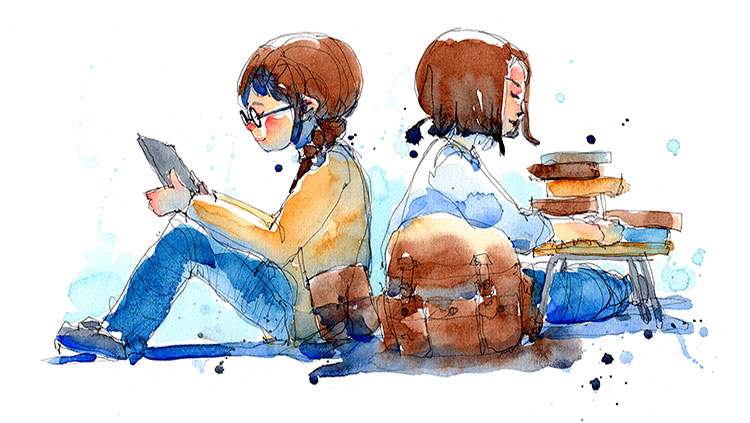
Reading on Paper Versus Screens: What’s the Difference?
Digital reading has been widespread for years — but how well are we absorbing it all?
 www.brainfacts.org

Pio1980
AK Member
So, how likely is it Tik Toc is a sinister subversive honey pot?View attachment 3186149
As part of a larger national security and foreign aid package, President Joe Biden on Wednesday signed into law legislation that forces TikTok parent ByteDance to divest the U.S. arm of its popular social media platform within 270 days or be banned from operating in the United States. The “Protecting Americans from Foreign Adversary Controlled Applications Act” seeks to cut any ties between TikTok, its current parent company and the Chinese government, which allegedly abuses the platform to “surveil and influence the American public” in a way that poses a threat to national security.
Compared to an earlier standalone bill that had passed the House in March but then failed to gain traction in the Senate, the newly passed bill extends the time given to ByteDance from 180 to 270 days, with the possibility of a 90-day extension if the president finds that significant progress towards a “qualified divesture” has been made. This means that TikTok’s Chinese owner now has until after the U.S. presidential election to find a suitable buyer, turning the question of whether or not TikTok should be divested or banned into a potential election issue. Sure enough, former president Donald Trump told young voters to remember that “crooked Joe Biden is responsible for banning TikTok,” when they vote in November, omitting the fact that he tried to ban TikTok himself during his time in office.
And while Trump was right in his view that young Americans would be more likely to oppose legislation against TikTok, he ignored the fact that the vast majority of Republican voters is in favor of a potential ban. According to a recent YouGov/The Economist survey, two thirds of Republicans strongly or somewhat approve the forced divesture/potential ban of TikTok versus just 20 percent who oppose such legislation. Democratic voters are almost evenly split on the issue, with 40 percent of respondents in favor of legislative action against TikTok and its parent company. Looking at different age groups, the trend is clear: the younger the respondents the more likely they are to oppose a potential TikTok ban, which is easily explained by the fact that young people are much more likely to be TikTok users.
So what happens next? If ByteDance fails to find a suitable buyer within the given timeframe, it would be unlawful for app stores and web hosting companies to distribute the app in the United States. Finding a buyer will be hard though, as any company with an interest and deep-enough pockets to acquire a platform of TikTok's stature will almost certainly face intense scrutiny from the FTC for antitrust reasons. It's also unlikely that ByteDance will go down without a fight. "Rest assured, we aren't going anywhere," TikTok CEO Shou Chew said in a video posted on Wednesday, claiming that the ultimate goal of the legislation is to ban TikTok, not sell it. "We are confident and we will keep fighting for your rights in the courts," he said, addressing the platform's 170 million U.S. users directly.
Thinking about assurances here vs assurances Hong Kong.
Mystic
We're all born mad
I have never used it, but I have seen examples of it replayed @ Youtube and elsewhere. Seems like a lotta little (mainly, but not exclusively) girls "twerking", or so they call it?So, how likely is it Tik Toc is a sinister subversive honey pot?
Thinking about assurances here vs assurances Hong Kong.
Mystic
We're all born mad

The U.S. economy grew slower than expected in Q1 2024 as inflation reaccelerated through the first three months of 2024. According to the BEA's advance estimate of U.S. gross domestic product for the first quarter of 2024, the economy grew at an annualized rate of 1.6 percent during the period, missing the 2.5 percent expected by economists. According to the BEA, the slowdown compared to Q4 2023, when real GDP increased had 3.4 percent, primarily reflected decelerations in consumer spending, exports and government spending as well as an increase in imports, which are a subtraction in the calculation of GDP. While the latest reading marks the slowest growth since Q2 2022, economists won't be overly concerned by it as the Fed has been trying to pour cold water on the economy for two years in its continued efforts to tame inflation.
The more worrying outcome from yesterday's GDP report was the fact that the price index for personal consumption expenditure (PCE), the Fed's preferred inflation gauge, heated up in the first three months of 2024, further dashing hopes of any imminent rate cuts. The PCE price index increased at an annual rate of 3.4 percent in Q1 2024, almost double the pace of the previous quarter, when prices grew 1.8 percent. The core PCE index, excluding food and energy, increased 3.7 percent in the first quarter, up from the Fed's target level of 2.0 percent in the past two quarters.
Similar threads

- Replies
- 20
- Views
- 2K


- Replies
- 35
- Views
- 3K


