• The move to the new server is done. There are some software and database maintenance updates in process. This has us passing the hat around to help out. We appreciate any donations. Seriously, even a dollar helps. The payment page may be found here - https://www.audiokarma.org/support.html

Recommended cartridges for Yamaha GT-2000

Crossposting here, because I'm sad and pi$$ed..

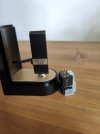
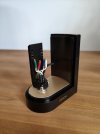
Finally got the Denon PCL-300 (nice condition, including the original box with instruction sheet) to go with my DL-103R.
IMG20230917111254.jpg

They are a perfect match, optically!
IMG20230917111417.jpg


But the PCL-300 had no screws included (the ebay seller didn't mention any, I'm afraid) and the screws from the packing of the DL-103R don't fit.
(they are both far too long and also feel like they aren't thick enough, since they wiggle inside the headshell threads.)
(I tried, just to see if they'd fit, the short srews from my Ortofon Rondo and they were wiggly, too.)

Is it possible that the screws for the headshell are a different size (girth) than the ones used to go through slotted headshells?

I will receive the Yamamoto HS-1A for the Ortofon Rondo tomorrow (brand new, so should come with screws).
What are my chances that these screws will fit the Denon Headshell, too?
And what are my chances that the Yamamoto doesn't have short enough screws to mount my Ortofon, either? (from the pictures of the headshell, I suppose I'd need around 10mm long screws. But the current ones are shorter since the Pro-Ject headshell was less than 1mm thick.)


Looks like I'm screwed, here.. :(


In case nothing fits, where can I order matching headshell screws? (non-magnetic ones, ideally)
And preferably not at a premium price, either.
 
Crossposting here, because I'm sad and pi$$ed..

Finally got the Denon PCL-300 (nice condition, including the original box with instruction sheet) to go with my DL-103R.
View attachment 2987500

They are a perfect match, optically!
View attachment 2987501


But the PCL-300 had no screws included (the ebay seller didn't mention any, I'm afraid) and the screws from the packing of the DL-103R don't fit.
(they are both far too long and also feel like they aren't thick enough, since they wiggle inside the headshell threads.)
(I tried, just to see if they'd fit, the short srews from my Ortofon Rondo and they were wiggly, too.)

Is it possible that the screws for the headshell are a different size (girth) than the ones used to go through slotted headshells?

I will receive the Yamamoto HS-1A for the Ortofon Rondo tomorrow (brand new, so should come with screws).
What are my chances that these screws will fit the Denon Headshell, too?
And what are my chances that the Yamamoto doesn't have short enough screws to mount my Ortofon, either? (from the pictures of the headshell, I suppose I'd need around 10mm long screws. But the current ones are shorter since the Pro-Ject headshell was less than 1mm thick.)


Looks like I'm screwed, here.. :(


In case nothing fits, where can I order matching headshell screws? (non-magnetic ones, ideally)
And preferably not at a premium price, either.
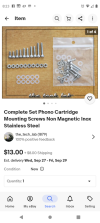
Screws rarely come with a cartridge these days, they are readily available on eBay for very little money.

Here's just one example, these are stainless, some will be aluminum and others brass, I keep several sets of each on hand. The brass are nice if needing to add a bit more weight, the aluminum for the opposite reason.

Screenshot_20230917-082321.png
 
Weight difference of brass versus aluminium screws? is it noticeable or just for the OCD?

And, regarding that offer: how is stainless steel not magnetic?!
 
Weight difference of brass versus aluminium screws? is it noticeable or just for the OCD?

And, regarding that offer: how is stainless steel not magnetic?!

As Jerry McGuire would say "help me to help you, help me to help you".

No different weight isn't just for "the OCD" it's often needed to allow a cartridge to work with some arms it's either too light or too heavy for. Can also allow a cartridge to work with an arm it's either too compliant or not compliant enough for.

Stainless steel "is" non-magnetic.

You're on your own, maybe curb your attitude a bit.
 
Last edited:
As Jerry McGuire would say "help me to help you, help me to help you".

No different weight isn't just for "the OCD" it's often needed to allow a cartridge to work with some arms it's either too light or too heavy for. Can also allow a cartridge to work with an arm it's either too compliant or not compliant enough for.

Stainless steel "is" non-magnetic.

You're on your own, maybe curb your attitude a bit.
didn't mean to offend, sorry. :rolleyes:

But can you elaborate on the compliance issue?
The Yamaha YA-39 was first thought to only work with 18-20g total mass of headshell+cartridge.. and now it's apparently fine to go to 24 grams (according to many of the owners here who use exactly such headshell/cartridge combinations)?

If the tonearm can handle 18-25 grams, why does a tiny difference make enough of a difference to matter?

Looking at the screws and their material, assuming the brass screws add 0.1g (since they are usually merely 0.6g in weight and brass vs steel is not even 10% difference in density) or remove 0.3g (since density of aluminium is about half of steel) we're talking about an insanely small difference in mass here.
(Compare that to the headshell that's supposedly 14g but measures 13.6g or any other headshell where the mass ranges from 5g to 16g and more?!)

Many here said to not bother with compliance and not get too fuzzy about that when I asked for details.

What's the truth, now?


And... what kind of non-magnetic stainless steel are you talking about?
I just used a magnet and ran around the lab searching for items made from stainless steel. And every single one of them was magnetic. (knives, scissors, srews, etc.)

I guess I'll just wait for the screws that come with the Yamamoto and if they don't fit, I'll get some brass screws to match the gold on the Denon..
 
didn't mean to offend, sorry. :rolleyes:

But can you elaborate on the compliance issue?
The Yamaha YA-39 was first thought to only work with 18-20g total mass of headshell+cartridge.. and now it's apparently fine to go to 24 grams (according to many of the owners here who use exactly such headshell/cartridge combinations)?

If the tonearm can handle 18-25 grams, why does a tiny difference make enough of a difference to matter?

Looking at the screws and their material, assuming the brass screws add 0.1g (since they are usually merely 0.6g in weight and brass vs steel is not even 10% difference in density) or remove 0.3g (since density of aluminium is about half of steel) we're talking about an insanely small difference in mass here.
(Compare that to the headshell that's supposedly 14g but measures 13.6g or any other headshell where the mass ranges from 5g to 16g and more?!)

Many here said to not bother with compliance and not get too fuzzy about that when I asked for details.

What's the truth, now?


And... what kind of non-magnetic stainless steel are you talking about?
I just used a magnet and ran around the lab searching for items made from stainless steel. And every single one of them was magnetic. (knives, scissors, srews, etc.)

I guess I'll just wait for the screws that come with the Yamamoto and if they don't fit, I'll get some brass screws to match the gold on the Denon..

Brass screws that add a bit more weight.
IMG_20230318_085922092_HDR.jpg

STAINLESS STEEL – MAGNETIC OR NOT?

In material intended for extrusion, hot rolling, forging, cold heading, etc. the ASTM specification again allows for a composition intended to produce the most desirable material. Somewhat more nickel and less chrome are used, which reduces the amount of ferrite formed. This “wrought” version of 316 may have a structure that is completely ferrite-free and non-magnetic. However, when this alloy is formed or “worked” by forging, rolling, stamping, etc., a phenomenon called Work Hardening takes place. The material becomes harder, stronger, and more magnetic. Heating (annealing) will remove the magnetic property along with part or all the extra strength previously gained by working. In most valve parts a degree of extra hardness is desirable, so again the parts may show some attraction to a strong magnet.

Quite obviously then the “magnet test” will not separate stainless from carbon steel unless some precautions are observed. A sample of soft carbon steel should be used to compare with the unknown. The stainless material may be magnetic when a strong magnet is used, but a significant difference will be noted when the magnet is touched to carbon steel. This difference will be noted when the magnet is touched to carbon steel. This difference would be used rather than the presence or absence of a magnetic property.
 
Crossposting here, because I'm sad and pi$$ed..

Finally got the Denon PCL-300 (nice condition, including the original box with instruction sheet) to go with my DL-103R.
View attachment 2987500

They are a perfect match, optically!
View attachment 2987501


But the PCL-300 had no screws included (the ebay seller didn't mention any, I'm afraid) and the screws from the packing of the DL-103R don't fit.
(they are both far too long and also feel like they aren't thick enough, since they wiggle inside the headshell threads.)
(I tried, just to see if they'd fit, the short srews from my Ortofon Rondo and they were wiggly, too.)

Is it possible that the screws for the headshell are a different size (girth) than the ones used to go through slotted headshells?

I will receive the Yamamoto HS-1A for the Ortofon Rondo tomorrow (brand new, so should come with screws).
What are my chances that these screws will fit the Denon Headshell, too?
And what are my chances that the Yamamoto doesn't have short enough screws to mount my Ortofon, either? (from the pictures of the headshell, I suppose I'd need around 10mm long screws. But the current ones are shorter since the Pro-Ject headshell was less than 1mm thick.)


Looks like I'm screwed, here.. :(


In case nothing fits, where can I order matching headshell screws? (non-magnetic ones, ideally)
And preferably not at a premium price, either.

That headshells looks really nice. Fear not, you'll get the screws sorted. It's just part of the learning curve.
 
You're on your own, maybe curb your attitude a bit.

I think we can cut him a bit of slack. He's been enduring a bit of an experience in buying a non-hifido GT-2000 that we've repeatedly warned people about on the GT thread and I'm guessing it has heightened whatever sense of OCD he has (much like many of us when tackling something new). Great explanation on the stainless!
 
Brass screws that add a bit more weight.
View attachment 2987708

STAINLESS STEEL – MAGNETIC OR NOT?

In material intended for extrusion, hot rolling, forging, cold heading, etc. the ASTM specification again allows for a composition intended to produce the most desirable material. Somewhat more nickel and less chrome are used, which reduces the amount of ferrite formed. This “wrought” version of 316 may have a structure that is completely ferrite-free and non-magnetic. However, when this alloy is formed or “worked” by forging, rolling, stamping, etc., a phenomenon called Work Hardening takes place. The material becomes harder, stronger, and more magnetic. Heating (annealing) will remove the magnetic property along with part or all the extra strength previously gained by working. In most valve parts a degree of extra hardness is desirable, so again the parts may show some attraction to a strong magnet.

Quite obviously then the “magnet test” will not separate stainless from carbon steel unless some precautions are observed. A sample of soft carbon steel should be used to compare with the unknown. The stainless material may be magnetic when a strong magnet is used, but a significant difference will be noted when the magnet is touched to carbon steel. This difference will be noted when the magnet is touched to carbon steel. This difference would be used rather than the presence or absence of a magnetic property.

okay, I didn't expect such massive screws :bigok:

Now, the first part of the explanation hints at non-magnetic stainless steel. But the second one sounds like one would be just noticeably less magnetic than the other?
(I only had a strong magnet to test with)


@808_state yeah, it's an "experience", for sure..
got 4 new feet (original, complete) coming in "soon" since they refused to refund me 200 bucks so I could buy the MNPC ones..

I guess I should've listened to you guys, instead of blindly trusting their 4000 positive reviews. :no:
 
Hi!

I have recently purchased a Yamaha GT-2000 with YA-39 tonearm from Hifido and upgraded it with Sanderz’ excellent YOP-1 clone. My current cartridges are AT art9, Hana ML and Denon DL-103, which are installed in individual headshells enabling swift cartridge exchanges.

The GT is a excellent turntable and I’m interested in trying other mc cartridges!

GT- 2000 owners, which cartridges do you have installed in the YA-39?
You already have a great cart the Denon 103r.
My advice is get it retipped with boron and nude Micro Ridge and get a snakewood body fitted. It will take this good cart and make it into a great cart which is perfect for heavier arms.
Chris
 
And... what kind of non-magnetic stainless steel are you talking about?
I just used a magnet and ran around the lab searching for items made from stainless steel. And every single one of them was magnetic. (knives, scissors, srews, etc.)
Knives and scissors are usually made from simple carbon steel, which is then plated to make it shiny.

And many screws that are supposed to be stainless steel often aren't!
 
okay, I didn't expect such massive screws :bigok:

Now, the first part of the explanation hints at non-magnetic stainless steel. But the second one sounds like one would be just noticeably less magnetic than the other?
(I only had a strong magnet to test with)


@808_state yeah, it's an "experience", for sure..
got 4 new feet (original, complete) coming in "soon" since they refused to refund me 200 bucks so I could buy the MNPC ones..

I guess I should've listened to you guys, instead of blindly trusting their 4000 positive reviews. :no:

I think some of these guys essentially pay for positive reviews via partial refunds. Either way they are not the most careful in what they sell and it's not worth the drama & trouble since you the end user often end up paying to make things whole.
 
Here we go!

Found a good compliance calculator bc I was going mad about this issue..

The Yamaha YA-39 has a mass of 9g (iirc, but it doesn't matter.. even if it were 22g like the manual says, all is still good)

The Denon DL-103R has a compliance of 5 (at 100hz) which was converted to 11 (at 10hz) by ppl much smarter than me...


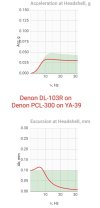
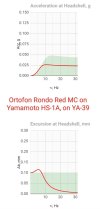
By these calculations, the Denon would work on the Yamamoto headshell, too (if the 11 compliance is correct) but it looks perfect on the Denon.

IMG_20230918_184352.jpg

IMG_20230918_184538.jpg

IMG_20230918_185309.jpg
 
Here we go!

Found a good compliance calculator bc I was going mad about this issue..

The Yamaha YA-39 has a mass of 9g (iirc, but it doesn't matter.. even if it were 22g like the manual says, all is still good)

The Denon DL-103R has a compliance of 5 (at 100hz) which was converted to 11 (at 10hz) by ppl much smarter than me...


By these calculations, the Denon would work on the Yamamoto headshell, too (if the 11 compliance is correct) but it looks perfect on the Denon.

View attachment 2988657

View attachment 2988656

View attachment 2988664
These calculators don't work.
The Denon stock needs an arm 25 to 35g. Retipped the compliance can be altered if desired to work well in an 18g effective mass arm, less if the snakewood body is fitted.
Chris
 
These calculators don't work.
The Denon stock needs an arm 25 to 35g. Retipped the compliance can be altered if desired to work well in an 18g effective mass arm, less if the snakewood body is fitted.
Chris
fun fact:
everyone claims something else, really. :dunno:

And I don't believe for one second that the Denon would be such a difficult cartridge to use.

FAR too many people reported formidable results without wasting any thought on compliance at all.


If those calculators don't work, why do manufacturers bother to provide information on compliance at all?

Why should science not work and instead one should rely on overpriced modifications to make one of the most successful/popular cartridges "usable"?!
 
fun fact:
everyone claims something else, really. :dunno:

And I don't believe for one second that the Denon would be such a difficult cartridge to use.

FAR too many people reported formidable results without wasting any thought on compliance at all.


If those calculators don't work, why do manufacturers bother to provide information on compliance at all?

Why should science not work and instead one should rely on overpriced modifications to make one of the most successful/popular cartridges "usable"?!
The Denon 103 was designed for a 35g effective mass broadcast arm. It will work on a much lighter arm but it will sound far far from optimal. Just because people are happy with this far from optimal performance it does not mean the cart won't sound a LOT better on an arm which is the correct effective mass.
The Denon states compliance at 100Hz and this number can't be converted to the 10Hz number, the conversion factor formula is nonsense.
The Denon is a great engine but the cantilever suspension and stylus are not designed for hifi they were designed fir radio station use.
Fitting the 103 with a stiffer lighter and slightly longer cantilever ( original is very short for broadcast) and a better tracking nude micro ridge stylus the cart can be made to work optimally on a much lighter arm around 18g. Add a snakewood body not only is far less resonant but it adds some needed mass so the rebodied cart now works with today's medium mass arms.
Compliance is very important, a Denon 103 needs a very heavy arm or modding and it will sing rather than just make music.
Chris
 
The Denon 103 was designed for a 35g effective mass broadcast arm. It will work on a much lighter arm but it will sound far far from optimal. Just because people are happy with this far from optimal performance it does not mean the cart won't sound a LOT better on an arm which is the correct effective mass.
The Denon states compliance at 100Hz and this number can't be converted to the 10Hz number, the conversion factor formula is nonsense.
The Denon is a great engine but the cantilever suspension and stylus are not designed for hifi they were designed fir radio station use.
Fitting the 103 with a stiffer lighter and slightly longer cantilever ( original is very short for broadcast) and a better tracking nude micro ridge stylus the cart can be made to work optimally on a much lighter arm around 18g. Add a snakewood body not only is far less resonant but it adds some needed mass so the rebodied cart now works with today's medium mass arms.
Compliance is very important, a Denon 103 needs a very heavy arm or modding and it will sing rather than just make music.
Chris
yeah, I get that compliance is important.

But I feel like you're spilling a lot of snake oil on your snake wood, here.

Most people agree that one should enjoy records instead of getting crazy about minor details that the human hearing cannot perceive anyways.


That said, since I'm a science guy with ocd:
Why should the 100hz number not be converted for 10hz?
Why should the conversion "not work", if all these things are technical measures for physical properties?!
It's all science, nothing else.

And my Tonearm will have an effective mass of 23 grams (if the YA-39 really only is 9g!) so not too far off.

Taking your wild claim to heart, and the graphic I showed suddenly looks very accurate again.
Because, on the lighter headshell, the Denon reaches closer to the upper limit. whereas, with a heavier tonearm of 25g (+10g headshell), it looks similar to the Ortofon's curve.

funny: the guys who made the simulation for compliance graphs state that the other formulas don't work, spitting out only one number that's not covering the whole truth.. (like what you said, see?!)
Instead, they apply more to this in order to predict the behaviour of a cartridge.


Lastly, if I had wanted to spend a thousand dollars for a modified DL-103R, I would've gotten a very different cartridge to begin with.


EDIT:
Looks like you were of a very different opinion just 3 years ago:
telling people that heavy arms could not possibly work...
referring to measurements and science and claiming that the compliance was actually 12! (I used 11 for my calculator, 12 would be even better)

What made you change your mind?
 
Last edited:
yeah, I get that compliance is important.

But I feel like you're spilling a lot of snake oil on your snake wood, here.

Most people agree that one should enjoy records instead of getting crazy about minor details that the human hearing cannot perceive anyways.


That said, since I'm a science guy with ocd:
Why should the 100hz number not be converted for 10hz?
Why should the conversion "not work", if all these things are technical measures for physical properties?!
It's all science, nothing else.

And my Tonearm will have an effective mass of 23 grams (if the YA-39 really only is 9g!) so not too far off.

Taking your wild claim to heart, and the graphic I showed suddenly looks very accurate again.
Because, on the lighter headshell, the Denon reaches closer to the upper limit. whereas, with a heavier tonearm of 25g (+10g headshell), it looks similar to the Ortofon's curve.

funny: the guys who made the simulation for compliance graphs state that the other formulas don't work, spitting out only one number that's not covering the whole truth.. (like what you said, see?!)
Instead, they apply more to this in order to predict the behaviour of a cartridge.


Lastly, if I had wanted to spend a thousand dollars for a modified DL-103R, I would've gotten a very different cartridge to begin with.


EDIT:
Looks like you were of a very different opinion just 3 years ago:
telling people that heavy arms could not possibly work...
referring to measurements and science and claiming that the compliance was actually 12! (I used 11 for my calculator, 12 would be even better)

What made you change your mind

Is it possibly an evolving science? :rflmao:

I think Chris may be highly experienced at cartridge retipping and possibly his views have developed with time and experience.

Chris: have patience with this youngster!
 
Last edited:
People, it’s been my experience that since stainless steel is merely a steel alloy - some is magnetic - and some is not. Depends on the alloy used. “Stainless” just means that it shouldn’t be rusting..
In the past, I’ve also been told that SS can’t be soldered to… Again, depends on the alloy.
 
yeah, I get that compliance is important.

But I feel like you're spilling a lot of snake oil on your snake wood, here.

Most people agree that one should enjoy records instead of getting crazy about minor details that the human hearing cannot perceive anyways.


That said, since I'm a science guy with ocd:
Why should the 100hz number not be converted for 10hz?
Why should the conversion "not work", if all these things are technical measures for physical properties?!
It's all science, nothing else.

And my Tonearm will have an effective mass of 23 grams (if the YA-39 really only is 9g!) so not too far off.

Taking your wild claim to heart, and the graphic I showed suddenly looks very accurate again.
Because, on the lighter headshell, the Denon reaches closer to the upper limit. whereas, with a heavier tonearm of 25g (+10g headshell), it looks similar to the Ortofon's curve.

funny: the guys who made the simulation for compliance graphs state that the other formulas don't work, spitting out only one number that's not covering the whole truth.. (like what you said, see?!)
Instead, they apply more to this in order to predict the behaviour of a cartridge.


Lastly, if I had wanted to spend a thousand dollars for a modified DL-103R, I would've gotten a very different cartridge to begin with.


EDIT:
Looks like you were of a very different opinion just 3 years ago:
telling people that heavy arms could not possibly work...
referring to measurements and science and claiming that the compliance was actually 12! (I used 11 for my calculator, 12 would be even better)

What made you change your mind?
The plastic body on thr Denon is resonant and the wood body is not, it also adds needed mass too.
Re what changed my mind, was actually measuring and testing Deonon carts.
It is no secret I retip carts so I see rather a lot of different cartridges and I still have respect for modded Denons. I have seen inside some VERY expensive cartridges and one thing I am sure of is the Denons are very well made. The areas they miss is is the cantilever, diamond and body, these are addressed in the mods people do and what results is a cart way better than the money spent.
My point is you don't think it is worth spending the money on a Deon rebody and a retip, I strongly disagree after hearing both stock and modded and many other very expensive carts to compare. I have over 100 carts and I have heard thousands and I still rate modded Denons.
Chris
 
Back
Top Bottom