• Check out the Annual AK Secret Santa exchange Program, signup before November 23rd in the AK Charities & Christmas forum!

Record Cleaning: Developing the Best Possible Methods

Status
Not open for further replies.
Water is a rather unique solvent, exhibiting polar as well as non-polar characteristics. That and the cavitation in a US process will give significant results all by itself. Hence, the light concentrations of other elements are icing on the cake. However, icing is good on cake, and the light concentrations of solution elements are even better.

Remember why you are adding each other element (see the associated resource thread). Knowing that you are losing unknown amounts of your additional elements when you process, as well as when you filter, adding more of whatever to an unknown solution does not restore the solution to known concentrations. Concentrations are carefully chosen to maximize positive effects, and to limit any potential negative effects.

Knowledge is power. Our goal here is to develop the best processes, for the best results we can get, for the costs involved. For many of us, Good enough is not good enough. We want to know how to get the best we can, and how we got there and why. We won't all come to the same choices, but it is always best to be as informed as possible while we decide.

Enjoy,
Rich P

Excellent advice.
I changed the water today. I still intend on filtering just not as often.
I can't get the water as easy as I would like so this stretches it out.
Can't be happier with the results so far.
 
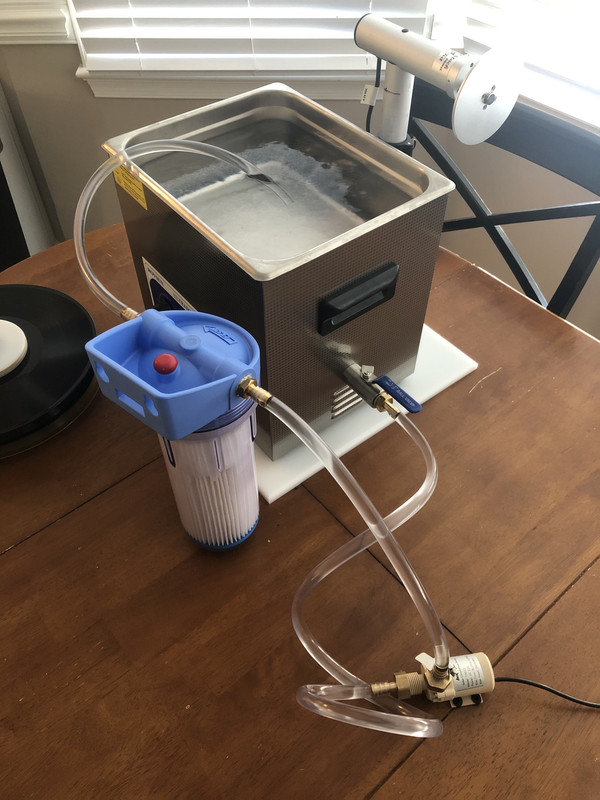
C7-A21-B14-FAD9-4505-ABFC-600-A537-E7985.jpg

Pic of my filter set up. Still requires some tidying up but works well.
Those with the vinyl stack check the rotation times per voltage. I was using 6v that was actually taking 5:30 per rotation.

Ollie, just caught this.....the instructions I received with the VinylStack say 6V will produce 1 revolution every 3 minutes. I checked mine, and it is very close to that. Did you actually measure? I think 5 revolutions in 15 minutes is working very well for me. If yours is not acting thusly then I wonder what the difference might be? I measure my AC at the house to be 121 volts most of the time. Could that be the explanation?
 
Ollie, just caught this.....the instructions I received with the VinylStack say 6V will produce 1 revolution every 3 minutes. I checked mine, and it is very close to that. Did you actually measure? I think 5 revolutions in 15 minutes is working very well for me. If yours is not acting thusly then I wonder what the difference might be? I measure my AC at the house to be 121 volts most of the time. Could that be the explanation?
Not sure why mine is out by so much. I'm glad I checked though.
I'm doing 11 minutes which is 2 full rotations. Seems to be working well. I can do 9 records in 30 minutes and give the US tank a break. Older records I'm doing on their own for 16 minutes.
 
I just wanted to weigh in on this discussion. I have done extensive research on this issue and for the most part ingredients are close to the mark. I found the original US patent for Discwasher fluid and it is more than what people think. There is TOO MUCH misinformation regarding an homemade brew for this. Here are the basic ingredients as per the patent:

Sodium Azide up to .001
Emulsifier - up to .0125
Surfactant up to .025
Propylene Glycol up to 5.0
Distilled Water at least 94.965

Sodium Azide is an anti fungal, which is a huge problem with stored vinyl and can damage vinyl irreparably. The surtactant is for breaking the surface tension of the water. The Emulsifier is to "clean" the vinyl. Propylene Glycol "spreads" the water, or makes it more "watery". And distilled water is the carrier.

Isopropyl alcohol is not a good idea as it can "dissolve" certain ingredients.

Emulsifier:

http://www.food-info.net/uk/qa/qa-fi63.htm

This is one of the variations from the patent as the original inventor, Dr Bruce Maier, PhD in Columbia, Missouri.

This is just one link:

https://www.yoursoundmatters.com/clean-vinyl-records-according-groovewasher/

As with any issue, emotions tend to outweigh facts, unfortunately.
If you are going to come in disagreeing with the conversation, please read the conversation first.

Rich P
 
Hello everyone. I have been using a solution with Hepastat 256 to clean my records.
I was reading the specs for Hepastat 256 (please see attachd specs), and, under Virucidal Efficacy column, it lists "SARS Assoc. Coronavirus" . So, I wanted to confirm with those on the thread who are knowledgeable on this subject if Hepastat 256 is indeed effective in disinfecting and killing coronavirus and, if so, what is the recommended dosage (the specs call for 1/2 oz to 2 oz per gallon of water).
I know this question is not necessarily about cleaning records, but, a lot of us on this thread use Hepastat 256 and, in light of the ever growing Pandemic, I think we would all be interested in the answer to this question.​
Best regards
Alex
 

Attachments

Hello everyone. I have been using a solution with Hepastat 256 to clean my records.
I was reading the specs for Hepastat 256 (please see attachd specs), and, under Virucidal Efficacy column, it lists "SARS Assoc. Coronavirus" . So, I wanted to confirm with those on the thread who are knowledgeable on this subject if Hepastat 256 is indeed effective in disinfecting and killing coronavirus and, if so, what is the recommended dosage (the specs call for 1/2 oz to 2 oz per gallon of water).
I know this question is not necessarily about cleaning records, but, a lot of us on this thread use Hepastat 256 and, in light of the ever growing Pandemic, I think we would all be interested in the answer to this question.​
Best regards
Alex

The active ingredient in Hepastat is the quaternary ammonium cation that is listed as effective in killing coronavirus. Hepastat 256 is diluted 1:256 (hepastat to water) for this purpose. Spray the surface and leave wet for 10 minutes.
 
Thank you for your response. It is good to know that we have an effective
disinfectant​
in house.
Regarding the dosage: the instructions in the specs that I attached earlier mention to use 1:64 dilution to kill Adenovirus Type 5 and 7. I think Adenovirus and Corona are related, so, I am wondering if the higher 1:64 concentration is needed to address Coronavirus also.
 
According to the SDS that I found online, Hepastat 256 contains 21.7w% of mixed dimethyl ammonium salts. I also understand that a concentration of such salts at 0.3w% is an effective antimicrobial. By mass balance, approximately 1.8 fl.oz of Hepastat 256 added to one gallon of water will provide you the 0.3w% concentration.
 
Spec sheet for Hepastat 256 mentions that the product has one year shelf life if un-opened. Does this product really go bad after one year and lose its disinfecting abilities? This question applies both to cleaning records as well as fighting the virus.
 
The active ingredients are organic ammonium salts, so yes, they can decompose over time. One year sounds a bit conservative though, and I would assume that there would be antimicrobial activity for at least a few years, for album cleaning purposes anyway. I suppose that the one year expiration timing would be prudent if you were using it to disinfect hospital rooms and such.
 
I was ready to pull the trigger on Triton-X 100 but then read that is possibly unsafe. Is Tergikleen safer or "less unsafe"? If not, is there some kind of "organic/natural" surfactant?
 
I was ready to pull the trigger on Triton-X 100 but then read that is possibly unsafe. Is Tergikleen safer or "less unsafe"? If not, is there some kind of "organic/natural" surfactant?

Triton X-100 has an NFPA safety rating of 1, out of a maximum of 4. It is potentially hazardous if it contacts the eyes or mucous membranes, much as any surfactant/soap would be. It is very safe as long as common sense precautions are taken.
 
Triton X-100 has an NFPA safety rating of 1, out of a maximum of 4. It is potentially hazardous if it contacts the eyes or mucous membranes, much as any surfactant/soap would be. It is very safe as long as common sense precautions are taken.

Interesting to learn that. I assume that Tergitol and Tergikleen have similiar NFPA safety ratings of 1 also?
 
Status
Not open for further replies.
Back
Top Bottom