• Check out the Annual AK Secret Santa exchange Program, signup before November 23rd in the AK Charities & Christmas forum!

Record Cleaning: Developing the Best Possible Methods

Status
Not open for further replies.
Now that I perfected the Triton mix, I would like to progress to the next level up and include EDTA.

Afraid I've more questions concerning EDTA. Reading previous posts Vince recommended HEPES/EDTA, Tris-acetate-EDTA (TAE) and MOPS-EDTA and I cannot find these in UK. Found TAE on ebay but cost £34 ($50) for a litre, way too much. However I found a few supplier that have EDTA Tetrasodium and wonder would this be a good substitute. If so how much would I need per litre of solution (Triton,IPA+Water).

EDTA Tetrasodium http://www.ebay.co.uk/itm/EDTA-Ethy...hash=item4d43ed7478:m:mHkdF2t6gCqV0r236_cA-QA
 
Last edited:
Captain, the buffer is optional. It's purpose is to keep a neutral environment and to help stop the enzymatic reaction during the wash. The EDTA in the buffer binds Calcium, Iron, and Magnesium ions that are required for activity and often the main mineral components of tap water. I have used the protocol without buffer and it works just fine. If you want to use a buffer, HEPES/EDTA, Tris-acetate-EDTA (TAE) and MOPS-EDTA are all good substitutes, but stay away from any phosphate based buffers. If you were to buy one component, I would skip the buffer, buy some EDTA and include it with the Triton wash solution at a concentration anywhere from 1 to 10 mM (1 gm EDTA per Liter of wash solution is about 3.4 mM, which is a good starting point) . This will help with mineral deposit removal and also disrupt ionic interactions among bound contaminants. Though very useful, I did not include it in the Triton mixes described above as people wanted the simplest mix with the fewest ingredients. Including it makes your wash solution that much better. A "Tweak" if you will, much like adding a Quat. Hence, my "Ultimate Wash Solution" is:
Triton (0.5%), EDTA (5 mM), and Behentriammonium Chloride (0.05%) and, occasionally, 5% IPA.
tcss - Thanks for the pointers.

Although can't find EDTA Tetrasodium there, I assume 1gm/Litre is a formulation for ALL EDTAs.

Whilst hunting for EDTA, the different variation of EDTA one's never sure are they suitable for records as they have differing uses, from dental to dietary. :eek: WIsh I found this thread earlier when Vince was still around.:mad:
 
Last edited:
Anyone else seen this or used this. Peaked my interest
https://www.amazon.com/dp/B019YI38Z2/ref=nav_timeline_asin?_encoding=UTF8&psc=1

Sorry if already posted

Yeah, I've been watching that in my 'list' since I found it back in December. I should go ahead and just get it, but I keep using that $25 for other things. I'll probably end up ordering it soon. Currently all my LPs are clean so I keep putting it off.

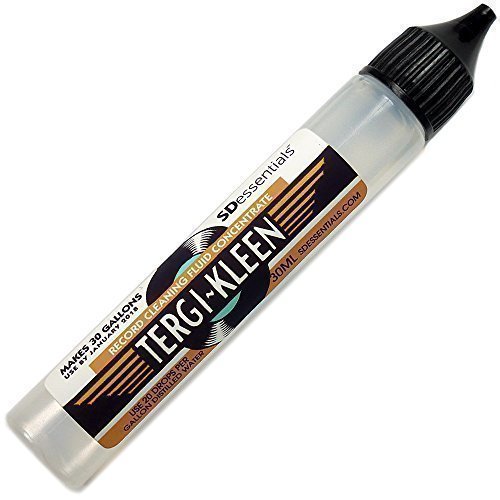
Here you go. This ought to fit your needs quite nicely. It is not Triton. It is Tergitol, but it is the other of the two formulas that Vince recommended: http://www.amazon.com/Professional-...=UTF8&qid=1463898467&sr=8-1&keywords=tergitol

3-5 drops of this per quart of water:

51tu9rQqFaL.jpg


Come back and tell us how you like it. I'm going to get some of this when my Mofi Super Record Wash runs out.

Enjoy,
Rich P
As I previously stated, I intend to pick some of this up, when my new purchase of MOFI Super Record Wash runs out. Whoever buys it first, don't forget to post your thoughts and experience with it.

Enjoy,
Rich P
 
Last edited:
Referring to the LoC's (Library of Congress) recommended solution - 2 mL tergitol in 4 L water (0.05% sol'n), what is the equivalent of triton x-100 that I should add to a 4 L jug of water, in lieu of tergitol? Would it be the same?
 
Last edited:
I just got my bottle of Triton and will be getting a Record Doctor V soon. I'm really looking forward to trying this solution out.

Record Dr. V arrived a couple of days ago so I finally had a chance to try it and the Triton cleaner out. I used 5ml. of the 10% working solution to 250ml distilled water. I was very happy with the coverage on the record surface and with the results. Followed up the vacuum with a distilled water rinse in my Spin-Clean, quick wipe with the lint free cloths that came with the Spin-Clean and air dry in a dish rack.

I think the results are better than with the Spin-Clean alone and even if the Triton solution is no better than commercial formulas it's at least as good and way cheaper.

Sounds like you are using a similar proportion to what I used in my Spin Clean.
 
So I ended up simply using the 2 mL Triton in 4 L water solution (0.05%) and it spread thoroughly on the record; this was immediately after shaking the solution vigorously - without letting it settle for the recommended 24 hrs. I honestly think that even the 2 mL of Triton might have been excessive. I wonder if those who lamented that their solutions started beading are simply using a lower grade of Triton.
Followed up with a water rinse and micro-fiber towel drying.
 
I guess people may not want to go through 470 some odd posts so it might make sense to summarize:

We’ve been using non-ionic detergents (Triton or Tergitol) to clean our records as recommended by preservationists. They are superior to common detergents (e.g. dishsoap or shampoo) as they do not introduce a negative charge which can promote static and solutions of them are neutral in pH. Like most detergents, they have long hydrophobic tails that help solubilize things like fats and polar head groups that make them soluble in aqueous solutions where they form micelles. We use them at a final concentration of 0.1 to 0.5% for initial cleaning of a dirty record. We also (optionally) add a bit of isopropanol solvent to aid in fluid dispersion and releasing contaminants. We are keeping the final concentration of alcohol to 15% or below to reduce the risk of extracting useful plasticizers incorporated in the vinyl. Some of us are also adding a cationic detergent to our mixes. These are quaternary ammonium surfactants (often called “quats” for short) that are antistats and have antimicrobial properties. They are typically found in hair conditioners and antistatic products (like fabric softeners or Statiguard). An example is Behentrimonium Chloride, and we have been including them at 0.05% or lower. A few adventurous audiophiles here are also experimenting with adding EDTA, a chelating agent, that binds and solubilizes iron, magnesium, and calcium deposits (major minerals found in water). Finally, in cases of very grimy records, we have discussed a method of enzymatic treatment prior to detergent cleaning that helps solubilize fats, sugars, and protein, the main organic contaminants found on surfaces.

So in a nutshell, that is what folks here are playing with and the results have been great. We have gone away from treating our vinyl with harsh household cleaners or introducing chemicals that aren’t compatible with a delicate surface intended for sound reproduction. One theory behind the use of the specific detergents is that they also leave behind a molecular layer that helps keep the surface conditioned in a way that reduces friction and does not introduce negative charge.

Much of the discussion has been on the best way to prepare and store these ingredients. For example, the Triton needs time to dissolve so we make a 10% stock solution and keep it in the fridge, or we dissolve a small amount of Triton first in some isopropanol, dilute it up with water, and use it up in a batch wash. Other parts of the discussion have been on methodology, most advocating the use of ultrasonic or vacuum-based cleaning machines. I recommend reading the entire thread if you don't already have a cleaning protocol. Also, stay tuned as many are just starting to tweak their formulations so we should have some great further discussions coming up!

Soooooo, just received a baggie of the Quaternary Ammonium Salt aka "quats" of Behentrimonium Chloride in the mail (from the US) the other day as per Dr. Vince's suggestion. Next brew I mix up which will be soon and will most definitively include this antistatic agent to see how well it works on knocking down static charge build-up on vinyl and the associated noises it makes on sensitive high quality gear. Will provide a less than scientific report on whether I think it makes a difference or not. After this I may try to tackle an enzymatic treatment for particularly nasty grunge. Probably won't go EDTA though because I will be sourcing industrial De-ionized water which won't have the major minerals found in water as per above...
 
Soooooo, just received a baggie of the Quaternary Ammonium Salt aka "quats" of Behentrimonium Chloride in the mail (from the US) the other day as per Dr. Vince's suggestion.
Would you mind providing a link to your source? I might try that instead of the siloxane.

Thanks!
 
Last edited:
Soooooo, just received a baggie of the Quaternary Ammonium Salt aka "quats" of Behentrimonium Chloride in the mail (from the US) the other day as per Dr. Vince's suggestion. Next brew I mix up which will be soon and will most definitively include this antistatic agent to see how well it works on knocking down static charge build-up on vinyl and the associated noises it makes on sensitive high quality gear. Will provide a less than scientific report on whether I think it makes a difference or not. After this I may try to tackle an enzymatic treatment for particularly nasty grunge. Probably won't go EDTA though because I will be sourcing industrial De-ionized water which won't have the major minerals found in water as per above...

I've also been trying to find a UK supplier of the quat without much success. It seems the US supplier Making Cosmetics are the best source but rather put off by their shipping cost, about 3 times the cost of the item :eek:

I seem to be having a little static problem with the cleaned records so would be interested if this improves it. If it does then I may have to bite the bullet and order it. Please let us know.
 
For people from UK or EU, I've found alternative quat from this place http://www.thesoapkitchen.co.uk/cgi...=Centrimonium-Chloride-cetchlor.html#SID=1548

The quat is cetrimonium chloride and the application seem very similar to our requirements i.e. anti-static. I'm no chemist but it says

"Cetrimonium Chloride is a quaternary ammonium compound with the following functions...Antistatic Agent, Cosmetic Biocide, Emulsifying agent and Surfactant, Antimicrobial, Preservative."

"Cetrimonium Chloride is a quaternary ammonium salt. In cosmetics and personal care products it is used in the formulation of hair shampoos and conditioners, hair dyes and colours, other hair care products, and in some skin care products.
It helps prevent or inhibit the build-up of static electricity and helps to cleanse the skin or to prevent odor by destroying or inhibiting the growth of microorganisms and by helping water to mix with oil and dirt so that they can be rinsed away.
It also helps to form emulsions by reducing the surface tension of the substances to be emulsified and helps to distribute or to suspend an insoluble solid in a liquid
."

I'm not sure what % to add to our mix and can only guess is the same as the Behentrimonium Chloride.

I'll order some soon.
 
Why's that?

I think most TTs are robust enough to withstand the ions. The gun wasn't made for anything else.

The large voltage potential the device can produce could easily fry a cartridge or other electronics. I think the device was made to treat records while off the turntable, but I've read of people using them on the table. Furthermore, how does one get exactly the same ion balance on a pull vs. the release? It's difficult to imagine not introducing charge. I used the device back in the 70's, along with my Dishwasher and never really achieved satisfactory results.
 
Status
Not open for further replies.
Back
Top Bottom