10K looks like 2 watts.Alright, it's been quite a while since last time...and I'm really exited since I just placed an order for JJ can caps, they should arrive next week. I started to decipher the power supply and did some more research on the amps.
I'll add some more details in the coming days, and plenty of pictures for those who are interested.
Prior to firing up the amps (once they're done) I'll have to figure out how to silence a humming secondary of my 4kVA isolation step down transformer (remember,240V country). I suspect that something became loose due some weakened varnish or some shrunken/worn out shims. It's probably not a good idea to let it hum along like this, the wires' insulation will likely break down and render the beast useless.
I slowly brought the big transformer up to 240V AC with a variac, first with nothing connected and it seemingly drew 80W. The hum set in at about 200V AC. Then with a 300W bulb connected to the 120V AC secondary it drew short of 400W, same hum.
Any input on that? Is there an easy way to varnish/silence it? Reading this here: http://www.audiokarma.org/forums/showthread.php?t=280008 I'm afraid not...
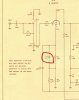
What else...ach ja, the attached pic shows how the HV PSU (460V, 380V, 170V) is actually implemented.
More to come.


You are using an out of date browser. It may not display this or other websites correctly.
You should upgrade or use an alternative browser.
You should upgrade or use an alternative browser.
Refurbishing two MC75 Monoblock Amplifiers
- Thread starter Rodeodave
- Start date

Bill Ferris
Lunatic Member
I haven't noticed any word on the inductors, L1 & L2 , that go to the plates of the output tubes. Do they normally not go bad? Has anyone replaced them?
Good thread!
Kennyg
They seem to never go bad, IME, but easy enough to test.

lakebilly
Member
Well, today I ordered some Illinois Capacitor polypropylene caps from AES. I will get the 2nd amp fully rebuilt with the exception of the caps. I will then temporarily tack the film caps in and give it a listen. I will compare it to the first amp with the Russian PIO's. I will likely switch the two amps in and out of the right channel (or maybe left) just so the difference I'm hearing will not be from the speakers or pre-amp. After all, they are old too and may not sound the same.
Any other thoughts on how to compare the two amps?
I really wish I would have installed the PIO's last. Instead, I installed everything the way McIntosh did it. Wires first, followed by caps, followed by resistors. So if the PIO's have to go, I will be stuck removing resistors and caps. Again!! Oh well, at least there are only seven on the tag board.
I'll keep you posted.
Any other thoughts on how to compare the two amps?
I really wish I would have installed the PIO's last. Instead, I installed everything the way McIntosh did it. Wires first, followed by caps, followed by resistors. So if the PIO's have to go, I will be stuck removing resistors and caps. Again!! Oh well, at least there are only seven on the tag board.
I'll keep you posted.
lakebilly
Member
They seem to never go bad, IME, but easy enough to test.
I've never measured any for inductance, but I've never found an open one or any that I suspected were bad.
On the other hand, contrary to others, I've found the majority of black beauties to be bad.
Bill Ferris
Lunatic Member
I've never measured any for inductance, but I've never found an open one or any that I suspected were bad.
On the other hand, contrary to others, I've found the majority of black beauties to be bad.
As Gomer Pyle was known to say :Surprise, surprise, surprise !!
lakebilly
Member
In another thread, a member was rebuilding an MC75 and was given the below advice from a fellow member.
"While you are in there, make sure you replace the 100uf electrolytic cap in the feedback circuit (usually marked C3) with a Nichicon bipolar cap of same value. Then bypass the new 100uf cap with a 0.33uf nichicon XY series film cap. All are available from mouser.com"
I believe in my units that C3 is a polarized 100uf electrolytic. What does the above accomplish? I'm familiar with the concept of bypass capacitors in speaker crossover's and other situations, but normally the value of a bypass capacitor is either 1% of the main cap's value or something like .1uf or .01uf.
Any thoughts on what the above might accomplish?
Coupling cap recommendations for MC75 | Audiokarma Home Audio Stereo Discussion Forums
Post #4
"While you are in there, make sure you replace the 100uf electrolytic cap in the feedback circuit (usually marked C3) with a Nichicon bipolar cap of same value. Then bypass the new 100uf cap with a 0.33uf nichicon XY series film cap. All are available from mouser.com"
I believe in my units that C3 is a polarized 100uf electrolytic. What does the above accomplish? I'm familiar with the concept of bypass capacitors in speaker crossover's and other situations, but normally the value of a bypass capacitor is either 1% of the main cap's value or something like .1uf or .01uf.
Any thoughts on what the above might accomplish?
Coupling cap recommendations for MC75 | Audiokarma Home Audio Stereo Discussion Forums
Post #4
Attachments

I got a MC75 recently (just one...couldn't pass it up). Of course, it needs 'everything' but is in fact functional as-is.
I measured 83 v p-p at clipping. That works out, into my 8 ohm load, to 107 watts rms. I figured I'd be lucky to be in the mid 80 watt range. I had no idea it would make this much power at clipping. I ran it with a pair of KT90s.
Has anyone else measured a MC75? How does that output compare to a MC275?
Now to find another one...or a single MC60...or a MC275 with a blown OPT...you get the picture.
I measured 83 v p-p at clipping. That works out, into my 8 ohm load, to 107 watts rms. I figured I'd be lucky to be in the mid 80 watt range. I had no idea it would make this much power at clipping. I ran it with a pair of KT90s.
Has anyone else measured a MC75? How does that output compare to a MC275?
Now to find another one...or a single MC60...or a MC275 with a blown OPT...you get the picture.
lakebilly
Member
I've measured 30's, 40's, 240's, 60's and 75's. I use a THD meter and crank the volume up until the distortion reaches the specified value. I would say, in general, that McIntosh tube amps will always reach rated power + at least 10% before exceeding the stated distortion specification. That is, of course, assuming the amplifier meets factory specs for the most part.
Just a note, I find it difficult to spot the early stages of clipping on an O-scope, hence the use of a THD meter. Once I'm able to see clipping on the scope, the THD meter is already reading several %THD.
I was fortunate enough to pickup a Keithley 2015 for just a few hunderd bucks.
Just a note, I find it difficult to spot the early stages of clipping on an O-scope, hence the use of a THD meter. Once I'm able to see clipping on the scope, the THD meter is already reading several %THD.
I was fortunate enough to pickup a Keithley 2015 for just a few hunderd bucks.

I believe that boh the 75 and 275 are supposed to meet their distortion spec at 100+ watts, but I can't remember the exact number.
Comparing the 275 to a pair of 75s? Same output transformer, same amplifier circuitry, same tubes, the only difference is two power transformers/power supplies vs one and I don't believe that there will be an advantage in power in either configuration.
Comparing the 275 to a pair of 75s? Same output transformer, same amplifier circuitry, same tubes, the only difference is two power transformers/power supplies vs one and I don't believe that there will be an advantage in power in either configuration.

Pio1980
AK Member
The prime advantage is weight handling and simpler servicing of the twins vs the two channel amp.I believe that boh the 75 and 275 are supposed to meet their distortion spec at 100+ watts, but I can't remember the exact number.
Comparing the 275 to a pair of 75s? Same output transformer, same amplifier circuitry, same tubes, the only difference is two power transformers/power supplies vs one and I don't believe that there will be an advantage in power in either configuration.

Hi lakebilly:Well, today I ordered some Illinois Capacitor polypropylene caps from AES. I will get the 2nd amp fully rebuilt with the exception of the caps. I will then temporarily tack the film caps in and give it a listen. I will compare it to the first amp with the Russian PIO's. I will likely switch the two amps in and out of the right channel (or maybe left) just so the difference I'm hearing will not be from the speakers or pre-amp. After all, they are old too and may not sound the same.
Any other thoughts on how to compare the two amps?
I really wish I would have installed the PIO's last. Instead, I installed everything the way McIntosh did it. Wires first, followed by caps, followed by resistors. So if the PIO's have to go, I will be stuck removing resistors and caps. Again!! Oh well, at least there are only seven on the tag board.
I'll keep you posted.
What was your reaction from the comparison? Would be interesting to know.
Regards
lakebilly
Member
I've been meaning to post an update on this subject.
Here's a quick summary:
Amp #1 was fully restored using Russian PIO caps. It tested out very well and sounded as I thought it should with no noticeable problems. I then fully restored amp #2 making it identical to AMP #1 with the exception of leaving out all of the coupling caps. Keep in my mind, I replaced all capacitors and all resistors. Everything was in spec. I then ordered a set of Illinois Film caps from AES so that I could do a side by side comparison of the two amps.
So, after placing the order for the IC caps, the three day wait for FedEx to deliver the caps was positively killing me. I was all over the web and this site researching what I thought would be an appropriate high end set of caps for the Mac75's. I read the cap reviews on Humble Homemade HIFI twenty times or so and decided to order one set Jupiter Copper Film caps. So $400 later, I've got Amp#2 outfitted with the Jupiter caps. I put the IC caps on the shelf for the time being.
So the next several days were spent comparing the left side to the right side. Fortunately my C22 preamp has a switch that allows me to swap left and right channels, listen in mono or send both the left and right channels to either speaker individually. At first listen, I struggled to notice much of difference between the two amps. I did notice that the bass response was tighter and quicker with the copper films. Maybe the overall speaker was a little faster, but not a huge difference by any stretch. I was beginning to think that maybe the $400 investment was not going to pay off. I was also trying to decide if should spend another $400 for a second set of caps, or remove the Jupiters and move on to the IC's or stick with the PIO's. What to do, what to do!!??
I continued the evaluation of the two amps over the next day or so. I'm a big Beatles fan and I was listening to several of their songs and something hit me. I had inadvertently left the C22 preamp in Mono and noticed that amp #2 had a different feel than amp #1. The sound stage was noticeably deeper and wider with the copper foil caps. I'm running JBL L300's and amp #2 had the instruments and vocals well out of the speaker and into the space in front of them. It was a significant difference. And as one poster in this forum says, "different is easy, better not so much".
So, was it better or different? After listing to a dozen tracks or so, I concluded that It was better. Better and not just different. Once I realized what the primary difference was between the copper films and the PIO, I was really able to focus on the sound stage and forget about clarity, response and everything else we focus on when evaluating a system.
Was the difference huge? Maybe, maybe not since it took me many hours to notice it. Was it a significant difference? Yes.
It was about now that I wanted to know for sure that the Jupiter Copper Foil caps were the reason for the difference in the sound stage. I swapped all the tubes between both amps. I swapped speakers. I swapped preamp outputs. I realized without a doubt that amp #2 had something that amp #1 did not. It just had a bigger sound stage. I listened to many different tracks, from all genres of music and without question amp #2 bested amp #1. So, now I'm to the point where I'm ready to spend another $400.00 and get amp #1 matching amp #2. A week later the second set of caps were on my door step.
After removing all the PIO caps, I decided to solder in the Illinois caps. After all, that was the original mission. I did a quick tack job and quickly started the comparison again. It was much easier this time knowing what to listen for. The IC caps were extremely close to the Jupiters. I mean extremely close. They certainly outperformed the PIO caps in sound stage and quickness. Did they measure up to the Jupiters in sound stage? Almost. Were the Jupiters worth the extra $800? Maybe, maybe not. I think the only way I could honestly answer that question would be to have two pairs of amps and run them for weeks in a comparison.
What I can say is that the MC75's are great amplifiers. It's no wonder that McIntosh is still making them. They also pair very well with the L300's. For about a year I ran MC30's and they just didn't have the power they needed. At any rate, I'm enjoying the system more than ever.
Here's a quick summary:
Amp #1 was fully restored using Russian PIO caps. It tested out very well and sounded as I thought it should with no noticeable problems. I then fully restored amp #2 making it identical to AMP #1 with the exception of leaving out all of the coupling caps. Keep in my mind, I replaced all capacitors and all resistors. Everything was in spec. I then ordered a set of Illinois Film caps from AES so that I could do a side by side comparison of the two amps.
So, after placing the order for the IC caps, the three day wait for FedEx to deliver the caps was positively killing me. I was all over the web and this site researching what I thought would be an appropriate high end set of caps for the Mac75's. I read the cap reviews on Humble Homemade HIFI twenty times or so and decided to order one set Jupiter Copper Film caps. So $400 later, I've got Amp#2 outfitted with the Jupiter caps. I put the IC caps on the shelf for the time being.
So the next several days were spent comparing the left side to the right side. Fortunately my C22 preamp has a switch that allows me to swap left and right channels, listen in mono or send both the left and right channels to either speaker individually. At first listen, I struggled to notice much of difference between the two amps. I did notice that the bass response was tighter and quicker with the copper films. Maybe the overall speaker was a little faster, but not a huge difference by any stretch. I was beginning to think that maybe the $400 investment was not going to pay off. I was also trying to decide if should spend another $400 for a second set of caps, or remove the Jupiters and move on to the IC's or stick with the PIO's. What to do, what to do!!??
I continued the evaluation of the two amps over the next day or so. I'm a big Beatles fan and I was listening to several of their songs and something hit me. I had inadvertently left the C22 preamp in Mono and noticed that amp #2 had a different feel than amp #1. The sound stage was noticeably deeper and wider with the copper foil caps. I'm running JBL L300's and amp #2 had the instruments and vocals well out of the speaker and into the space in front of them. It was a significant difference. And as one poster in this forum says, "different is easy, better not so much".
So, was it better or different? After listing to a dozen tracks or so, I concluded that It was better. Better and not just different. Once I realized what the primary difference was between the copper films and the PIO, I was really able to focus on the sound stage and forget about clarity, response and everything else we focus on when evaluating a system.
Was the difference huge? Maybe, maybe not since it took me many hours to notice it. Was it a significant difference? Yes.
It was about now that I wanted to know for sure that the Jupiter Copper Foil caps were the reason for the difference in the sound stage. I swapped all the tubes between both amps. I swapped speakers. I swapped preamp outputs. I realized without a doubt that amp #2 had something that amp #1 did not. It just had a bigger sound stage. I listened to many different tracks, from all genres of music and without question amp #2 bested amp #1. So, now I'm to the point where I'm ready to spend another $400.00 and get amp #1 matching amp #2. A week later the second set of caps were on my door step.
After removing all the PIO caps, I decided to solder in the Illinois caps. After all, that was the original mission. I did a quick tack job and quickly started the comparison again. It was much easier this time knowing what to listen for. The IC caps were extremely close to the Jupiters. I mean extremely close. They certainly outperformed the PIO caps in sound stage and quickness. Did they measure up to the Jupiters in sound stage? Almost. Were the Jupiters worth the extra $800? Maybe, maybe not. I think the only way I could honestly answer that question would be to have two pairs of amps and run them for weeks in a comparison.
What I can say is that the MC75's are great amplifiers. It's no wonder that McIntosh is still making them. They also pair very well with the L300's. For about a year I ran MC30's and they just didn't have the power they needed. At any rate, I'm enjoying the system more than ever.
Last edited:
Bill Ferris
Lunatic Member
I've been meaning to post an update on this subject.
Here's a quick summary:
Amp #1 was fully restored using Russian PIO caps. It tested out very well and sounded as I thought it should with no noticeable problems. I then fully restored amp #2 making it identical to AMP #1 with the exception of leaving out all of the coupling caps. Keep in my mind, I replaced all capacitors and all resistors. Everything was in spec. I then ordered a set of Illinois Film caps from AES so that I could do a side by side comparison of the two amps.
So, after placing the order for the IC caps, the three day wait for FedEx to deliver the caps was positively killing me. I was all over the web and this site researching what I thought would be an appropriate high end set of caps for the Mac75's. I read the cap reviews on Humble Homemade HIFI twenty times or so and decided to order one set Jupiter Copper Film caps. So $400 later, I've got Amp#2 outfitted with the Jupiter caps. I put the IC caps on the shelf for the time being.
So the next several days were spent comparing the left side to the right side. Fortunately my C22 preamp has a switch that allows me to swap left and right channels, listen in mono or send both the left and right channels to either speaker individually. At first listen, I struggled to notice much of difference between the two amps. I did notice that the bass response was tighter and quicker with the copper films. Maybe the overall speaker was a little faster, but not a huge difference by any stretch. I was beginning to think that maybe the $400 investment was not going to pay off. I was also trying to decide if should spend another $400 for a second set of caps, or remove the Jupiters and move on to the IC's or stick with the PIO's. What to do, what to do!!??
I continued the evaluation of the two amps over the next day or so. I'm a big Beatles fan and I was listening to several of their songs and something hit me. I had inadvertently left the C22 preamp in Mono and noticed that amp #2 had a different feel than amp #1. The sound stage was noticeably deeper and wider with the copper foil caps. I'm running JBL L300's and amp #2 had the instruments and vocals well of the speaker and into the space in front of them. It was a significant difference. And as one poster in this forum says, "different is easy, better not so much".
So, was it better or different? After listing to a dozen tracks or so, I concluded that It was better. Better and not just different. Once I realized what the primary difference was between the copper films and the PIO, I was really able to focus on the sound stage and forget about clarity, response and everything else we focus on when evaluating a system.
Was the difference huge? Maybe, maybe not since it took me many hours to notice it. Was it a significant difference? Yes.
It was about now that I wanted to know for sure that the Jupiter Copper Foil caps were the reason for the difference in the sound stage. I swapped all the tubes between both amps. I swapped speakers. I swapped preamp outputs. I realized without a doubt that amp #2 had something that amp #1 did not. It just had a bigger sound stage. I listened to many different tracks, from all genres of music and without question amp #2 bested amp #1. So, now I'm to the point where I'm ready to spend another $400.00 and get amp #1 matching amp #2. A week later the second set of caps are on my door step.
After removing all the PIO caps, I decided to solder in the Illinois caps. After all, that was the original mission. I did a quick tack job and quickly started the comparison again. It was much easier this time knowing what to listen for. The IC caps were extremely close to the Jupiters. I mean extremely close. They certainly outperformed the PIO caps in sound stage and quickness. Did they measure up to the Jupiters in sound stage? Almost. Were the Jupiters worth the extra $800? Maybe, maybe not. I think the only way I could honestly answer that question would be to have two pairs of amps and run them for weeks in a comparison.
What I can say is that the MC75's are great amplifiers. It's no wonder that McIntosh is still making them. They also pair very well with the L300's. For about a year I ran MC30's and they just didn't have the power they needed. At any rate, I'm enjoying the system more than ever.
 ,
,  ,
,  ,
, 

Actually, the MC75 was discontinued in 2020.
Larry
Larry

What I sorta recall is that the whole idea that different types of capacitors affect sound quality became a thing after Marsh and Jung published their famous (or infamous) 2-part article called "Picking Capacitors" which was published in Audio magazine and I also think in Audio Amateur magazine. I believe this was initially submitted as a paper to the AES Journal (Audio Engineering Society) and rejected for publication for some reason. Seems like after this article I recall seeing, for example, that Audio Research equipment switched from mylar caps to Rel brand polypropylene caps (sometimes branded as "Wonder Caps.") I heard recently that Wilson Audio bought the Rel cap company at some point to make them in house for their speakers.
If you're interested, you can read the article, in two parts, on line. It's not short.
Part 1 starts on page 52 of the Feb. 1980 issue of Audio which is here: https://worldradiohistory.com/Archive-All-Audio/Archive-Audio/80s/Audio-1980-02.pdf
Part 2 starts on page 50 of the Mar. 1980 issue of Audio which is here: https://worldradiohistory.com/Archive-All-Audio/Archive-Audio/80s/Audio-1980-03.pdf
(Note the page numbers are on the left side halfway up but only on some pages so it's hard to navigate to a particular page.)
If you're interested, you can read the article, in two parts, on line. It's not short.
Part 1 starts on page 52 of the Feb. 1980 issue of Audio which is here: https://worldradiohistory.com/Archive-All-Audio/Archive-Audio/80s/Audio-1980-02.pdf
Part 2 starts on page 50 of the Mar. 1980 issue of Audio which is here: https://worldradiohistory.com/Archive-All-Audio/Archive-Audio/80s/Audio-1980-03.pdf
(Note the page numbers are on the left side halfway up but only on some pages so it's hard to navigate to a particular page.)
lakebilly
Member
Actually, the MC75 was discontinued in 2020.
Larry
Thank you Larry.
lakebilly
Member
What I sorta recall is that the whole idea that different types of capacitors affect sound quality became a thing after Marsh and Jung published their famous (or infamous) 2-part article called "Picking Capacitors" which was published in Audio magazine and I also think in Audio Amateur magazine. I believe this was initially submitted as a paper to the AES Journal (Audio Engineering Society) and rejected for publication for some reason. Seems like after this article I recall seeing, for example, that Audio Research equipment switched from mylar caps to Rel brand polypropylene caps (sometimes branded as "Wonder Caps.") I heard recently that Wilson Audio bought the Rel cap company at some point to make them in house for their speakers.
If you're interested, you can read the article, in two parts, on line. It's not short.
Part 1 starts on page 52 of the Feb. 1980 issue of Audio which is here: https://worldradiohistory.com/Archive-All-Audio/Archive-Audio/80s/Audio-1980-02.pdf
Part 2 starts on page 50 of the Mar. 1980 issue of Audio which is here: https://worldradiohistory.com/Archive-All-Audio/Archive-Audio/80s/Audio-1980-03.pdf
(Note the page numbers are on the left side halfway up but only on some pages so it's hard to navigate to a particular page.)
I'll be reading both issues of Audio Magazine. I've saved both pdf's for now.
Thanks for sharing those.
lakebilly
Member
Looks like the Illinois metallized polypropylene caps are the sensible choice then for performance vs price.
I would put that in the "for sure" category. Compared to my $800.00 investment in the Jupiter copper foils caps, the IC caps are virtually free. Almost free and almost as good!
Hi Everyone!
This is my first post to this wonderful forum, although I have been following it for some time. I am very impressed by the expertise and general erudition found in the threads here; also the courtesy and civility. A welcome relief!
A quick introduction: I am a retired research chemist turned database coder. I have no formal training in electronics but I have been tinkering since I was 12 (I am now 75) during the Golden Age of World Way 2 military surplus electronics . I was heavily involved in discreet logic design and construction (7400 series ICs) in grad school. In 1966 my mother gave me a Mc75 as a combination Christmas/high school graduation present (only one because they were rather expensive and I had only one speaker at the time, a Wharfdale W60). By the time I could afford to go stereo (1974) the Mc75 was no longer being made so I went with a Mc2100 driven by a SAE2900 (purchased used) and a pair of Rectilinear III Highboys, also used. At the beginning of the pandemic, while everyone else was learning to make sourdough bread, I decided to rebuild the 2100; I estimated it had about 62000 hours on it (I listen to a LOT of music, mostly classical, some jazz and for fun once in a while a little heavy metal (lately Xandria and Powerwolf). That was when I became familiar with Audio Karma. Thank you all! And thank you all for this particular thread, and especially to Rodeodave for all his posts and the excellent pictures of his meticulous work, and to all the other contributors.
I recently decided to go for it, and when a single Mc75 came up on eBay I went of it. I will be driving a pair of B&W 702 S2s with it. Now I am embarking on rebuilds of each unit. I am about to start adding new components to the one my mother gave me (the date code in the 220 ohm wire-wounds indicates it was made in 3Q 1966; the one I just got, 2Q 1962). Now, there are a couple of differences in the circuitry, in the power supply, the values of a couple of resistors (R11 & R12), a 22pf ceramic disc bypass capacitor across R4 and C8 (100pf from one anode of the 12AU7 to ground) is missing entirely. The recently purchased unit is consistent with the schematic that came with my original. So, first question: should I change the recently purchased unit to match the “newer” one, or rebuild them as they each are? I know this could make a difference in the sound, but would I be able to discern it? I kind of doubt it, but… The second question involves C2, 330pkfcap in the feedback. I was going to leave it but the wire broke while I was removing the other components attached to the solder lug. Careful examination of a picture posted by Rodeodave (01Dec11) shows that capacitor replaced with a mica cap CM05ED330JO3 which a search revealed this is a 33pf capacitor, not 330pf. Is the smaller value considered better? Also, would ceramic disc type be suitable rather than the mica?
Any advice will be greatly appreciated! Thanks muchly!
-John
This is my first post to this wonderful forum, although I have been following it for some time. I am very impressed by the expertise and general erudition found in the threads here; also the courtesy and civility. A welcome relief!
A quick introduction: I am a retired research chemist turned database coder. I have no formal training in electronics but I have been tinkering since I was 12 (I am now 75) during the Golden Age of World Way 2 military surplus electronics . I was heavily involved in discreet logic design and construction (7400 series ICs) in grad school. In 1966 my mother gave me a Mc75 as a combination Christmas/high school graduation present (only one because they were rather expensive and I had only one speaker at the time, a Wharfdale W60). By the time I could afford to go stereo (1974) the Mc75 was no longer being made so I went with a Mc2100 driven by a SAE2900 (purchased used) and a pair of Rectilinear III Highboys, also used. At the beginning of the pandemic, while everyone else was learning to make sourdough bread, I decided to rebuild the 2100; I estimated it had about 62000 hours on it (I listen to a LOT of music, mostly classical, some jazz and for fun once in a while a little heavy metal (lately Xandria and Powerwolf). That was when I became familiar with Audio Karma. Thank you all! And thank you all for this particular thread, and especially to Rodeodave for all his posts and the excellent pictures of his meticulous work, and to all the other contributors.
I recently decided to go for it, and when a single Mc75 came up on eBay I went of it. I will be driving a pair of B&W 702 S2s with it. Now I am embarking on rebuilds of each unit. I am about to start adding new components to the one my mother gave me (the date code in the 220 ohm wire-wounds indicates it was made in 3Q 1966; the one I just got, 2Q 1962). Now, there are a couple of differences in the circuitry, in the power supply, the values of a couple of resistors (R11 & R12), a 22pf ceramic disc bypass capacitor across R4 and C8 (100pf from one anode of the 12AU7 to ground) is missing entirely. The recently purchased unit is consistent with the schematic that came with my original. So, first question: should I change the recently purchased unit to match the “newer” one, or rebuild them as they each are? I know this could make a difference in the sound, but would I be able to discern it? I kind of doubt it, but… The second question involves C2, 330pkfcap in the feedback. I was going to leave it but the wire broke while I was removing the other components attached to the solder lug. Careful examination of a picture posted by Rodeodave (01Dec11) shows that capacitor replaced with a mica cap CM05ED330JO3 which a search revealed this is a 33pf capacitor, not 330pf. Is the smaller value considered better? Also, would ceramic disc type be suitable rather than the mica?
Any advice will be greatly appreciated! Thanks muchly!
-John