• The move to the new server is done. There are some software and database maintenance updates in process. This has us passing the hat around to help out. We appreciate any donations. Seriously, even a dollar helps. The payment page may be found here - https://www.audiokarma.org/support.html

Replacement Stylus for Stanton 881S Cartridge

Thanks for the link, I had seen it. And the comments from users are good, they are satisfied, although they are a bit old, the oldest is from 2009, it is 13 years since Jico manufactured these needles, because surely they did not manufacture them again, that is what I can deduce. I do not think that the elastomer has degraded in that time... or has it?
They are listed in their webiste as available
 
Thanks for the link, I had seen it. And the comments from users are good, they are satisfied, although they are a bit old, the oldest is from 2009, it is 13 years since Jico manufactured these needles, because surely they did not manufacture them again, that is what I can deduce. I do not think that the elastomer has degraded in that time... or has it?

Shibata is not the best option. Better ask @cafe latte if he can retip it with microridge.
 
Because its shape does not maintain constant radius when it wear out, and it do it wear very quick. cafe latte explained it many times so I believe he will chime in with copy/paste his comments :)
Is cafe latte your only source for this information?
 
No. But he is right. Just search and learn about different shapes.
That's fine but in the end, I prefer to judge for myself. There's a lot of info on audio gear that is simply re-hashed.

The OP asked for a replacement stylus for his 881S, so I linked a suitable replacement by a reputable manufacturer.
 
No. But he is right. Just search and learn about different shapes.
Go to the Orbray Web page, go to the micro ridge page and look at the graphs for a line contact ( Shibata) and micro ridge for frequency inner and outer grooves.
The micro ridge manages 20KHz inner and outer grooves, but the Shibata has has a bit of a roll off in the outer grooves but in the inner grooves the Shibata does a frequency noise dive over 10KHz and this is a new unworn stylus. When the Shibata minor radius starts to grow ( which it does as it wears unlike the Micro Ridge) then this trend gets worse and worse.
A micro ridge is a far better stylus profile.
A Shibata is simply a conical with two cuts crossing like crossed swords with a minor radius of 6 or 7um.
A micro ridge has a 2.5 to 3um minor radius which is a laser cut then polished ridge 75um long and the minor radius unlike the Shibata does not widen as it wears.
The micro ridge is a far better stylus.
Chris
 
why is that?
Elliptical was invented to track complex highs and inner grooves better. Next was the fine ellipticals like the 0.2x0.7 which has the same minor radius as a Shibata so it can track complex modulations and inner groove highs the same as a Shibata on unworn vinyl at least. Shibata manages better on damaged grooves as it can bridge Elliptical damage. Noteworthy a 0.2x0.7 tracking at 1.5g marks the grooves in one play in the same test the Shibata did no damage in 25 plays.
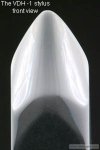
After the Shibata in the 70s the nest big step forward was the VDH with a 2.5um minor radius. For the fist time inner groove distortion was eliminated as the small minor radius did not suffer issues with tracking error in the inner grooves.
The issues was the VDH with age the minor radius grows like other stylus so there is a gradual deterioration.
Next up was the micro ridge, again a 2 4um minor radius but the ridge means the minor radius does not grow with wear so a micro ridge just before the end of its life sounds and tracks like it did when it was new.
Many reasons why a micro ridge is a better stylus
 
Elliptical was invented to track complex highs and inner grooves better. Next was the fine ellipticals like the 0.2x0.7 which has the same minor radius as a Shibata so it can track complex modulations and inner groove highs the same as a Shibata on unworn vinyl at least. Shibata manages better on damaged grooves as it can bridge Elliptical damage. Noteworthy a 0.2x0.7 tracking at 1.5g marks the grooves in one play in the same test the Shibata did no damage in 25 plays.
After the Shibata in the 70s the nest big step forward was the VDH with a 2.5um minor radius. For the fist time inner groove distortion was eliminated as the small minor radius did not suffer issues with tracking error in the inner grooves.
The issues was the VDH with age the minor radius grows like other stylus so there is a gradual deterioration.
Next up was the micro ridge, again a 2 4um minor radius but the ridge means the minor radius does not grow with wear so a micro ridge just before the end of its life sounds and tracks like it did when it was new.
Many reasons why a micro ridge is a better stylus
That's a nice history lesson but most "ellipticals" are merely conicals with the leading and trailing edges shaved off. The contact radius would be that of a .7 mil conical. I'm not simply repeating what someone else posted, I've looked at them close up. A true "ellipse" does not have flat sides, but somehow, "elliptical" stylus tips do, not all of course, but most of what I have seen up close and in person do.

None of this really matters anyway. The OP is asking for a replacement for his 881S. There are many vintage cartridges from the 1960's & 1970's that are just as good as anything produced today, the only drawback are available styli for these classics. I would never discourage anyone from having an old stylus re-tipped but that is not the only option.

I've outfitted a couple dozen vintage Shure cartridges with JICO replacements and they perform as good or better than the originals. I have quite a few NOS, some of which are unusable due to deteriorated suspensions or corroded cantilevers, "re-tipping" will not help them.
 
Last edited:
That's a nice history lesson but most "ellipticals" are merely conicals with the leading and trailing edges shaved off. The contact radius would be that of a .7 mil conical. I'm not simply repeating what someone else posted, I've looked at them close up. A true "ellipse" does not have flat sides, but somehow, "elliptical" stylus tips do, not all of course, but most of what I have seen up close and in person do.

None of this really matters anyway. The OP is asking for a replacement for his 881S. There are many vintage cartridges from the 1960's & 1970's that are just as good as anything produced today, the only drawback are available styli for these classics. I would never discourage anyone from having an old stylus re-tipped but that is not the only option.

I've outfitted a couple dozen vintage Shure cartridges with JICO replacements and they perform as good or better than the originals. I have quite a few NOS, some of which are unusable due to deteriorated suspensions or corroded cantilevers, "re-tipping" will not help them.
The minor radius of an elliptical which the front and rear are shaved off is not the same as a conical you have some big basics misunderstanding on this topic.
Also good as Jico can sound they don't test anything like the originals do frequency plot or testing the elastomer, then comparing tieback and cantilever they are totally different.
They work and sound ok but too different from originals.
Chris
 
In my particular case, if I want to listen to these old cartridges again, which I would very much like to, I have no other option than to buy the Jico replacement stylus, because - as I already explained - the cantilevers have gone bad.
And how did that happen, is anyone curious?
In the case of one of the two cartridges, one day I put a record on and the tonearm skidded all over the surface of the vinyl. Upon examination, the diamond had come off. Needless to say, I didn't bother trying to find the diamond to have it glued back, even though it was an original Stereohedron....
And the other cartridge, on another fateful day - full of expletives when I came to the conclusion of what was happening - the cantilever broke, the aluminum consumed by corrosion. It simply weakened until it gave way and touched the cartridge body to the vinyl.
There are no photos, there were no cell phones in those years.
So, I tell you that before each reproduction I used a liquid - which is probably just distilled water - from Disc Washer, the "special" one to add to the hard bristle brush, also from them. You put a few drops of SC-2 on the brush, then gently scrape it back and forth and that's it, isn't it wonderful? Of course, after so much time using this method - recommended by the manufacturer - the humidity deposited on the cantilever did the damage I already described. So you are warned, you draw your own conclusions and do what you want, of course!
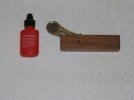
The photos are from the web, surely another victim decided to sell these gadgets, I still have them, using the hard bristle brush dry does its job, although it is very dangerous if you don't have a steady hand.


Attachments

  • 78864.jpg
    78864.jpg
    100.4 KB · Views: 2
And let me add this: A Denon DL-103 cartridge (MC-Conical stylus) costs about $100 more than a Jico stylus for 881S. Beyond all the technical descriptions about the differences in diamond tips, to ME the sound is far superior to all the MM cartridge styli I have owned, and I will gladly spend the extra money and buy another DL-103, because I take as much or more care of the one I already own than I do my wife :eek:, and another one would be nice because I have a spare headshell on my Micro Seiki MA707 tonearm. As for me, thank you all and keep up the good work. Period.
 
Last edited:
In my particular case, if I want to listen to these old cartridges again, which I would very much like to, I have no other option than to buy the Jico replacement stylus, because - as I already explained - the cantilevers have gone bad.
And how did that happen, is anyone curious?
In the case of one of the two cartridges, one day I put a record on and the tonearm skidded all over the surface of the vinyl. Upon examination, the diamond had come off. Needless to say, I didn't bother trying to find the diamond to have it glued back, even though it was an original Stereohedron....
And the other cartridge, on another fateful day - full of expletives when I came to the conclusion of what was happening - the cantilever broke, the aluminum consumed by corrosion. It simply weakened until it gave way and touched the cartridge body to the vinyl.
There are no photos, there were no cell phones in those years.
So, I tell you that before each reproduction I used a liquid - which is probably just distilled water - from Disc Washer, the "special" one to add to the hard bristle brush, also from them. You put a few drops of SC-2 on the brush, then gently scrape it back and forth and that's it, isn't it wonderful? Of course, after so much time using this method - recommended by the manufacturer - the humidity deposited on the cantilever did the damage I already described. So you are warned, you draw your own conclusions and do what you want, of course!
The photos are from the web, surely another victim decided to sell these gadgets, I still have them, using the hard bristle brush dry does its job, although it is very dangerous if you don't have a steady hand.


I lost Stereohedron many years ago very quick (within year) after wet playing with Lenco Clean. Cantilever is terrible, it corrodes very fast. Of course wet play is not recommended with aluminum cantilevers, but to corrode completely within 1 year (it was not everyday play) - too fast even for aluminum. Then I switched to LOMC Ortofon MC5000 etc and left 881 for 78rpm.
 
In my particular case, if I want to listen to these old cartridges again, which I would very much like to, I have no other option than to buy the Jico replacement stylus, because - as I already explained - the cantilevers have gone bad.
And how did that happen, is anyone curious?
In the case of one of the two cartridges, one day I put a record on and the tonearm skidded all over the surface of the vinyl. Upon examination, the diamond had come off. Needless to say, I didn't bother trying to find the diamond to have it glued back, even though it was an original Stereohedron....
And the other cartridge, on another fateful day - full of expletives when I came to the conclusion of what was happening - the cantilever broke, the aluminum consumed by corrosion. It simply weakened until it gave way and touched the cartridge body to the vinyl.
There are no photos, there were no cell phones in those years.
So, I tell you that before each reproduction I used a liquid - which is probably just distilled water - from Disc Washer, the "special" one to add to the hard bristle brush, also from them. You put a few drops of SC-2 on the brush, then gently scrape it back and forth and that's it, isn't it wonderful? Of course, after so much time using this method - recommended by the manufacturer - the humidity deposited on the cantilever did the damage I already described. So you are warned, you draw your own conclusions and do what you want, of course!
The photos are from the web, surely another victim decided to sell these gadgets, I still have them, using the hard bristle brush dry does its job, although it is very dangerous if you don't have a steady hand.

Actually, you mustn't use the Discwasher stylus brush "back and forth". That's guaranteed to damage the stylus and/or cantilever. Gently stroke over the diamond from back to front only...
 
Actually, you mustn't use the Discwasher stylus brush "back and forth". That's guaranteed to damage the stylus and/or cantilever. Gently stroke over the diamond from back to front only...

I believe it is written in all user manuals and related to all stylus cleaning brushes and cleaning procedure, but who read the manual :) But it is not a 881S case. This is very high compliance stylus with VTF range 0,75-1,25g so cantilever should be lightweight too. In result it is very fragile.
 
They work and sound ok but too different from originals.
Again, the originals are 50 years old, they sound okay too but there is no one on this planet that can say a 50 year old stylus sounds exactly like it did when new.
 
Last edited:
Back
Top Bottom