• The move to the new server is done. There are some software and database maintenance updates in process. This has us passing the hat around to help out. We appreciate any donations. Seriously, even a dollar helps. The payment page may be found here - https://www.audiokarma.org/support.html

Replacing VFETs with MOSFETs

PE9ZZ

Event Horizon
Subscriber
Many people said it couldn't be done so I saw a challenge. On the Audiofreaks forum I documented (in Dutch) my efforts in getting a dud Sony TA-4650 going again without having to resort to tying to get unobtanium 2SJ18/2SK60 SIT transistors. I decided to use IRFP(9)240 instead. Of course the TO-247 package is not a metal can TO-3 but after removing the socket it can be mounted neatly. I am planning to make an English write-up on my own site.

The mod boils down to my realization that a VFET, being a depletion type device, needs a negative gate voltage (for N-channel) and a MOSFET needs a positive voltage as it is an enhancement type. Initially I wanted to use the Renesas (Hitachi) 2SJ162/2SK1058 combo but decided against it as I also wanted to get rid of the additional power supply voltages on top of the regular ones that Sony needed to properly bias the VFETs. As the Renesas MOSFETs have a gate threshold voltage of near zero volts this presented issues that I could not easily solve. The IRFPs need about 4 V and that worked like a charm. In the end I needed to change six resistor values, remove a lot of caps and resistors and add two extra caps to get rid of parasitics. I made heavy use of LTSpice (attached).

I have yet to compare it to an original TA-4650 but I will have to fix that one first...

Tjerk, 9ZZ
 

Attachments

Register to hide this ad
+1 Nice work! - I think you will find quite a few people on this site interested in an English write up. :thumbsup:

Please would you post the URL of your site? ;)
 
Very good - I just sold a TA 4650 here in NZ for $1 after one of the VFETs blew.

A serviceable mod for these amps would be great to bear in mind for the future.
 
+1 Nice work! - I think you will find quite a few people on this site interested in an English write up. :thumbsup:

Please would you post the URL of your site? ;)

Thanx! My site is polonai.se, when I have the story done I'll post the full link.

I just received the other 4650, when I have that one going there will be blood. Euh... listening test!

Tjerk, 9ZZ
 
I'm curious.... Why didn't you use the Fairchild FQA12P20 AND FQA19N20? I ask because the IRFP9240 is known to have a quirk some like and some don't.
 
What quirk is that? I am not aware of any, nor did I see anything amiss during testing.

The devices you mention differ more than the IRFPs in R(DS,ON) and C(iss). Also max drain current of the P-Channel device is much lower. I am sure there are other devices than the IRFPs that could be successfully paired. I'm afraid your Fairchild devices aren't because neither Mouser nor Pharnell stock'em. Also, the IRFPs are more recent (2011 vs. 2000).

Tjerk, 9ZZ
 
The IRFP9240 has a nonlinearity quirk that lends it to 2nd order distortion. The IR and Fairchild parts are interchangeable in a number of Nelson Pass designs which is why I'm familiar with them. Some people prefer the cleaner Fairchild parts, but some like the 2nd harmonic the IR parts impart. It's a minor thing. I use the IR parts in my F5. I like the sound a lot. Sony VFETs can be used in an F5 topology with minor changes like you describe.
 
Incidentally, the IRFP(9)240 is made by Vishay (Siliconix). I don't think the non-linearity (which is present in all active devices) will affect distortion in this topology. I'm more worried about the ripple in the idling current because this is from an unstabilized source. The output amp has heavy feedback which should take care of any non-linearity (and ripple, for that matter). My distortion analyzer will show this. It also showed the parasitics I was experiencing before I killed them.

Tjerk, 9ZZ
 
Oh, this sucks... I'm facing two issues. The first one is the thermal runaway the IRFPs exhibit as outlined in this excellent article by Rod Elliott. This is real. While performing distortion tests into my dummy load the bias current surged to 0.5A (no signal) only to settle down when the heat sink had cooled down again. It is only 40 mA when cold. The second one is distortion. This goes through the roof compared to the VFET amp I have available now for (unfortunately) a short time. The VFET TA-4650 has a distortion at a low 0.01% whereas my Frankenamp (TM) hovers between 0.04 and 0.4%. The latter just before clipping, but still. I cannot go back to the 2SK1057/2SJ161 devices because I've torn out the +/-75 V supplies. But then, I can always put them back in and see how the Hitachi/Renesas MOSFETs fare. Maybe C(iss) has something to do with it. The datasheets for the Hitachi/Renesas devices actually have the transfer characteristics (V(GS)/I(D)) for different temperatures. As this slope is rather shallow these MOSFETs are not affected as much as the HEXFETs I used. Back to the drawing board I guess...

Edit: The IRFP9240 datasheet does include the thermal properties. At V(GS)=4 V the drain current at 25°C is 0.4A and at 125°C it's 1A. At lower values this must be worse which is consistent with my experience. Great...

Tjerk, 9ZZ
 
Last edited:
Pass uses thermistors on the F5 MOSFETs to draw down the bias and help stabilize them. Would something like that help?
 
For sure but calibration wil be a formidable task. It will also complicate the circuit. Maybe coupling the third diode in the bias circuit with the heat sink might help. Or do too much... I'm not done with it just yet!

Tjerk, 9ZZ
 
You'll probably have to add some sort of Vgs multiplier if you want to stay with the HEXFETs. You might also look at some of the Exicon TO-3 lateral MOSFETs from Profusion in the UK. They switch to a negative temperature coefficient around 70-100ma. But you will need the extra rail voltages for them.
 
I wasn't aware of them. Pricey but look like a suitable replacement. And I still have the TO-3 sockets :-D But before I get them I could also try my 2SJ161/2SK1057s as they are almost identical.

Tjerk, 9ZZ
 
Oh! I discovered something! I now understand why my lateral MOSFETs didn't work:
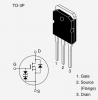
2sk1058_package.png

Source and drain have been swapped. This is usually the case with audio MOSFETs. Quite an "instinker" as we (the Dutch) say.

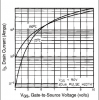
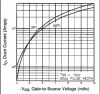
Also found the transfer graphs for my HEXFETs:
irfp240_xfer.png

irfp9240_xfer.png

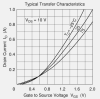
Thermal runaway much more pronounced than with its lateral brother:
2sk1058_xfer.png

Note that with the HEXFETs, V(GS) is at the leftmost end of the graph (idle). The difference here is greatest. At I(D)=0.1A for the 2SK1058, the difference is zero!

Tjerk, 9ZZ
 
Last edited:
I bought my TO-3 mosfets for my Soundcraftsmen amp from these people. They worked perfectly to replace the originals. If I were going to try to replace VFETS with mosfets, I'd just copy the drive / bias scheme from a Soundcraftsmen amp. http://www.exicon.info/purchase.php
 
Thanx, but it's not going to help me. The Sony is a compound setup, yours a source follower.

Tjerk, 9ZZ
 
I don't have anything useful to say, but just want to let you know this is one of the most potentially useful and interesting threads I've seen on AK in years. Do please continue with your efforts... I'm on the edge of my seat even if I don't say much along the way.:lurk:
 
Last edited:
Back
Top Bottom